Sucker Management
Mark and selectively thin root suckers in late spring, keeping strong, well-placed shoots 30–60 cm apart and removing crowded ones to maintain an open, manageable thicket.

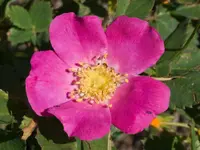
Woods' rose (Rosa woodsii) is a hardy deciduous shrub rose native to much of western and central North America. It forms thickets of upright, arching stems with straight or slightly curved thorns. In late spring to early summer it produces simple pink, five-petaled flowers, followed by bright red hips that often persist into winter. This species typically grows in open woods, stream banks, and prairie edges, showing strong tolerance to cold and variable moisture. Its toughness and adaptability make it relatively easy to establish for gardeners who want to care for Woods' rose in naturalistic or low-maintenance landscapes.

Care Difficulty
Easy Care

Light Preference
Full Sun

Water Requirements
Moderate Water

Temperature Preference
Cold Hardy

Hardiness Zone
3–8

Soil Texture
Sandy, Loamy, Rocky

Soil pH
Acidic (5.5–6.5), Slightly acidic (6.5–7.0)

Soil Drainage
Well-drained

Fertilization
Minimal (feed rarely)
Scan your plant to receive care tips personalized for your specific plant
Available on iOS and Android
This species prefers strong light and performs best with consistent sun exposure.
Rosa woodsii prefers evenly moist but never waterlogged soil once established.
This hardy wild rose tolerates a wide temperature range with proper seasonal adjustment.
This species is adapted to dry climates, so indoor humidity is rarely a concern.
Rosa woodsii grows best in moderately fertile, well-drained mineral soils that still hold some moisture.
This species can be grown in containers outdoors if the pot is large and stable enough for its root system and upright canes.
This native shrub usually needs minimal feeding, but light fertilization can support better flowering and vigor when growing Woods' rose in poorer soils.
Pruning helps maintain health and structure of Rosa woodsii while supporting good flowering.
This species is usually grown in the ground, so focus on careful transplanting rather than frequent repotting.
Rosa woodsii can be propagated through suckers, stem cuttings, or seeds under suitable conditions.
This rose is generally cold hardy and often needs little specific winter care in the ground.

Plant Health Check
Not sure what's wrong with your plant? Check your plant's health inside the app.
This wild rose is native across much of western and central North America, from lowland prairies and foothills up into montane forests, showing high ecological flexibility in cold and semi-arid climates.
Its hips and foliage are a key food for many birds and mammals, including grouse, wild turkeys, and deer, and the dense thickets provide nesting and protective cover for small animals.
Because of its deep, fibrous root system and tolerance of poor soils, it is widely used in erosion control, riparian restoration, and post-fire rehabilitation projects in its native range.

Genetic and field studies have shown that this species frequently hybridizes with other native roses, which contributes to complex local variation in flower and leaf traits across its broad geographic range.
This species spreads by both seed and underground suckers, forming thickets over time. In small gardens, root barriers, regular sucker removal, and thoughtful placement help prevent it from taking over nearby beds or lawn areas.
Keep your plants happy and healthy with plant identification, disease detection, and easy care guidance.