Control Lateral Spread
Install 20–30 cm deep edging or root barrier around the planting area to limit underground rhizomes and make it easier to remove unwanted shoots as the clump matures.

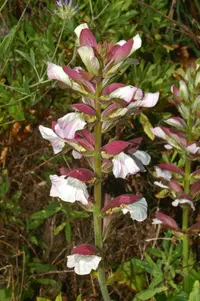
Bear's breeches (Acanthus mollis) is a clump-forming perennial grown mainly for its bold, deeply lobed leaves and tall flower spikes. It forms a dense mound of glossy green foliage that can become a strong visual focal point in garden beds.
In late spring to summer, it sends up upright stems with hooded white to pinkish flowers marked with purple, giving a structural, architectural look. The plant is native to the Mediterranean region, where it grows in dry, rocky, often partially shaded habitats.
Once established, it is reasonably drought tolerant and long-lived but can spread by roots, so placement needs some planning. Those learning how to care for Bear's breeches should focus on providing sun to light shade, well-drained soil, and protection from extreme winter wet.

Care Difficulty
Moderate Care

Light Preference
Partial Shade

Water Requirements
Moderate Water

Temperature Preference
Cool Climate

Hardiness Zone
7–10

Soil Texture
Loamy, Clay, Organic-rich

Soil pH
Slightly acidic (6.5–7.0), Neutral (7.0)

Soil Drainage
Moist but well-drained

Fertilization
Minimal (feed rarely)
Scan your plant to receive care tips personalized for your specific plant
Available on iOS and Android
This perennial prefers bright conditions with some protection from harsh midday sun.
This plant likes consistently moist but not saturated soil, especially during active growth.
This hardy perennial tolerates a range of outdoor temperatures but grows best in mild conditions.
This species grows best in moderate air moisture but usually adapts to typical home or garden conditions.
This plant prefers deep, fertile, moisture-retentive but well-drained soil for strong root and leaf growth.
This species can be grown in containers, but it needs careful sizing and support to manage its strong root system and tall foliage.
Acanthus mollis benefits from moderate feeding to support lush foliage and flowering.
Pruning Acanthus mollis is mainly about tidying foliage and managing clump size.
This species is usually grown in the ground, so focus on careful transplanting rather than frequent repotting.
Acanthus mollis is commonly propagated by division or root cuttings, with seeds also possible but slower.
In mild climates this plant is fairly hardy, but some winter care helps roots stay healthy and long-lived.

Plant Health Check
Not sure what's wrong with your plant? Check your plant's health inside the app.
The deeply cut, glossy leaves of this species inspired the stylized foliage on ancient Greek and Roman Corinthian capitals, linking a living plant directly to classical architectural design.
Unlike many large perennials, this plant produces tall, vertical spikes of white and purple-tinged flowers even in bright shade, making it a key structural plant in low-light Mediterranean woodland edges.
It spreads slowly via short underground rhizomes and can form long-lived clumps, which helps it persist for decades in old gardens and ruins where other ornamentals have disappeared.

Acanthus leaves were so closely associated with classical art that stylized acanthus motifs became a standard decorative element in Western design for over 2,000 years, appearing on stone carvings, manuscripts, and furniture long after the plant itself had disappeared from many original sites.
Lack of flowers usually comes from too much shade, nutrient-poor or very dry soil, or plants that are still immature. Overly heavy spring feeding with nitrogen can also favor foliage over flower spikes.
Keep your plants happy and healthy with plant identification, disease detection, and easy care guidance.