Layered woodland mulch
Maintain a 3–5 cm layer of fine bark or leaf litter around the plant to mimic forest duff, keeping roots cool and moist while suppressing weeds without smothering the rhizomes.

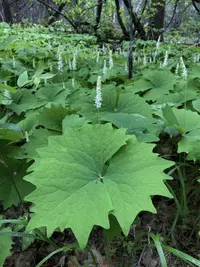
Deer's foot (Achlys californica) is a low-growing woodland perennial native to the moist forests of the Pacific Northwest. It forms small clumps of broad, fan-shaped leaves that resemble a deer's hoof. In spring, it sends up slender spikes of tiny white flowers, giving a delicate, airy look above the foliage.
This plant naturally occurs in cool, shaded forest floors with rich, humus-based soil and consistent moisture. It is slow-growing and somewhat particular about shade and moisture, so care for deer's foot is easier in sheltered, woodland-style gardens or similar conditions.
In cultivation, it prefers dappled shade, cool temperatures, and soil that drains well but never fully dries out. It suits patient growers who can provide stable, mild conditions.

Care Difficulty
Moderate Care

Light Preference
Partial Shade

Water Requirements
Regular Water

Temperature Preference
Cold Hardy

Hardiness Zone
6–9

Soil Texture
Loamy, Silty, Organic-rich

Soil pH
Acidic (5.5–6.5), Slightly acidic (6.5–7.0)

Soil Drainage
Moist but well-drained

Fertilization
Minimal (feed rarely)
Scan your plant to receive care tips personalized for your specific plant
Available on iOS and Android
This woodland perennial prefers cool, filtered light similar to a north-facing forest edge.
This plant prefers evenly moist, cool soil that never stays soggy for long periods.
This species is adapted to cool, moist woodland conditions with mild summers and winters.
This woodland perennial prefers moderately moist air but adapts to typical home humidity.
This species thrives in loose, humus-rich soil that stays evenly moist yet drains freely.
This species can grow in containers if the pot mimics a cool, moist, woodland-like root zone.
Achlys californica needs minimal feeding when grown in suitable, humus-rich woodland soil.
Pruning Achlys californica is simple and mainly focused on cleanliness rather than shaping.
This woodland perennial is usually grown in the ground, so focus on gentle transplanting rather than frequent repotting.
Achlys californica is most reliably multiplied by careful division of established clumps.
This species is cold hardy in much of its native range and usually needs little special winter care.

Plant Health Check
Not sure what's wrong with your plant? Check your plant's health inside the app.
The leaves are large, fan-shaped blades that look like a single leaf but are actually formed by fused leaflets, giving the plant its distinctive parasol appearance on the forest floor.
Its flowers are very small, greenish-white, and held on a slender spike above the leaves, relying mainly on wind for pollination rather than showy petals to attract insects.
This species is native to moist, shady coniferous forests of the Pacific Northwest, where it typically grows in cool, humus-rich soil beneath trees such as Douglas-fir and western redcedar.

Dry, crushed leaves of this species were traditionally scattered on sleeping mats by Indigenous peoples of the Pacific Northwest because the foliage was believed to help repel fleas.
This woodland perennial spreads slowly by rhizomes, forming loose clumps rather than dense carpets. It can gradually enlarge over several years but is generally easy to contain and is not considered an aggressive spreader in garden settings.
Keep your plants happy and healthy with plant identification, disease detection, and easy care guidance.