Aeonium aureum Care

Aeonium aureum

About Aeonium aureum

Aeonium aureum is a small rosette-forming succulent from the Canary Islands, valued for its compact size and geometric leaf arrangement. Its fleshy, rounded leaves form tight, almost flat rosettes that can develop warm golden-green tones in bright light.

This species typically grows low to the ground and may cluster slowly over time, making it suitable for small containers or rock garden settings. It prefers bright, indirect light, very well-drained gritty soil, and dry conditions between waterings.

Aeonium aureum is generally considered moderate in difficulty because it dislikes excess moisture and prolonged frost. Once basic succulent needs are met, it is relatively stable, and learning how to care for Aeonium aureum helps prevent rot and sun damage.

Main Plant Requirements

Care Difficulty

Moderate Care

Light Preference

Full Sun

Water Requirements

Low Water

Temperature Preference

Warm Climate

Hardiness Zone

9–11

Soil Texture

Sandy, Loamy, Rocky

Soil pH

Slightly acidic (6.5–7.0), Neutral (7.0)

Soil Drainage

Well-drained

Fertilization

Minimal (feed rarely)

Get Personalized Care Plan

Scan your plant to receive care tips personalized for your specific plant

Available on iOS and Android

How to Care for the Aeonium aureum

This succulent prefers bright, soft light that avoids harsh midday intensity.

  • Provide 4–6 hours of morning sun or bright filtered light daily; Aeonium aureum tolerates light afternoon shade in hotter regions.
  • Outdoors, give dappled or east-facing exposure; strong summer sun from 11 a.m.–3 p.m. can scorch leaves and cause bleached or crispy patches.
  • In too much shade, rosettes elongate and lose compact shape; gradually increase light over 7–10 days to prevent sunburn when moving to brighter spots.

This plant stores water in its leaves and needs infrequent but thorough watering.

  • Water only when the top 3–5 cm of soil feel completely dry; in active growth this may be every 7–14 days depending on heat and wind.
  • Use sharply draining soil; water until it flows from the drainage holes, then let excess drain away to reduce root-rot risk.
  • Reduce watering during summer dormancy and in winter; yellowing, mushy leaves indicate overwatering, while wrinkled, limp leaves signal underwatering.

This succulent prefers mild, frost-free conditions with cool nights and moderate daytime warmth.

  • Ideal growing temperatures are 60–75°F (16–24°C), with slightly cooler nights improving coloration and overall vigor.
  • Protect from frost; it is usually damaged below 32°F (0°C) and should be sheltered or moved under cover if hard freezes are forecast.
  • Tolerates brief heat up to about 90°F (32°C) if shaded during peak sun and given airflow; above this, growth slows and stress marks can appear on leaves.

This succulent tolerates low household humidity well and rarely needs special adjustment.

  • Target 30–50% humidity, which matches typical indoor air in heated or air-conditioned homes.
  • Dry air is usually fine, but prolonged hot drafts can dehydrate rosettes faster than the roots can supply water.
  • Low humidity stress appears as shriveling, thin leaves; improve conditions by shading from hot airflow rather than misting.

Aeonium aureum needs a sharply draining, mineral-rich substrate to prevent root rot.

  • Use a gritty, sandy mix such as 50–70% inorganic material (pumice, coarse perlite, or grit) blended with 30–50% lean potting mix.
  • Aim for a slightly acidic to neutral pH around 6.0–7.0, which supports nutrient availability without encouraging rot organisms.
  • Improve aeration by using coarse particles (3–6 mm) and avoiding fine peat that compacts and holds water around the roots.
  • Avoid dense, clay-heavy, or constantly moist substrates, and never use garden soil straight in containers for this species.

This species is well suited to container growing when planted in stable, well-drained pots.

  • Choose a wide, shallow pot to accommodate the relatively shallow root system and maintain stability for the rosette top growth.
  • Select unglazed terracotta if extra evaporation is needed in damp climates, or heavier ceramic where wind could tip lighter pots.
  • Raise the container slightly on pot feet or bricks so drainage holes clear the saucer and excess water can escape rapidly.

Light feeding supports compact growth in Aeonium aureum without forcing weak, lush tissue.

  • Use a balanced liquid succulent fertilizer (around 10-10-10 or 20-20-20) diluted to 25–50% strength.
  • Apply every 4–6 weeks during active growth in spring and fall, when rosettes are expanding.
  • Skip feeding in hot, dormant midsummer and reduce or stop in winter to avoid soft, etiolated growth.
  • On established outdoor plants, a thin top-dressing of fine compost once a year is sufficient.

Pruning is mainly corrective and helps keep Aeonium aureum compact and tidy.

  • Best timing is late winter to early spring, just before strong new growth starts.
  • Remove dead, damaged, or shriveled rosettes and stems with clean, sharp scissors or pruners.
  • Thin out crowded stems to improve light penetration and airflow around remaining rosettes.
  • Shortening leggy shoots encourages branching and denser, lower growth over time.

Repotting or transplanting is infrequent but useful to refresh the root zone and growing space.

  • Check for roots circling the pot, distorted drainage holes, or slowed growth as signals to move Aeonium aureum.
  • Repot every 2–3 years in late winter or early spring, before the main growth flush.
  • Use a shallow container with a fast-draining cactus mix, handling brittle roots gently to limit damage.
  • After repotting, water lightly once, then allow the soil to dry well to reduce transplant stress and rot risk.

Propagation is commonly done from cuttings to maintain desired forms of Aeonium aureum.

  • Take healthy rosette stem cuttings in late winter to late spring, when plants are actively growing.
  • Allow cut ends to callus for 2–5 days in a dry, bright place before planting.
  • Insert cuttings into barely moist, gritty cactus mix and keep in bright, indirect light.
  • Maintain warm temperatures (65–75°F) and minimal watering until firm rooting develops.

Cold sensitivity means Aeonium aureum needs thoughtful winter management in many climates.

  • Tolerates light chills but is damaged by hard frost, typically below about 28–30°F.
  • In cold regions, grow in containers and move indoors to a bright, cool, frost-free space for winter.
  • Outdoors in mild zones, use a gravel mulch to keep the crown dry and protect roots from saturated soil.
  • Keep winter watering sparse, allowing soil to dry between light soakings to prevent rot in cool conditions.

Care Tips

Rotate for symmetry

Rotate the pot 90° every 1–2 weeks during active growth so the rosettes receive even light and develop a compact, symmetrical form instead of leaning toward one direction.

Controlled summer rest

In very hot, dry summers, slightly reduce watering and move the plant to bright shade to support its natural semi-dormant phase and reduce stress that can cause leaf drop.

Protect from heavy rain

If grown outdoors in containers, move pots under cover before prolonged rain so the leaf rosettes and crown do not stay waterlogged, which reduces the risk of rot in the growing point.

Use top-dressing grit

Apply a 0.5–1 in layer of horticultural grit or coarse sand on the soil surface to keep lower leaves dry, discourage fungus gnats, and make spotting excess moisture at the crown easier when caring for Aeonium aureum.

Monitor stem aging

Inspect stems at least once a season and, if they become tall, bare, or corky, take tip cuttings and re-root them to maintain a compact, healthy plant rather than allowing weak, top-heavy growth to develop.

Common Pests and Diseases

Mealybugs

This pest feeds on sap, often hiding in the tight rosette center and along leaf bases, leaving white cottony clusters. Symptoms include stunted growth, honeydew, and sooty mold on older foliage.

Solution

Isolate the plant, then dab visible mealybugs with cotton swabs dipped in 70% isopropyl alcohol and rinse the rosette gently with a firm stream of water. For ongoing Aeonium aureum care, repeat alcohol spot treatments weekly and improve light and airflow to discourage reinfestation; use a neem oil or insecticidal soap spray labeled for succulents if the infestation is heavy.

Aphids

These insects gather on tender new growth and flower stalks, sucking sap and causing distorted leaves and sticky honeydew. Ant activity around the plant often indicates their presence.

Solution

Rinse colonies off with a strong but controlled stream of water, taking care not to damage the rosette. If needed, apply insecticidal soap or neem oil to the affected areas every 5–7 days until populations drop, and reduce excess nitrogen fertilization that promotes soft, aphid-prone growth.

Soft scale

This pest appears as small, smooth, dome-shaped bumps on stems and leaf bases that do not brush off easily. Symptoms include yellowing leaves, weak growth, and sticky honeydew that can lead to sooty mold.

Solution

Gently scrape or wipe off individual scales with a fingernail or cotton pad dipped in 70% isopropyl alcohol, then rinse the plant. For larger infestations, use repeated applications of horticultural oil or neem oil, ensuring full coverage of stems and leaf bases while improving airflow and avoiding overwatering stress.

Powdery mildew

This disease shows up as white, powdery patches on leaves, often when aeoniums are kept crowded in humid, stagnant air. Symptoms include dull, discolored foliage and reduced vigor, especially on shaded or older leaves.

Solution

Remove and discard heavily affected leaves and improve spacing, airflow, and light exposure around the plant. Treat remaining foliage with a sulfur-based fungicide or a potassium bicarbonate product labeled for ornamentals, applying in dry conditions and avoiding treatment during very high temperatures.

Fungal leaf spots

Symptoms include brown, tan, or dark spots with defined edges on older leaves, often starting near the base where moisture lingers. In wet or poorly ventilated conditions, spots may merge and cause premature leaf drop.

Solution

Cut off and discard affected leaves, water at the soil level, and allow the rosette to dry between waterings. If spotting continues, apply a copper-based fungicide or other ornamental foliar fungicide according to label directions and maintain bright light and low humidity around the foliage.

Interesting Facts

Endemic to Gran Canaria

This species occurs naturally only on the island of Gran Canaria in the Canary Islands, where it grows on rocky slopes and cliffs in dry, coastal-influenced habitats.

Winter-growing life cycle

Aeonium aureum is a winter-growing succulent that does most of its active growth in the cool season and often slows or partially rests in the hot, dry summer.

Rosettes die after flowering

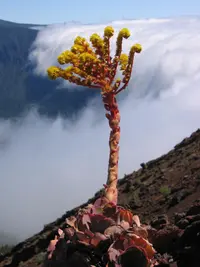
Each rosette is monocarpic, meaning it flowers once and then dies, producing a tall inflorescence with many small yellow flowers before the rosette withers.

FAQs about Aeonium aureum

Yellowing leaves often result from overwatering, poor drainage, or natural aging of the lowest rosettes. Check that the soil dries between waterings, the pot has drainage holes, and roots are firm, not mushy or foul-smelling.

Grow Healthy Plants with Botan Care

Keep your plants happy and healthy with plant identification, disease detection, and easy care guidance.


Botan plant care app — identify plants on mobile

Explore More Plants