Support sandy roots
In very loose or sandy sites, top-dress around young plants with a 1–2 in layer of un-compacted coarse sand or fine gravel to stabilize the root zone without smothering the crown.

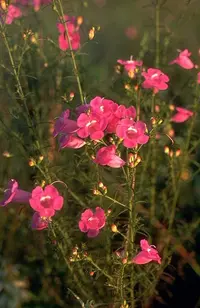
Beach false foxglove (Agalinis fasciculata) is a small, wiry annual wildflower known for its delicate pink to purple, tubular blooms. It typically grows in open, sandy or dry coastal habitats, dunes, and disturbed sites in the eastern and southeastern United States.
The plant has narrow, linear leaves and a branching habit, giving it a fine, airy appearance. Flowers often attract bees and other small pollinators.
This species is partially parasitic, drawing some nutrients from nearby plant roots, which can make it less predictable and slightly challenging to cultivate. To care for beach false foxglove, provide sunny, open conditions with well-drained, low-fertility soil that mimics its natural habitat.

Care Difficulty
Moderate Care

Light Preference
Full Sun

Water Requirements
Moderate Water

Temperature Preference
Warm Climate

Hardiness Zone
7–11

Soil Texture
Sandy, Loamy

Soil pH
Acidic (5.5–6.5), Slightly acidic (6.5–7.0)

Soil Drainage
Well-drained

Fertilization
Minimal (feed rarely)
Scan your plant to receive care tips personalized for your specific plant
Available on iOS and Android
This coastal annual thrives in open, sunny sites with strong light for most of the day.
This species prefers dry to moderately moist, fast-draining sandy soils and is sensitive to persistent wetness.
This warm-season annual favors mild to hot coastal conditions and does not handle freezing well.
Humidity has little influence on beach false foxglove, which is adapted to dry, coastal air.
Agalinis fasciculata prefers light, fast-draining soils that mimic sandy coastal habitats.
This species is only moderately suitable for container growing and performs better in open ground.
This annual wildflower is adapted to low-nutrient sandy soils and usually needs no fertilizer in garden settings.
Agalinis fasciculata needs only light pruning to keep plants tidy and focused on healthy flowering.
This species is rarely kept in pots and is best handled as a direct-sown or carefully transplanted annual.
Seed is the primary method for Agalinis fasciculata propagation and suits its annual life cycle.
This annual wildflower does not overwinter; living tissue dies back after frost and needs no special winter care.

Plant Health Check
Not sure what's wrong with your plant? Check your plant's health inside the app.
This species is a hemiparasitic herb that performs photosynthesis but also taps the roots of nearby grasses and forbs to obtain water and dissolved nutrients, and it naturally occurs on coastal dunes and sandy, well-drained sites in the southeastern United States.
Its pink, tubular flowers appear mainly in late summer to early fall and provide nectar for bees and butterflies during a seasonal window when many other native coastal wildflowers have already declined.
The plant completes its entire life cycle within a single growing season and produces numerous tiny seeds that disperse from dry capsules, helping it quickly recolonize shifting sandy habitats after disturbance.
This species is an annual wildflower. It completes its entire life cycle from seed to flowering and seed set within one growing season, then dies back and relies on new seedlings each year.
Keep your plants happy and healthy with plant identification, disease detection, and easy care guidance.