Train New Vines
In early growth, gently wind young, flexible stems around the support in the desired direction and secure them loosely with soft ties every 20–30 cm to create an even, well-covered framework.

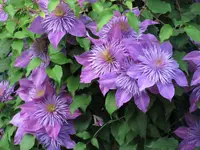
Clematis Crystal Fountain is a compact, deciduous climbing vine grown mainly for its showy, double flowers with a frilly central mound over outer petals. Blooms are usually bluish-lavender with a silvery sheen, creating a strong focal point on trellises, fences, or containers.
This cultivar belongs to Clematis, a genus of flowering vines native mainly to temperate regions of Europe and Asia. It has a twining, climbing habit and needs support to grow vertically.
Clematis Crystal Fountain is considered moderately easy if basic needs are met, which influences how to care for Clematis in gardens and on patios. It prefers cool roots, sun to partial shade for the vines, and evenly moist, well-drained soil.

Care Difficulty
Moderate Care

Light Preference
Full Sun

Water Requirements
Regular Water

Temperature Preference
Cold Hardy

Hardiness Zone
4–9

Soil Texture
Loamy, Sandy, Organic-rich

Soil pH
Acidic (5.5–6.5), Slightly acidic (6.5–7.0)

Soil Drainage
Moist but well-drained

Fertilization
Light (every 4–6 weeks)
Scan your plant to receive care tips personalized for your specific plant
Available on iOS and Android
This large-flowered climber needs generous sun on its top growth with cooler, shaded roots.
This plant prefers consistently moist but never waterlogged soil around its root zone.
This clematis is a hardy perennial that prefers cool roots and moderate air temperatures.
This cultivar prefers moderate outdoor humidity and usually adapts well in typical garden conditions.
Soil should be moisture-retentive yet free-draining to keep roots cool and aerated.
This clematis is suitable for container growing when the pot supports its deep root system and climbing habit.
Nutrient support helps Clematis Crystal Fountain flower well but should stay moderate.
Thoughtful pruning keeps Clematis Crystal Fountain flowering strongly and within bounds.
Transplanting Clematis Crystal Fountain requires planning to avoid disturbing its sensitive roots.
Propagation of Clematis Crystal Fountain is usually done by cuttings or layering rather than seed.
Winter care for Clematis Crystal Fountain focuses on root protection rather than heavy intervention.

Plant Health Check
Not sure what's wrong with your plant? Check your plant's health inside the app.
This cultivar produces unusual semi-double blooms where the central tuft of narrow petaloid stamens develops first, then is surrounded by a second ring of broader sepals, giving the layered, fountain-like effect that inspired its trade name.
Individual flowers often open with a stronger blue-violet tone and a greenish-white center, then age to softer lilac-blue with a whiter middle, so a single vine can show several color stages at once during peak bloom.
As a large-flowered Clematis in the early large-flowered group, it is known for an early main flush on old wood followed by additional blooms later in the season on new growth, extending the ornamental period more than many older cultivars.

Clematis 'Crystal Fountain' was first introduced in Japan under the name 'Hanajima' and later marketed internationally under the Crystal Fountain trade name, so older references in horticultural literature may still list it by its original Japanese cultivar name.
Sparse flowering often results from pruning at the wrong time, insufficient light, or nutrient imbalance. Avoid hard pruning of young stems, provide a balanced slow‑release fertilizer, and ensure at least several hours of bright, indirect outdoor light.
Keep your plants happy and healthy with plant identification, disease detection, and easy care guidance.