


Mounting strategy
Fix the plant to a cork slab or hardwood mount with just a thin pad of long-fiber sphagnum around the roots so air can circulate freely and new roots can quickly attach to the surface.

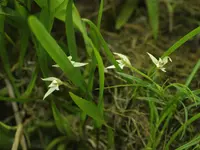
Nidema boothii is a small epiphytic orchid, usually found growing on trees rather than in soil. It forms compact clumps of slender, upright or arching stems with narrow leaves and delicate, often fragrant flowers. In nature, this species occurs in tropical regions of Central and South America, where it experiences high humidity, good air movement, and filtered light under a forest canopy.
Its relatively small size makes it suitable for growers with limited space, though it prefers stable conditions and does not enjoy extremes. Many hobbyists find it moderately challenging, mainly because it dislikes drying out completely or sitting in stale, soggy media. Understanding how to care for Nidema boothii starts with providing bright, indirect light, consistent moisture, and very free-draining orchid substrate.

Care Difficulty
Moderate Care

Light Preference
Partial Shade

Water Requirements
Moderate Water

Temperature Preference
Tropical / Frost Sensitive

Hardiness Zone
Unknown

Soil Texture
Organic-rich, Peaty, Loamy

Soil pH
Acidic (5.5–6.5)

Soil Drainage
Moist but well-drained

Fertilization
Light (every 4–6 weeks)
Scan your plant to receive care tips personalized for your specific plant
Available on iOS and Android
This epiphytic orchid prefers bright, filtered light with some gentle direct sun each day.
This orchid prefers evenly moist but never waterlogged conditions around its roots.
This species prefers consistently warm, frost‑free conditions throughout the year.
This epiphytic orchid prefers moderately humid air and reacts quickly to very dry conditions.
This orchid does not grow in regular potting soil and needs a very airy, fast-draining medium.
This species is well suited to container culture, including hanging baskets and small orchid pots.
Light feeding supports healthy growth but excessive fertilizer can stress Nidema boothii, especially in low-organic native soils.
Pruning is mainly used to maintain health and structure of Nidema boothii rather than to control size.
Transplanting or occasional repotting keeps Nidema boothii roots healthy and prevents decline from crowding.
Propagation of Nidema boothii is practical for expanding plantings when done under stable, warm conditions.
Winter care focuses on shielding Nidema boothii from freezing temperatures and root damage in colder regions.

Plant Health Check
Not sure what's wrong with your plant? Check your plant's health inside the app.
This species is a tiny epiphytic orchid native to moist tropical forests in Central America and northern South America, where it grows on tree branches rather than in soil and experiences frequent mist and high humidity.
The plant produces small, cream to yellowish flowers in short clusters that can be lightly fragrant, especially in the evening, a trait that likely helps attract specific pollinating insects in its native habitat.
Its slender, trailing stems and closely spaced, narrow leaves can form hanging mats on host trees, which helps the plant capture more light and intercept dripping moisture in the lower forest canopy.
Flowering often fails when light is too low, nighttime temperatures are too warm, or the plant is underfed. Provide bright but indirect light, a slight night temperature drop, and a balanced orchid fertilizer during active growth to support blooms.
Keep your plants happy and healthy with plant identification, disease detection, and easy care guidance.

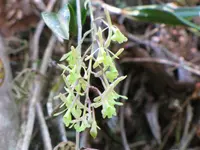
Greenfly Orchid
Epidendrum conopseum
 POPULAR
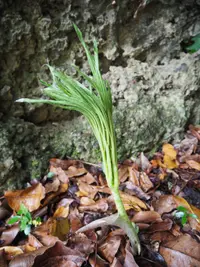
Amorphophallus henryi
Amorphophallus henryi
 POPULAR
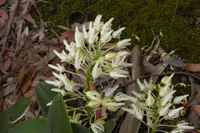
Rock orchid
Dendrobium speciosum
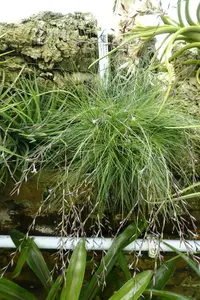
Tillandsia filifolia
Tillandsia filifolia
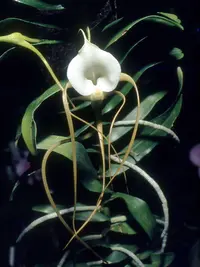
Angraecum ramosum
Angraecum ramosum
Showy Blue Ear
Cyanotis speciosa
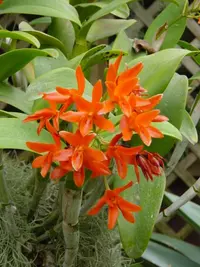
Guarianthe aurantiaca
Guarianthe aurantiaca
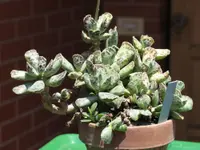
Plover Eggs Plant
Adromischus cooperi