Rotate For Symmetry
Turn the pot 90° every 1–2 weeks so the petioles do not lean strongly toward one side and the leaves stack neatly instead of twisting toward the light source.

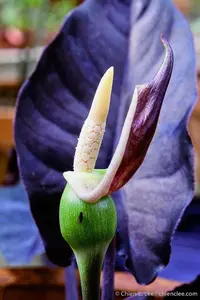
Alocasia infernalis is a compact aroid grown mainly for its dark, almost black leaves with a metallic sheen. The foliage is typically heart-shaped with pronounced veins, giving the plant a dramatic, sculptural look.
This species is native to Borneo, where it grows on the forest floor in warm, shaded, and constantly moist conditions. It is considered a challenging plant, as it reacts quickly to low humidity, irregular watering, and temperature fluctuations.
Those wanting to learn how to care for Alocasia infernalis should know it prefers bright, filtered light, evenly moist but airy soil, and stable indoor conditions with good humidity control.

Care Difficulty
Hard Care

Light Preference
Bright Indirect Light

Water Requirements
Keep Soil Moist

Temperature Preference
Tropical / Frost Sensitive

Hardiness Zone
11–12

Soil Texture
Loamy, Peaty, Organic-rich

Soil pH
Acidic (5.5–6.5), Slightly acidic (6.5–7.0)

Soil Drainage
Moist but well-drained

Fertilization
Light (every 4–6 weeks)
Scan your plant to receive care tips personalized for your specific plant
Available on iOS and Android
This shade-loving aroid prefers soft, filtered light that mimics a dim tropical understory.
This species prefers consistently moist but not waterlogged soil around its roots.
This plant grows best in warm, stable conditions similar to a humid, tropical understory.
This species needs consistently high humidity to maintain healthy foliage.
This aroid prefers a loose, airy, organic-rich mix that stays slightly moist but never waterlogged.
This species is well suited to container growing when moisture and stability are controlled carefully.
Nutrient support helps Alocasia infernalis maintain strong foliage and steady growth in containers.
Pruning needs are light and focus on keeping Alocasia infernalis clean and healthy rather than reshaping it.
Container-grown Alocasia infernalis benefits from occasional repotting to maintain root health and fresh substrate.
Multiplying Alocasia infernalis is typically done by division of the underground rhizomes rather than by leaf cuttings.
Cool-season protection is important because Alocasia infernalis is highly sensitive to cold and frost.

Plant Health Check
Not sure what's wrong with your plant? Check your plant's health inside the app.
This species is known for its unusually dark, almost black leaves with a metallic, beetle-like sheen that becomes most pronounced under moderate, diffuse light.
It is native to the shaded understory of lowland forests in Sarawak on the island of Borneo, where it grows on the forest floor in constantly warm, humid, and sheltered microhabitats.
Unlike many larger Alocasia species, it typically remains small and forms a low rosette close to the substrate, an adaptation to deep shade and limited light penetration in its native habitat.
This species is well suited to indoor decoration due to its compact size and dark, glossy foliage. Stable warmth, moderate humidity, and consistent but careful watering are key parts of Alocasia infernalis indoor care.
Keep your plants happy and healthy with plant identification, disease detection, and easy care guidance.