Prevent crown rot
Plant slightly on a mound or in a shallow basin that slopes away from the rosette so water runs off the crown and does not stagnate around the central leaves.

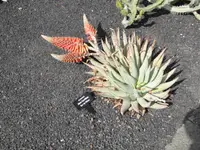
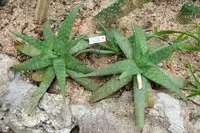
Aloe claviflora, commonly called kraal aloe, is a small, stemless succulent from arid regions of South Africa and Namibia. It forms low, dense rosettes that often sprawl in a ring-like cluster. Thick, grey-green leaves are lined with firm teeth and curve outward, giving the plant a sculptural look. In season it sends up short stalks of tubular orange to red flowers that attract pollinators. This species is adapted to strong sun, rocky or sandy soil, and long dry periods, which makes it well suited to container growing in bright, dry indoor spaces. Its slow growth and drought tolerance mean it suits owners who prefer to care for kraal aloe with a light, minimal approach.

Care Difficulty
Easy Care

Light Preference
Full Sun

Water Requirements
Low Water

Temperature Preference
Tropical / Frost Sensitive

Hardiness Zone
10–11

Soil Texture
Sandy, Loamy, Rocky

Soil pH
Slightly acidic (6.5–7.0), Neutral (7.0)

Soil Drainage
Well-drained

Fertilization
Minimal (feed rarely)
Scan your plant to receive care tips personalized for your specific plant
Available on iOS and Android
This sun-loving succulent needs strong light to maintain compact, healthy rosettes.
This species prefers deep, infrequent watering that allows the roots to dry between soakings.
This arid-adapted aloe prefers warm conditions and is sensitive to prolonged frost.
This arid-origin succulent handles typical indoor humidity well and rarely needs adjustment.
This species requires a fast-draining, mineral-rich mix that prevents water from lingering around the roots.
This low, clumping species is well suited to container growing when stability and rapid drainage are prioritized.
Aloe claviflora is a low-feeding succulent that benefits from light, targeted nutrition during its active season.
Aloe claviflora needs only light pruning to maintain health and a tidy rosette outline.
Aloe claviflora grows slowly and prefers infrequent disturbance, whether in containers or in-ground clumps.
Aloe claviflora is most often propagated by division of offsets, with seeds used mainly by experienced growers.
This species is drought-tolerant but only mildly frost-tolerant, so winter care focuses on keeping roots dry and above freezing.

Plant Health Check
Not sure what's wrong with your plant? Check your plant's health inside the app.
This species forms rosettes that lie sideways on the ground rather than upright, with leaves all leaning in one direction like a wind-swept fan, a key field character used to separate it from many other aloes in the Namaqualand and Karoo regions.
Its long, tubular orange to red flowers are adapted for bird pollination, especially by nectar-feeding sunbirds, which insert their beaks into the downward-pointing clusters and transfer pollen between plants.
In its native South African habitats, dense patches of this aloe help stabilize sandy and gravelly soils on plains and low slopes, reducing erosion in environments with sparse grass cover.

Aloe claviflora naturally forms striking crescent- or horseshoe-shaped colonies as the sideways rosettes proliferate and expand, creating curved living bands that can be seen as distinctive patterns in the landscape.
Flowering is often reduced by insufficient light, too much water, or excess nitrogen fertilizer. This species needs high light, lean soil, and a cool, dry rest period to form flower stalks reliably.
Keep your plants happy and healthy with plant identification, disease detection, and easy care guidance.