Rock mulch ring
Place a wide ring of coarse rocks or gravel around the base to keep the neck dry, stabilize the shallow roots, and reduce soil splash that can cause fungal issues.

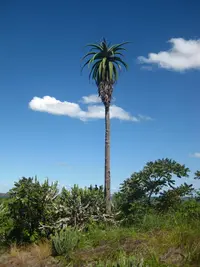
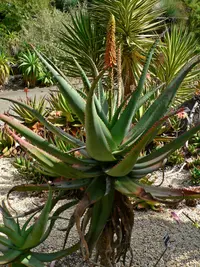
Zimbabwe aloe (Aloe excelsa) is a large, tree-forming succulent known for its tall single trunk and rosette of thick, upright, blue-green leaves. The leaf edges carry firm reddish teeth, and mature plants produce tall branched flower spikes with bright red to orange tubular blooms. This aloe is native to rocky hillsides and dry woodland in Zimbabwe and neighboring regions of southern Africa. It is naturally adapted to strong sun, high heat, and long dry periods, which makes it a resilient choice for dry gardens and large containers. In cultivation, it prefers bright light, very well-drained gritty soil, and infrequent deep watering, which simplifies how to care for Zimbabwe Aloe in suitable climates.

Care Difficulty
Easy Care

Light Preference
Full Sun

Water Requirements
Low Water

Temperature Preference
Tropical / Frost Sensitive

Hardiness Zone
10–11

Soil Texture
Sandy, Loamy, Rocky

Soil pH
Slightly acidic (6.5–7.0), Neutral (7.0)

Soil Drainage
Well-drained

Fertilization
Minimal (feed rarely)
Scan your plant to receive care tips personalized for your specific plant
Available on iOS and Android
This large African aloe thrives in strong light and handles full sun when acclimated gradually.
This drought-adapted aloe prefers deep but infrequent watering and fast-draining soil.
This species prefers warm, dry conditions and does poorly in prolonged cold or frost.
This species thrives in dry air and usually needs no special humidity management indoors.
This succulent requires a very fast-draining, mineral-dominant soil mix to prevent root and stem rot.
This species is suitable for container growing when the pot is chosen to manage weight, depth, and drainage carefully.
Aloe excelsa grown in containers benefits from light, controlled feeding during the warm growing season.
Pruning Aloe excelsa is mainly hygienic and structural, helping keep the rosette clean and the trunk safe.
Aloe excelsa in containers or young landscape plants may need occasional transplanting to maintain healthy root growth.
New Aloe excelsa plants are most often produced from offsets, with seed used mainly for larger-scale growing.
Aloe excelsa is not frost hardy and needs thoughtful winter care in regions with freezing temperatures.

Plant Health Check
Not sure what's wrong with your plant? Check your plant's health inside the app.
This species develops a single, tall, woody trunk topped with a compact rosette of leaves, giving it a distinct tree-like form unusual among many aloes that stay stemless or short-stemmed.
In its native range in Zimbabwe and neighboring regions, this aloe is typically found on rocky hillsides and granite outcrops, where its strong taproot anchors it into shallow, stony soils.
The plant produces striking, upright branched inflorescences with dense clusters of red to orange tubular flowers that stand well above the leaf rosette and are highly visited by sunbirds in habitat.
Aloe excelsa is one of the taller arborescent aloes in southern Africa, with old plants sometimes forming small, sparse stands on exposed rocky slopes that act as important structural perches and nectar sources for local bird communities.
This species usually needs to be several years old, well established, and exposed to strong light and seasonal temperature shifts before flowering. Crowded roots, excessive shade, or heavy, high-nitrogen feeding commonly delay or prevent the flower spike from forming.
Keep your plants happy and healthy with plant identification, disease detection, and easy care guidance.