Seasonal rest setup
Simulate the plant’s natural dry summer dormancy by gradually withholding water and moving the pot to a bright but slightly cooler, shaded position from late spring until early fall to support long-term vigor.

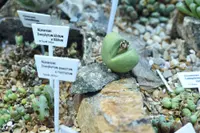
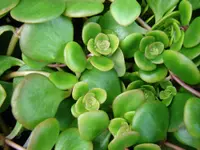
Conophytum bilobum is a miniature, clumping succulent from arid regions of South Africa and Namibia. It forms tight mats of paired, bilobed leaves that resemble small pebbles. Each growth cycle produces new leaves inside the old ones, which dry to form a protective sheath during summer rest. In autumn, it often produces daisy-like flowers in shades of yellow or orange. This species stays very small and is slow-growing, which makes it suitable for windowsills and small collections. It prefers bright light, excellent drainage, and very sparse watering, especially in summer dormancy. With an understanding of its seasonal rhythm, it is relatively straightforward to care for Conophytum bilobum.

Care Difficulty
Hard Care

Light Preference
Partial Sun

Water Requirements
Low Water

Temperature Preference
Tropical / Frost Sensitive

Hardiness Zone
10–11

Soil Texture
Sandy, Rocky, Loamy

Soil pH
Slightly acidic (6.5–7.0), Neutral (7.0)

Soil Drainage
Well-drained

Fertilization
Minimal (feed rarely)
Scan your plant to receive care tips personalized for your specific plant
Available on iOS and Android
This small South African succulent needs bright, gentle light that mimics cool, open desert conditions.
This species is a winter-growing succulent that needs careful, sparse watering and very fast drainage.
This plant prefers cool to mild conditions, with active growth in autumn and winter.
This South African succulent prefers very dry air and rarely suffers from low household humidity.
This species requires a very fast-draining, mineral-based mix to prevent root and body rot.
This species is very suitable for container growing due to its compact, clumping habit.
This compact succulent needs very light feeding to stay healthy in cultivation.
Conophytum bilobum needs minimal pruning, mainly for cleanliness and airflow around the clumps.
This species prefers infrequent disturbance, so repot only when clear signs appear.
Conophytum bilobum is most often propagated by division, with seed used for larger collections or breeding.
This species is a cool-season grower and requires careful dry, frost-free conditions in winter.

Plant Health Check
Not sure what's wrong with your plant? Check your plant's health inside the app.
This species produces small tubular flowers in autumn that open in the evening, releasing a noticeable sweet fragrance adapted to attract nocturnal pollinators in its native South African habitats.
During its summer dormancy, the paired leaf-lobes dry into a papery sheath while new bodies form inside, an adaptation that reduces water loss and protects the growing tissue from heat and drought.
Its bilobed, stone-like bodies closely match the color and shape of surrounding quartz and gravel, a form of camouflage called crypsis that helps reduce herbivore damage in the wild.

In habitat, this species often forms dense, cushion-like colonies that can be many decades old, with each new generation of leaf-pairs growing from the same slowly expanding rootstock, creating a long-lived, clonal mat over the rock surface.
This species usually blooms in fall, producing daisy-like flowers in shades of yellow to orange. Blooms open in the afternoon or evening, last several days, and often appear from the slit between the paired leaf bodies.
Keep your plants happy and healthy with plant identification, disease detection, and easy care guidance.