Deep root training
During the first growing season, water less often but more deeply to encourage a taproot and deeper lateral roots, which helps the plant tolerate drought and wind exposure better long term when growing Alysicarpus.

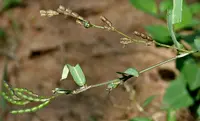
Alysicarpus monilifer is a small, herbaceous legume often found as a groundcover or low, branching shrub. It typically carries slender stems with small, simple leaflets and small clustered flowers. Native to dry and semi-dry regions of South Asia and nearby areas, it commonly grows in grasslands, open fields, roadsides, and disturbed soils. This species is adapted to sun and periodic drought, which generally makes it a resilient plant where conditions are warm and not overly wet. For anyone learning how to care for Alysicarpus, it helps to know that it prefers well-drained soil and does best with plenty of light and moderate moisture, rather than constant saturation.

Care Difficulty
Easy Care

Light Preference
Full Sun

Water Requirements
Low Water

Temperature Preference
Warm Climate

Hardiness Zone
9–11

Soil Texture
Sandy, Loamy, Rocky

Soil pH
Slightly acidic (6.5–7.0), Neutral (7.0)

Soil Drainage
Well-drained

Fertilization
Minimal (feed rarely)
Scan your plant to receive care tips personalized for your specific plant
Available on iOS and Android
This sun-loving legume thrives in bright, open sites with warm conditions.
This drought-tolerant species prefers deep but infrequent watering once established.
This warm-climate plant grows best in consistently mild to hot conditions without frost exposure.
This species handles a wide humidity range and rarely needs special humidity management.
This species prefers lean, well-drained, mineral soils that do not stay wet for long.
This plant can be grown in containers where drainage and root aeration are carefully managed.
This drought-tolerant legume generally needs minimal feeding in ordinary, well-drained soil.
Pruning Alysicarpus monilifer is mainly done to maintain a tidy shape and remove weak growth.
This species is more often grown in the ground, so focus on careful transplanting rather than frequent repotting.
Alysicarpus monilifer is most reliably propagated from seed under warm, bright conditions.
In mild, frost-free climates, this plant usually needs little special winter attention.

Plant Health Check
Not sure what's wrong with your plant? Check your plant's health inside the app.
This species develops slender seed pods that look like a string of beads, with clear constrictions between individual seeds, which is the origin of the epithet monilifer, meaning bead-bearing or necklace-bearing.
It is typically an annual or short-lived perennial herb native to tropical and subtropical regions of the Old World, where it occupies open, disturbed ground and light sandy or loamy soils.
As a member of the pea family (Fabaceae), it forms root nodules with nitrogen-fixing bacteria, helping enrich poor soils and contributing to early stages of grassland and wasteland succession.
This species is generally a short-lived perennial in warm regions, resprouting from its root system, but it may behave as an annual where conditions are harsher, very dry, or seasonally cold.
Keep your plants happy and healthy with plant identification, disease detection, and easy care guidance.