Canadian serviceberry Care (Amelanchier canadensis)

Also known as: Chuckleberry
Canadian serviceberry

About Canadian serviceberry

Canadian serviceberry, Amelanchier canadensis, is a hardy deciduous shrub or small tree valued for multi-season interest. It produces white spring blossoms, followed by small edible berries and good autumn color.

This species is native to eastern North America, where it grows along forest edges, stream banks, and open woodlands. It typically forms a clumping, upright habit that fits well into mixed borders and naturalistic plantings.

Canadian serviceberry is generally easy to grow, which helps explain why many gardeners look up how to care for Canadian serviceberry. It prefers sun to light shade, evenly moist but well-drained soil, and benefits from protection from extreme drought or waterlogging.

Main Plant Requirements

Care Difficulty

Easy Care

Light Preference

Full Sun

Water Requirements

Moderate Water

Temperature Preference

Cold Hardy

Hardiness Zone

3–7

Soil Texture

Loamy, Sandy, Clay

Soil pH

Acidic (5.5–6.5), Slightly acidic (6.5–7.0)

Soil Drainage

Moist but well-drained

Fertilization

Minimal (feed rarely)

Get Personalized Care Plan

Scan your plant to receive care tips personalized for your specific plant

Available on iOS and Android

How to Care for the Canadian serviceberry

This species performs best in outdoor sites with cool roots and access to direct light.

  • Aim for 4–6 hours of direct sun daily, ideally morning sun with light afternoon shade, to support dense flowering and fruiting for Canadian serviceberry.
  • Plant where it receives partial shade in hotter regions; dappled or filtered light under taller trees helps prevent leaf scorch in strong afternoon sun.
  • In summer, monitor for pale leaves or weak flowering as signs of insufficient light, and consider thinning overhead shade during the growing season.

Watering aims to keep the root zone moist but never saturated.

  • Allow the top 3–5 cm of soil to dry before deep watering, then soak the root area rather than sprinkling foliage, especially during the first 2–3 years after planting.
  • Use well-drained soil; persistent puddling, yellowing leaves, or wilting despite wet soil indicate overwatering or poor drainage that can lead to root rot.
  • During hot, dry periods, check soil every few days and increase deep watering, while in cool or rainy seasons water only when soil dryness is clearly detectable.

This hardy shrub tolerates a wide temperature range once established.

  • Optimal growth occurs around 60–75°F (16–24°C) during the active spring and early summer season, supporting strong shoot and root development.
  • Fully dormant plants tolerate winter lows near -20°F (-29°C) or slightly colder, but young or newly planted specimens benefit from mulch to buffer freeze–thaw cycles.
  • Mature shrubs endure short heat spells up to about 90°F (32°C) if soil stays evenly moist; prolonged extreme heat with drought can cause leaf scorch and early leaf drop.

This shrub is adapted to outdoor conditions and does not have special humidity requirements beyond typical temperate climates.

This shrub prefers deep, evenly moist, well-drained soil with moderate organic content.

  • Use a loamy soil that balances sand, silt, and clay so roots stay moist but not waterlogged.
  • Aim for slightly acidic to neutral pH around 5.5–7.0, which supports nutrient availability for Amelanchier canadensis.
  • Incorporate 20–40% compost or leaf mold into native soil to improve structure and moisture retention without creating soggy conditions.
  • Avoid compacted, heavy clay or sites with standing water; if needed, raise the planting area and blend in coarse sand or fine bark for better aeration.

This species can be grown in large containers for several years, though it ultimately performs best in the ground.

  • Select a tall, heavy container to support the shrub’s height and prevent tipping in wind.
  • Use a deep, slightly wider-than-rootball pot to allow a spreading root system and reduce surface drying.
  • Choose a thick-walled, non-metal container in sunny sites to limit rapid heating and moisture loss of the root zone.

This native shrub or small tree needs modest feeding when grown on reasonably fertile soil.

  • Apply a light layer of compost or well-rotted manure around the root zone in early spring to support new growth.
  • Use a balanced slow-release fertilizer (around 10-10-10) once in early spring if soil is poor or growth is weak.
  • Keep fertilizer away from the trunk and use at 1/2 label strength for young plants to avoid root burn.
  • Avoid feeding Canadian serviceberry from late summer through winter so growth can harden before freezing.

Pruning supports structure, health, and flowering in Amelanchier canadensis.

  • Carry out main pruning in late winter to very early spring while the plant is dormant.
  • Remove dead, diseased, crossing, or inward-growing branches with clean, sharp bypass pruners or loppers.
  • Thin crowded interior branches to increase light and air flow, which improves flowering and reduces disease risk.
  • Shorten or remove awkward shoots after flowering to maintain a balanced, multi-stemmed form.

This species is usually grown in the ground, so focus on careful transplanting rather than frequent repotting.

  • Transplant young shrubs in early spring or fall when soil is moist and temperatures are mild.
  • Move plants when growth is slow, roots circle the container, or the root ball dries very quickly after watering.
  • Dig a wide planting hole, keep the root flare at soil level, and backfill with the original soil, not rich potting mix.
  • Water deeply after transplanting, then keep soil evenly moist and apply 5–8 cm of mulch to limit stress.

Propagation is practical using seeds or softwood cuttings when correct timing and conditions are provided.

  • Collect ripe berries in late summer, clean the seeds, and sow them in pots outdoors for natural cold stratification over winter.
  • Alternatively, cold-stratify stored seed in moist medium at 34–41°F for about 3 months before spring sowing.
  • Take softwood cuttings in late spring to early summer, use rooting hormone, and place in a humid, bright, indirect light environment.
  • Keep the rooting mix lightly moist and well aerated to reduce rot and encourage root formation.

This shrub is cold hardy in much of North America and usually needs minimal winter care once established.

  • Mulch the root zone with 5–8 cm of bark or leaf mold in late fall, keeping mulch slightly away from the stems.
  • Newly planted shrubs benefit from consistent fall watering so roots enter winter well hydrated.
  • Container-grown plants in cold regions should be moved into an unheated garage or sheltered area to prevent root freeze.

Care Tips

Multi-stem management

Select 3–7 strong stems as permanent framework trunks while young and remove weak, rubbing, or crowded shoots at the base to maintain an open, storm-resistant clump.


Root-zone protection

Maintain a wide, undisturbed mulch ring under the canopy and avoid turf right up to the trunk to reduce drought stress, mower damage, and competition for nutrients.

Bird and fruit strategy

If fruit harvest is a goal, install fine wildlife netting just as berries start to color and remove it promptly after harvest to balance wildlife support with crop protection when growing Canadian serviceberry.

Sucker control

Check the base and nearby soil a few times per season and promptly cut off unwanted root suckers at or slightly below soil level to keep the plant from spreading into a thicket.

Disease monitoring routine

From early spring to early summer, inspect young leaves and shoots every 1–2 weeks for leaf spots, blight, or rust and prune out infected twigs on dry days to limit spread and reduce the need for chemical treatments.

Common Pests and Diseases

Pear trellis rust

This disease causes bright orange spots on leaves that later develop raised, blister-like structures, and can lead to premature leaf drop. Symptoms include reduced vigor over time if infections repeat yearly.

Solution

Prune out and destroy infected leaves and small twigs as soon as symptoms appear and rake fallen leaves in autumn to reduce spores. Increase spacing and airflow, avoid overhead watering, and if the disease is severe and recurring, use a labeled myclobutanil or propiconazole fungicide spray at bud break and again after bloom, following local regulations and label directions.

Fire blight

This disease causes blossoms, leaves, and young shoots to suddenly wilt, blacken, and appear scorched, often bending into a characteristic shepherd’s crook. Infections can move into larger branches and the trunk, potentially killing the plant over several seasons.

Solution

Prune out infected shoots 20–30 cm below visible symptoms during dry weather, disinfecting tools between each cut with alcohol or a 10% bleach solution. Avoid high-nitrogen fertilizer that promotes soft, susceptible growth, remove water sprouts, and in high-risk areas consider preventative copper or streptomycin sprays during bloom as allowed by local guidelines.

Leaf spot (fungal)

This disease produces small purple, brown, or tan spots on leaves that may merge, leading to yellowing and early leaf drop, especially after wet springs. Symptoms include a thinning canopy and reduced ornamental quality but usually not plant death.

Solution

Rake and dispose of fallen leaves to reduce fungal spores and maintain good spacing and pruning for airflow. If leaf spot is severe in repeated seasons, apply a labeled broad-spectrum fungicide such as chlorothalonil or copper at leaf emergence and repeat during wet periods, following all label instructions.

Aphids

These insects cluster on young shoots and the undersides of leaves, sucking sap and causing curling, distortion, and sticky honeydew that can lead to sooty mold. This pest rarely kills plants but can stress young or newly planted shrubs and small trees.

Solution

Spray colonies off with a strong stream of water, and encourage or introduce natural predators like lady beetles. On persistent infestations, use insecticidal soap or a light horticultural oil, coating leaf undersides and tender growth and repeating as needed according to label directions.

Pear sawfly (pear slug)

This pest is the larval stage of a small wasp and skeletonizes leaves, leaving only the veins and a thin leaf surface, giving foliage a scorched or lace-like appearance. Heavy feeding can cause significant defoliation in late spring or late summer generations.

Solution

Hose larvae off foliage or hand-pick where practical, and encourage predators such as birds and beneficial insects. For larger shrubs or trees with recurring damage, apply a horticultural oil or a spinosad-based product targeting young larvae, following timing and usage directions on the label.

Interesting Facts

Early spring nectar

This species flowers very early in spring, often before leaf-out, providing one of the first rich nectar and pollen sources for native bees and early-emerging pollinators in its eastern North American range.

Edible blueberry-like fruit

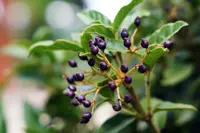
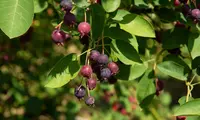
Its dark purple pomes are sweet and edible when fully ripe, with a flavor often compared to a mix of blueberry and almond due to the seeds, and are used in pies, jams, and traditional foods by Indigenous peoples and local foragers.

High wildlife value

The shrub supports a wide range of wildlife, offering nesting sites in its dense branching, spring flowers for pollinators, and summer fruit that is heavily consumed by birds such as cedar waxwings and thrushes.

Botan icon

Did you know?

The common name Canadian serviceberry is linked to its bloom time coinciding with spring thaw in colonial North America, when remote communities could finally hold burial services once the ground softened, and the flowering shrubs became associated with that seasonal event.

FAQs about Canadian serviceberry

The fruits are edible and often compared to blueberries in flavor. They can be eaten fresh, baked, or made into jams. Only harvest fully ripe, dark purple berries, and avoid consuming foliage, bark, or unripe parts.

Grow Healthy Plants with Botan Care

Keep your plants happy and healthy with plant identification, disease detection, and easy care guidance.

Botan plant care app — identify plants on mobile

Explore More Plants