Deep root harvesting
To obtain straight, intact roots, water the soil deeply the day before harvest and use a narrow, deep spade or digging fork to loosen soil along the root line before pulling.

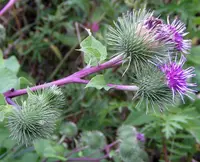
Greater burdock (Arctium lappa) is a robust biennial herb often grown for its edible roots and distinctive hooked seed burrs. In its second year, it forms tall, branching stems with large, heart-shaped leaves and thistle-like purple flower heads. It is native to Eurasia but now naturalized in many temperate regions, where it commonly grows along roadsides, field edges, and disturbed soils. This plant is generally easy to grow in full sun and moist, well-drained soil, but its deep taproot and self-seeding habit require some control. Understanding how to care for greater burdock helps prevent unwanted spreading while making use of its vigorous growth.

Care Difficulty
Easy Care

Light Preference
Full Sun

Water Requirements
Moderate Water

Temperature Preference
Cold Hardy

Hardiness Zone
3–7

Soil Texture
Sandy, Loamy, Organic-rich

Soil pH
Acidic (5.5–6.5), Slightly acidic (6.5–7.0)

Soil Drainage
Well-drained

Fertilization
Minimal (feed rarely)
Scan your plant to receive care tips personalized for your specific plant
Available on iOS and Android
This species prefers full sun but copes with some light shade, especially in hot regions.
This deep-rooted plant prefers consistently moist but not waterlogged soil.
This cool-temperate biennial grows best in mild conditions without extreme heat or intense frost.
Humidity is not a major factor for Arctium lappa, which adapts well to typical outdoor air levels.
This species develops best in deep, loose, well-drained mineral soil that allows long taproot growth.
This species is generally unsuitable for containers because its long taproot needs more depth than most pots provide.
Arctium lappa is a biennial that usually needs only modest feeding in average garden soil.
Pruning Arctium lappa is mainly about hygiene and limiting unwanted spread rather than shaping.
This deep-rooted biennial is best direct-sown, and transplanting must be done carefully to avoid taproot damage.
Arctium lappa is most commonly propagated from seed, as root disturbance makes vegetative methods impractical.
This species is cold hardy in most temperate climates and usually needs minimal winter care in the ground.

Plant Health Check
Not sure what's wrong with your plant? Check your plant's health inside the app.
The hooked bracts on its burrs famously inspired Swiss engineer George de Mestral to invent hook-and-loop fasteners, later commercialized as Velcro, after he studied how the burrs clung to clothing and animal fur under a microscope.
This species typically lives for 2 years, forming a large taproot and leaf rosette in the first year, then using those stored reserves to produce tall flowering stalks, burrs, and seeds in the second year before dying.
In East Asia the thick, fleshy taproot of this species is a traditional vegetable known as gobo, valued for its mild, earthy flavor and crunchy texture when cooked or eaten young.

Genetic and archaeological evidence indicate that Arctium lappa was one of the earliest Eurasian plants to be moved from wild foraging into deliberate field cultivation, with records from Japan and parts of Europe documenting its transition from weed to root crop several centuries ago.
This species self-seeds readily and can spread quickly if flower heads are not removed. Burs cling to clothing and animal fur, helping seeds travel. Deadhead before seeds mature and pull unwanted seedlings early to prevent large colonies forming.
Keep your plants happy and healthy with plant identification, disease detection, and easy care guidance.