banana passionfruit Care (Passiflora tripartita)

banana passionfruit

About banana passionfruit

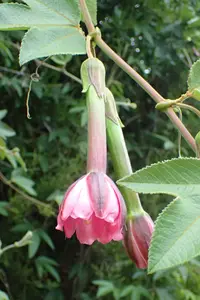
Banana passionfruit (Passiflora tripartita) is a fast-growing, evergreen climbing vine known for its long, banana-shaped fruits and showy, tubular flowers. It typically scrambles over supports, fences, or trees, forming a dense green curtain of three-lobed foliage.

This species is native to cool tropical and subtropical highlands of the Andes in South America. It prefers mild climates without extreme heat or frost and can become invasive in some regions with ideal conditions.

The plant grows quickly and can be vigorous, so it needs strong support and regular pruning to manage size. It is moderately easy to grow if given bright light, consistent moisture, and well-drained soil, and understanding how to care for banana passionfruit helps keep it healthy and productive.

Main Plant Requirements

Care Difficulty

Moderate Care

Light Preference

Full Sun

Water Requirements

Regular Water

Temperature Preference

Warm Climate

Hardiness Zone

9–11

Soil Texture

Sandy, Loamy, Organic-rich

Soil pH

Acidic (5.5–6.5), Slightly acidic (6.5–7.0)

Soil Drainage

Moist but well-drained

Fertilization

Moderate (every 2–4 weeks)

Get Personalized Care Plan

Scan your plant to receive care tips personalized for your specific plant

Available on iOS and Android

How to Care for the banana passionfruit

Passiflora tripartita performs best with strong, consistent light to support vigorous vine and fruit growth.

  • Provide 6–8 hours of direct sun daily, ideally with morning sun and light afternoon shade, especially in hot summer climates.
  • Tolerates bright partial shade (around 4–5 hours sun) but flowering and banana passionfruit production decline in deeper shade.
  • In very hot regions, protect from intense afternoon sun to prevent leaf scorch; in winter, avoid heavy shade from buildings or evergreens that reduces light too much.

This vine prefers evenly moist, well‑drained soil and reacts quickly to both drought and waterlogging.

  • Water when the top 3–5 cm of soil feels dry, aiming for moisture that reaches the root zone without leaving the soil soggy.
  • Increase watering during hot, active growth and flowering seasons; reduce in cooler months while avoiding complete drying of the root area.
  • Watch for yellowing, soft leaves as a sign of overwatering and crisp, curling leaves or wilting at midday and evening as signs of underwatering in Passiflora tripartita.

This subtropical vine thrives in mild, frost‑free conditions and struggles with hard freezes or extreme heat.

  • Optimal growth occurs around 65–80°F (18–27°C), which supports strong vegetative growth and flowering through the warm season.
  • Tolerates brief drops to about 30–32°F (-1–0°C) but young shoots and buds are easily damaged; repeated frosts can kill stems back.
  • Handles short heat spikes up to 90–95°F (32–35°C) if soil moisture is consistent, but prolonged high heat with dry soil leads to stress, leaf drop, and poor fruit set.

This species prefers moderately high humidity and reacts if air stays very dry for long periods.

  • Aim for 50–70% humidity; it tolerates brief dips lower but prolonged levels near 30% cause stress.
  • Dry, crisp leaf edges, curling, and stalled new growth indicate humidity is too low for banana passionfruit.
  • Increase humidity with grouped plants, a nearby humidifier, or an outdoor spot sheltered from drying wind.

Passiflora tripartita grows best in loose, well‑aerated, moisture‑retentive but fast‑draining soil.

  • Use a loamy mix with 40–60% organic matter such as compost plus added perlite or coarse sand for drainage.
  • Target a slightly acidic to neutral pH around 6.0–7.0, avoiding strongly alkaline or saline substrates.
  • In heavy or clay soils, create a raised bed or large mound and blend in coarse sand and fine bark to improve aeration.
  • Avoid waterlogged, compacted, or poorly structured soil, which promotes root rot and weak, chlorotic foliage.

This species can be grown successfully in containers if the pot supports its vigorous climbing habit.

  • Choose a deep, heavy container that resists tipping once the vine climbs a trellis or other support structure.
  • Select a pot volume that allows a broad root zone rather than a narrow tall column, which dries unevenly.
  • Use a free‑draining mix and elevate the pot slightly so drainage holes clear the surface and water exits quickly.

Passiflora tripartita responds well to moderate feeding during active growth to support flowering and fruiting.

  • Use a balanced liquid fertilizer (around 10-10-10 or 20-20-20) diluted to 1/2 strength every 2–4 weeks in spring and summer.
  • Alternatively, apply a slow-release balanced fertilizer or a thin layer of well-rotted compost at the start of the growing season.
  • Pause or reduce feeding to 1/4 strength once every 6–8 weeks in fall and winter, especially for indoor or container plants.
  • Ensure soil is moist before applying fertilizer to reduce root burn and avoid salt buildup.

Pruning Passiflora tripartita helps control size, maintain structure, and encourage flowering wood.

  • Carry out main pruning in late winter or early spring before strong new growth begins.
  • Remove dead, damaged, or weak stems first, then thin congested or crossing vines to improve light and air flow.
  • Shorten overly long shoots to shape the vine and direct growth along the support structure.
  • Use clean, sharp bypass pruners and make cuts just above a healthy bud or side shoot.

This vigorous climber benefits from timely transplanting or repotting to maintain strong growth and root health.

  • Plan major repotting or ground transplanting for early spring, just before rapid growth starts.
  • Look for roots circling the pot, pushing through drainage holes, or unexplained slow growth as signals it needs more space.
  • Repot every 1–2 years into a container 1–2 in wider, using free-draining, fertile soil and firm support for the vine.
  • Water thoroughly after moving the plant, keep it shaded for several days, and avoid heavy pruning at the same time to limit stress.

Passiflora tripartita is commonly propagated from semi-ripe cuttings or seeds for new vines.

  • Take 8–12 in semi-ripe stem cuttings in late spring or summer, keeping 2–3 nodes per cutting.
  • Remove lower leaves, dip the base in rooting hormone, and place in a moist, well-draining mix under high humidity and bright, indirect light.
  • Sow fresh seeds in warm conditions (70–80°F) in a sterile mix, lightly covered, and keep evenly moist for best germination.
  • Bottom heat and a humidity dome or clear cover improve rooting and seedling establishment.

This species has limited frost tolerance and benefits from protective winter care in cooler climates.

  • In regions with frost, grow Passiflora tripartita in containers and move indoors or into a frost-free greenhouse before temperatures drop below 32°F.
  • Mulch the root zone with 5–8 cm of organic material in fall to buffer soil temperature and moisture.
  • In mild climates, train stems against a sheltered wall and consider a breathable frost cloth during freezing nights.
  • Reduce watering in winter, keeping soil lightly moist but never waterlogged, especially for banana passionfruit in pots.

Care Tips

Provide strong support

Install a sturdy trellis, fence, or wire system before planting so the vine can be loosely tied and layered as it grows, which reduces stem breakage and maximizes flowering surface.

Train for airflow

Guide and prune the vines so they spread in a fan shape rather than forming a dense tangle, which improves air circulation and reduces fungal problems on leaves and fruit when growing banana passionfruit.

Mulch the root zone

Apply a 5–8 cm layer of organic mulch around, but not touching, the stem to keep roots cool, reduce water stress, and stabilize soil structure on this shallow‑rooted vine.

Use targeted pollination

In areas with few pollinators, gently brush the inside of freshly opened flowers with a soft paintbrush in the morning and transfer pollen between flowers to improve fruit set.

Rotate pest monitoring

Inspect foliage and stems every 7–10 days, checking the undersides of leaves and new growth for aphids, caterpillars, and mites, so that any infestation can be treated early with targeted controls like insecticidal soap or Bacillus thuringiensis (Bt).

Common Pests and Diseases

Passionvine mite

This pest causes fine yellow stippling, leaf bronzing, and eventual leaf drop, often starting on older foliage and spreading rapidly in warm, dry conditions.

Solution

Rinse foliage thoroughly with a strong but gentle stream of water, then apply a horticultural oil or insecticidal soap to the undersides of leaves every 5–7 days for several cycles; reduce plant stress with regular watering and increase humidity to slow population growth.

Heliconius caterpillars

These insects chew irregular holes and can skeletonize leaves, especially on young vines and new growth in outdoor plantings.

Solution

Hand-pick and remove caterpillars and egg clusters from leaves, encourage natural predators such as birds where possible, and use fine mesh netting to protect young vines; only consider targeted biological products like Bacillus thuringiensis (Bt) if defoliation becomes severe and other methods are not sufficient.

Passionflower fusarium wilt

This disease causes sudden wilting, yellowing, and dieback of shoots despite moist soil, often progressing from one side of the plant and moving along the vine and roots.

Solution

Remove and destroy affected vines and roots, avoid replanting passionfruit in the same soil for several years, and improve drainage and soil structure; use clean tools, disinfect pruning equipment, and start new plants from certified disease-free material when growing banana passionfruit in production settings.

Brown spot (Alternaria leaf spot)

This disease produces small brown leaf spots with darker margins that can merge into larger patches, leading to premature leaf drop under humid conditions.

Solution

Prune to improve airflow, avoid overhead watering, promptly remove and dispose of fallen leaves, and apply a copper-based or other labeled fungicide if spotting progresses, spacing treatments according to product instructions.

Scale insects

These insects appear as small, dome-shaped bumps on stems and leaf veins, excreting sticky honeydew that can lead to sooty mold growth on foliage and fruit stalks.

Solution

Gently scrape or wipe off scales with a soft cloth or cotton swab dipped in alcohol, then treat remaining colonies with horticultural oil, ensuring thorough coverage of stems and leaf undersides; repeat treatments every 7–14 days until new crawlers are controlled and monitor new growth regularly.

Interesting Facts

High-elevation specialist

This species is naturally adapted to cool, humid Andean cloud forests and commonly occurs at elevations around 2,000–3,600 m, which is unusually high for many passionflower vines.

Unique leaf shape

Its leaves are deeply 3-lobed and narrow, giving a distinctly tripartite, lance-like outline that visually sets it apart from many broader-leaved Passiflora species.

Moth-pollinated flowers

The long, tubular pink to reddish flowers are adapted to pollination by long-tongued moths, which can reach nectar at the base of the tube when visiting at dusk or night.

Botan icon

Did you know?

In regions of the tropical Andes, this species and its close relatives are a primary native host for certain Heliconius butterflies, whose caterpillars specialize on passionflower vines and have co-evolved to tolerate the defensive chemicals produced by these plants.

FAQs about banana passionfruit

This species is a vigorous climbing vine that uses tendrils to latch onto nearby structures. It naturally grows upward over trellises, fences, or other plants, rather than creeping along the ground as a spreading ground cover.

Grow Healthy Plants with Botan Care

Keep your plants happy and healthy with plant identification, disease detection, and easy care guidance.

Botan plant care app — identify plants on mobile

Explore More Plants