Use Wood With Bark
Inoculate freshly cut hardwood logs or branches that still have intact bark, as this species colonizes and fruits most reliably on firm, bark-covered wood rather than on heavily decayed or barkless pieces.

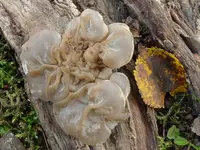
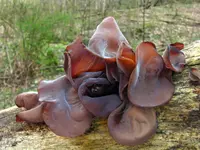
Tripe fungus (Auricularia mesenterica) is a wood-decay fungus, not a traditional houseplant. It forms thick, wavy, ear-like brackets with a leathery, ridged upper surface. The underside is smoother and often paler, with a jelly-like texture when moist.
This species typically grows on dead or decaying hardwood, especially in temperate forests across Europe and parts of North America. It plays an important role in breaking down wood and recycling nutrients.
In cultivation it is moderately demanding, as it needs consistently damp, shady conditions and a suitable wood substrate. Understanding how to care for Tripe Fungus starts with providing stable moisture and cool, sheltered locations that mimic its natural woodland habitat.

Care Difficulty
Moderate Care

Light Preference
Shade

Water Requirements
Keep Soil Moist

Temperature Preference
Cool Climate

Hardiness Zone
Unknown

Soil Texture
Loamy, Silty, Organic-rich

Soil pH
Acidic (5.5–6.5), Slightly acidic (6.5–7.0)

Soil Drainage
Moist but well-drained

Fertilization
Minimal (feed rarely)
Scan your plant to receive care tips personalized for your specific plant
Available on iOS and Android
Auricularia mesenterica is a wood-decaying fungus that fruits best in cool, shaded forest-like light conditions.
Moisture management for Auricularia mesenterica focuses on keeping the woody substrate consistently damp, not saturated.
Stable, cool to mild conditions support reliable fruiting of this wood-inhabiting fungus.
Auricularia mesenterica requires consistently high humidity similar to a damp woodland environment.
For cultivation, Auricularia mesenterica relies on woody, organic-rich substrates rather than typical garden soil.
This species can be grown in containers only when the container holds inoculated wood or woody substrate rather than soil.
Auricularia mesenterica, often called Tripe Fungus, usually needs no fertilizer when growing on decaying wood outdoors.
Pruning Auricularia mesenterica is minimal and focuses on hygiene rather than shaping.
This fungus is usually grown on outdoor logs or hardwood pieces rather than in traditional pots.
Propagation of Auricularia mesenterica is typically done by mycelium transfer rather than by cuttings or seeds.
Auricularia mesenterica is cold hardy in most temperate climates and usually needs little winter care outdoors.

Plant Health Check
Not sure what's wrong with your plant? Check your plant's health inside the app.
This fungus forms firm, gelatinous brackets with clearly zoned bands of gray, brown, and buff on the upper surface and a wrinkled, often pinkish underside, giving it a tripe-like appearance that inspired its common name tripe fungus.
It grows mainly on dead or decaying broadleaf wood, especially beech and oak, where it contributes to white rot by selectively breaking down lignin and leaving the wood pale and fibrous.
Although native across much of Europe and parts of Asia and North America, it is often overlooked because fruiting bodies are small, tough, and blend with bark, and they can persist on the wood for long periods, sometimes rehydrating and swelling after rain.

Molecular studies have shown that the species long known as Auricularia mesenterica in Europe and North America actually represents a complex of closely related, look-alike taxa, and some collections once placed under this name have been reassigned to distinct species based on DNA evidence.
This jelly fungus is generally considered edible but is thin, tough, and not highly valued as food. Identification must be absolutely certain, since confusing fungi is risky. Local foraging regulations and expert guidance are strongly recommended.
Keep your plants happy and healthy with plant identification, disease detection, and easy care guidance.