Replicate burned wood
Establish the fungus on well-decayed, fungus-free hardwood that has been lightly charred on the surface, as field observations show this species often fruits on old fire-damaged wood in nature.

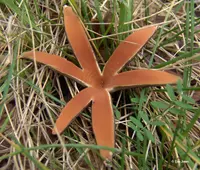
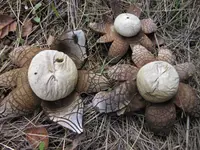
Texas star is the common name for Chorioactis geaster, a rare and unusual fungus, not a true plant. It is best known for its star-shaped fruiting body that splits open into several thick, brown arms around a dark spore mass.
This species occurs naturally in parts of Texas and a few locations in Japan, usually on decaying wood or old tree stumps. It is considered difficult to cultivate because it has very specific habitat and wood-decay requirements, so most information on how to care for Texas Star focuses on conserving its natural sites rather than growing it at home.
In nature it favors cool, moist conditions and shaded woodland environments.

Care Difficulty
Hard Care

Light Preference
Partial Shade

Water Requirements
Keep Soil Moist

Temperature Preference
Warm Climate

Hardiness Zone
7–9

Soil Texture
Loamy, Silty, Organic-rich

Soil pH
Acidic (5.5–6.5)

Soil Drainage
Moist but well-drained

Fertilization
Minimal (feed rarely)
Scan your plant to receive care tips personalized for your specific plant
Available on iOS and Android
This rare fungus prefers dappled woodland light rather than direct, open sun.
Moist but not waterlogged conditions support reliable fruiting of this woodland fungus.
This species favors cool to mild conditions typical of shaded woodlands.
This fungus forms best outdoors in cool, consistently moist air rather than very dry conditions.
Chorioactis geaster relies on very specific outdoor substrate conditions rather than conventional potting soil.
This species is not realistically suitable for container growing because it depends on complex outdoor wood-decay habitats.
Chorioactis geaster is a saprophytic fungus that gains nutrients from decaying wood and usually does not benefit from added fertilizer in typical garden or container culture.
Pruning is not a standard practice for Chorioactis geaster, since the visible star-shaped body is a short-lived fruiting structure rather than a plant stem or foliage.
Transplanting this wood-inhabiting fungus is rarely successful, as the main organism lives hidden in decaying wood rather than in conventional potting soil.
Propagation of Chorioactis geaster is highly specialized and usually limited to scientific or conservation settings rather than home culture.
This fungus is naturally adapted to the seasonal climates where it occurs and generally needs no targeted winter care in outdoor settings.

Plant Health Check
Not sure what's wrong with your plant? Check your plant's health inside the app.
This fungus is known natively only from scattered sites in Texas and a few locations in Japan, making its natural distribution one of the most geographically disjunct among macrofungi documented so far.
When the fruiting body splits open, it can produce a faint hissing or popping sound as spores are forcibly discharged, a relatively rare audible event in larger fungi.
The fungus starts as a dark, cigar-like capsule that later splits into a star-shaped structure with several rays, exposing a rusty spore mass in the center that gives it a distinctive earthstar-like appearance.
This species is so distinctive and unusual that it is the sole member of its genus and was placed in its own family, Chorioactidaceae, based on both its unique morphology and molecular (DNA-based) studies.
Yes, this species can be container-grown if given a deep, well-drained, gritty substrate and stable outdoor-like conditions. Containers must not overheat or stay waterlogged, since the fungus is sensitive to excess moisture and temperature extremes.
Keep your plants happy and healthy with plant identification, disease detection, and easy care guidance.