Use hardwood blocks
For reliable Auricularia delicata care, inoculate fresh, untreated hardwood logs or blocks (for example oak or beech) and keep them shaded and off bare soil to reduce contamination by competing fungi.

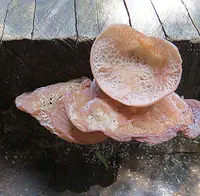
Karoko, Auricularia delicata, is a jelly fungus rather than a typical leafy plant. It forms soft, rubbery, ear-shaped fruiting bodies on decaying wood. Colors range from pale beige to brown, often with a wavy, lobed surface.
This species occurs mainly in tropical and subtropical forests, especially on fallen branches and dead trunks. It plays an important role in breaking down wood and recycling nutrients.
In cultivation, it prefers warm, humid conditions, shaded light, and consistently moist but not waterlogged woody substrates. These specific needs make care for karoko more specialized than common houseplants.

Care Difficulty
Moderate Care

Light Preference
Shade

Water Requirements
Keep Soil Moist

Temperature Preference
Warm Climate

Hardiness Zone
Unknown

Soil Texture
Loamy, Silty, Organic-rich

Soil pH
Acidic (5.5–6.5), Slightly acidic (6.5–7.0)

Soil Drainage
Moist but well-drained

Fertilization
Minimal (feed rarely)
Scan your plant to receive care tips personalized for your specific plant
Available on iOS and Android
Auricularia delicata prefers shaded, forest-like light conditions with brief gentle sun exposures.
This fungus needs consistently moist, not waterlogged conditions to fruit well and stay healthy.
This species favors cool to mildly warm conditions similar to a shaded woodland climate.
This fungus needs consistently high humidity to fruit well in cultivation.
Auricularia delicata is typically grown on woody substrates rather than true soil, but similar principles guide its support medium.
This species can be cultivated in containers or bags that hold a moist, woody substrate rather than regular potting soil.
Auricularia delicata usually needs minimal fertilization when grown on nutrient-rich wood or prepared substrate.
Pruning Auricularia delicata is rarely needed, as this fungus does not form woody stems or foliage.
Auricularia delicata is typically managed by renewing or moving its substrate rather than classic repotting.
Propagation of Auricularia delicata is done by expanding mycelium rather than using cuttings or seeds like a typical plant.
Auricularia delicata in outdoor logs or beds generally tolerates cool conditions but responds to harsh freezes and drying winds.

Plant Health Check
Not sure what's wrong with your plant? Check your plant's health inside the app.
The fruiting body of this fungus has a smooth to finely hairy gelatinous surface that often forms lobed or folded disks, helping it retain moisture on decaying wood in humid forests.
This species most often colonizes dead or dying hardwood branches and logs in tropical and subtropical regions, contributing to wood decomposition and nutrient recycling in those ecosystems.
On a microscopic level, its spore-bearing surface carries tiny spine-like projections called acanthoid hairs, a feature that helps mycologists distinguish it from similar jelly fungi.

Auricularia delicata has a wide pantropical distribution, occurring in regions of Asia, Africa, the Americas, and Oceania, which indicates strong ecological adaptability to warm, humid forest environments on multiple continents.
This jelly fungus is considered edible when properly identified and cooked. It is mainly valued for texture rather than strong flavor. Only harvest from clean, pesticide-free wood and avoid look-alikes if there is any doubt.
Keep your plants happy and healthy with plant identification, disease detection, and easy care guidance.