

Use hardwood discs
Place thin, untreated hardwood discs or chips on top of a moist, sterile substrate so the fungus can colonize a stable, slowly decomposing food source that mimics its natural leaf-litter habitat.

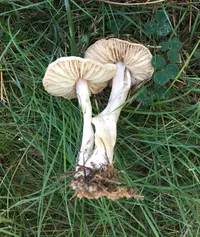
Marasmius nigrodiscus is a small, saprophytic mushroom that grows on decaying wood and leaf litter rather than in pots or garden beds. It forms delicate, dark-capped fruiting bodies on thin stems, often appearing in scattered groups on forest floors.
This species is documented from specific woodland habitats and is not commonly cultivated, so information on how to care for Marasmius nigrodiscus is limited. It typically favors shaded, humid environments with abundant organic debris, which makes intentional home cultivation challenging for most growers.

Care Difficulty
Moderate Care

Light Preference
Partial Shade

Water Requirements
Moderate Water

Temperature Preference
Warm Climate

Hardiness Zone
Unknown

Soil Texture
Loamy, Organic-rich

Soil pH
Acidic (5.5–6.5)

Soil Drainage
Moist but well-drained

Fertilization
Minimal (feed rarely)
Scan your plant to receive care tips personalized for your specific plant
Available on iOS and Android
This woodland fungus prefers low, filtered light similar to a shaded forest floor.
Moist, well‑draining organic substrate is essential for sustained fruiting of this fungus.
This species favors mild, consistently cool to warm conditions similar to a shaded forest understory.
This fungus prefers consistently humid conditions to fruit reliably.
For cultivation, this species needs a loose, organic-rich substrate that mimics decomposing forest litter.
This species can be grown in shallow containers that simulate a moist forest floor.
This woodland fungus relies on decaying organic matter and usually does not need direct feeding in cultivation.
Marasmius nigrodiscus does not require true pruning, but small hygiene tasks help maintain clean culture.
This species is usually managed by refreshing substrate rather than traditional repotting.
Marasmius nigrodiscus is typically propagated by mycelium expansion rather than home methods like cuttings or seed.
Outdoors in suitable climates, this woodland fungus generally overwinters in the substrate with minimal attention.

Plant Health Check
Not sure what's wrong with your plant? Check your plant's health inside the app.
This species is distinguished by its small, dark, disc-like caps that are typically blackish to dark brown, often with a somewhat depressed center, which helps separate it from paler, more umbrella-shaped Marasmius species.
It is known from forest habitats where it fruits directly on fallen leaves and other fine plant debris, playing a role as a saprotroph that decomposes this material and returns nutrients to the soil.
Published records indicate that this fungus is known from relatively few documented localities, and its distribution is considered localized compared with many cosmopolitan Marasmius species, though detailed mapping is still incomplete.
Identification of small brown fungi is difficult, and misidentification can be dangerous. This species is not established as an edible mushroom and has no culinary value. It is safest to treat it as inedible and for observation only.
Keep your plants happy and healthy with plant identification, disease detection, and easy care guidance.

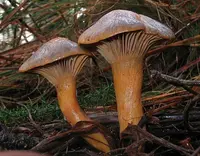
Brownish Chroogomphus
Chroogomphus rutilus
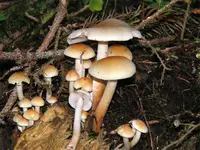
Smoky-gilled Hypholoma
Hypholoma capnoides
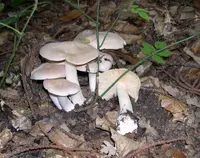
livid pinkgill
Entoloma sinuatum
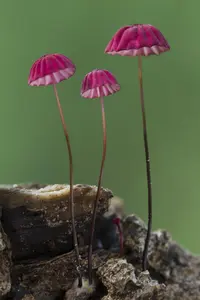
purple pinwheel
Marasmius haematocephalus
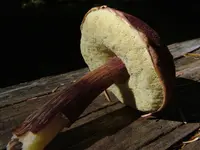
admirable bolete
Aureoboletus mirabilis
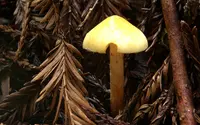
Lavender Baeospora
Baeospora myriadophylla
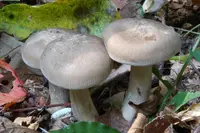
Fried Chicken Mushroom
Lyophyllum decastes
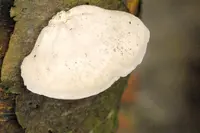
White Cheese Polypore
Tyromyces chioneus