mammee sapote Care (Pouteria sapota)

Also known as: naseberry / mamey sapote / mamey sapota, Mamey sapote, naseberry
mammee sapote

About mammee sapote

Mammee sapote, Pouteria sapota, is a tropical evergreen fruit tree valued for its large, sweet, apricot-like fruits and dense, glossy foliage. It forms a broad canopy and can become a substantial shade tree in warm climates.

This species is native to Central America and the Caribbean, where it thrives in humid, frost-free regions. The tree has a deep root system and thick leaves, which help it tolerate short dry periods once established.

It usually prefers full sun, consistent moisture, and well-drained, slightly fertile soil. Understanding how to care for mammee sapote starts with providing stable warmth and avoiding cold, waterlogged conditions.

Main Plant Requirements

Care Difficulty

Hard Care

Light Preference

Full Sun

Water Requirements

Regular Water

Temperature Preference

Tropical / Frost Sensitive

Hardiness Zone

10–12

Soil Texture

Sandy, Loamy, Organic-rich

Soil pH

Acidic (5.5–6.5), Slightly acidic (6.5–7.0)

Soil Drainage

Moist but well-drained

Fertilization

Moderate (every 2–4 weeks)

Get Personalized Care Plan

Scan your plant to receive care tips personalized for your specific plant

Available on iOS and Android

How to Care for the mammee sapote

Pouteria sapota needs strong light in warm climates to produce healthy growth and fruit.

  • Provide 6–8 hours of direct sun daily, ideally with morning sun and light afternoon shade, especially in hotter inland areas.
  • Young trees benefit from 30–50% filtered shade cloth during the first 1–2 years to reduce leaf scorch and transplant stress for mammee sapote.
  • In marginal climates, choose a south-facing, wind-sheltered site so winter sun stays above nearby structures and trees.

Pouteria sapota prefers evenly moist, well-drained soil and does poorly in waterlogged conditions.

  • Irrigate when the top 3–5 cm of soil feels dry, applying a deep soak that wets the root zone rather than light, frequent splashes.
  • Use soil with good drainage, and avoid standing water around the trunk to prevent root rot, yellowing leaves, and leaf drop from overwatering.
  • In hot, dry periods increase frequency while still letting the surface dry slightly; in cool or rainy seasons reduce watering to avoid saturated soil.

This tropical fruit tree requires warm, frost-free conditions for reliable growth and fruiting.

  • Aim for 70–90°F (21–32°C) as the main growing range; growth slows noticeably below about 65°F (18°C).
  • Avoid temperatures below 40°F (4°C); young trees can be damaged near this level and are often killed by light frost or brief freezes.
  • In very hot spells above 95°F (35°C), provide extra irrigation and, for young trees, temporary light shade to limit heat and sun stress.

This species prefers moderately high humidity but usually adapts to typical household levels if watering is consistent.

  • Aim for 50–70% humidity to support healthy foliage and steady growth in mammee sapote.
  • Crisp leaf edges, slowed growth, and persistent tip browning can indicate air that is too dry.
  • Increase humidity with a nearby humidifier or grouped plants rather than misting, which adds only brief moisture.

Pouteria sapota grows best in deep, well-aerated, moisture-retentive but free-draining soil.

  • Use a loamy mix with high organic content, such as 50–60% composted bark or compost blended with coarse sand or perlite.
  • Ensure rapid drainage so water does not stand around the roots, which are sensitive to low-oxygen, waterlogged conditions.
  • Aim for slightly acidic to neutral soil, around pH 6.0–7.0, to support nutrient availability and balanced root growth.
  • Improve heavy or compact soil by incorporating coarse sand, perlite, or fine gravel to prevent compaction and improve aeration.

This species can be grown in large containers, especially when young or in cooler climates.

  • Choose a tall, heavy container that resists tipping as the plant becomes taller and more top-heavy over time.
  • Select a pot diameter that leaves 3–5 cm of mix around the root ball so the medium dries evenly and does not stay wet for days.
  • Use a sturdy, moisture-stable mix in containers to support the weight of the plant and prevent settling that can reduce root aeration.

Nutrient-rich soil supports strong growth and fruiting in mammee sapote, especially in warm climates with long seasons.

  • Apply a balanced granular or slow-release fertilizer (around 8-3-9 or similar fruit-tree blend) at the start of the warm growing season.
  • Feed young trees 2–3 times per growing season; mature trees usually need 1–2 light applications.
  • Use about half the label rate for trees in rich soil or when growth is already vigorous.
  • Complement mineral fertilizer with 2–5 cm of well-rotted compost over the root zone, kept away from the trunk.

Thoughtful pruning supports safe structure and manageable size in Pouteria sapota trees.

  • Carry out main pruning in late winter or very early spring, before strong new growth starts.
  • Remove dead, diseased, crossing, or inward-growing branches to open the canopy to light and air.
  • Shorten overly vigorous upright shoots to maintain a strong central framework and balanced shape.
  • Use clean, sharp bypass pruners or a pruning saw, making smooth cuts just outside the branch collar.

This tropical fruit tree is usually field-grown, so focus on careful transplanting rather than frequent repotting.

  • Transplant young trees in late spring or early summer once soil is warm and frost risk is past.
  • Look for signs such as roots circling the container, water running off quickly, or stunted growth before moving to a larger pot or ground.
  • Handle the root ball gently, keep roots shaded and moist, and plant at the same depth in well-drained soil.
  • Water deeply after planting, then maintain even moisture for several weeks to limit transplant shock and support new root growth.

New Pouteria sapota plants are most often produced from seeds, with vegetative methods used in specialized orchards.

  • Sow fresh seeds in late spring in a warm medium kept around 75–85°F with consistent moisture but no waterlogging.
  • Remove pulp from seeds, then plant them 2–3 cm deep in a free-draining, slightly acidic mix.
  • Provide bright, indirect light and stable warmth; germination is slow and may take several weeks or longer.
  • Advanced growers sometimes use grafting onto compatible rootstocks to improve uniformity, vigor, and fruit quality.

This species is highly frost-sensitive and needs careful winter management in any climate with cool or freezing conditions.

  • In-ground trees suit frost-free areas only; young plants can be damaged below about 32°F.
  • Add 5–8 cm of organic mulch over the root zone, keeping it a few cm away from the trunk base.
  • Wrap young trunks and main branches with breathable frost cloth during cold snaps in marginal climates.
  • Grow container plants in large pots and move them indoors or into a heated greenhouse before temperatures drop near freezing.

Care Tips

Early framework training

Select 3–4 main scaffold branches in the first 2–3 years and remove steep, crowded shoots so the tree develops a wide, balanced canopy that can support heavy fruit loads later.

Fruit load management

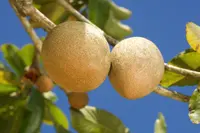
Thin young fruits so they are spaced 15–20 cm apart on each branch to reduce branch breakage, improve individual fruit size, and maintain more regular yearly cropping.

Wind and branch support

In windy sites, install sturdy stakes for young trees and use padded ties to support long, fruiting branches that tend to bend or crack under the weight of maturing fruit.

Mulch for root stability

Maintain a 5–8 cm layer of coarse organic mulch in a wide ring beyond the drip line to keep surface roots cool, reduce soil compaction, and protect fine feeder roots that are important for nutrient uptake.

Seasonal pest monitoring

From spring through harvest, inspect new flushes and developing fruit every 1–2 weeks for scale, mites, and borers, and use horticultural oil or other labeled treatments early, before infestations spread, as part of caring for mammee sapote in warm climates.

Common Pests and Diseases

Fruit borers

This pest targets developing fruits, where larvae tunnel inside, causing internal damage, premature fruit drop, and rotten patches around entry holes.

Solution

Collect and destroy infested or fallen fruits, prune to keep the canopy airy, and use fine mesh bags or sleeves over young fruits where practical; in outdoor orchards, pheromone or light traps and releases of beneficial wasps can help reduce borer populations as part of integrated pest management.

Scale insects

These insects attach to twigs, leaves, and fruit stalks, sucking sap and excreting honeydew that encourages sooty mold growth and can weaken the tree over time.

Solution

Wipe or gently scrub small infestations from bark and leaves, prune heavily infested twigs, and apply horticultural oil thoroughly to branches and leaf undersides during mild weather to smother nymphs and adults while monitoring regularly for re‑infestation.

Mealybugs

This pest forms white, cottony clusters in leaf axils and on tender shoots, feeding on sap and causing leaf yellowing, curling, and sticky honeydew on leaves and fruit.

Solution

Remove small colonies with a cotton swab dipped in 70% isopropyl alcohol, encourage natural predators such as lady beetles outdoors, and, for larger trees, use repeated applications of insecticidal soap or horticultural oil directed into crevices and sheltered areas where mealybugs hide.

Anthracnose

This disease causes dark, sunken lesions on young shoots, leaves, flowers, and fruits, often leading to flower blight, fruit spotting, and premature drop under warm, humid conditions.

Solution

Prune and dispose of infected twigs and mummified fruits, avoid overhead irrigation, improve canopy airflow, and, in regions where anthracnose is persistent, apply copper-based fungicides or other labeled fungicides at flushing and flowering stages according to local guidelines for growing mammee sapote.

Leaf spot complex

Symptoms include small brown to gray lesions on leaves that may expand, coalesce, and cause partial defoliation, especially during prolonged wet weather.

Solution

Rake and discard fallen leaves, space trees and thin the canopy to promote quick drying after rain, avoid wetting foliage late in the day, and, if spotting is recurrent and severe, consider preventive fungicide sprays timed to the early rainy season following local extension recommendations.

Interesting Facts

Bright carotenoid pulp

The fruit pulp is naturally deep orange to salmon-colored due to high levels of carotenoid pigments such as beta-carotene, which are the same compounds that give carrots and sweet potatoes their color.

Specialized latex system

Like many members of the Sapotaceae family, this species produces a sticky white latex in its bark and unripe fruit, a defensive trait that deters many herbivores and can seal small wounds on the tree.

Lowland tropical specialist

Pouteria sapota is naturally adapted to warm, frost-free lowland tropics and is most commonly found at elevations below about 1,000 m, where consistent heat and moisture support its growth and fruiting.

Botan icon

Did you know?

Archaeobotanical evidence shows that Pouteria sapota has been cultivated and used as a fruit tree in Mesoamerica for many centuries, making it one of the region’s long-established traditional orchard species.

FAQs about mammee sapote

Yes, this species grows reliably from fresh seed, which should be cleaned and sown soon after extraction. Germination is usually fast in warm conditions. Seed-grown trees are variable and often take several years before they start fruiting.

Grow Healthy Plants with Botan Care

Keep your plants happy and healthy with plant identification, disease detection, and easy care guidance.

Botan plant care app — identify plants on mobile

Explore More Plants