


Early vine training
Install a sturdy trellis or wire frame at planting time and gently spiral young shoots around it every 3–5 days so the plant develops a well-organized, evenly supported framework instead of a tangled mass.

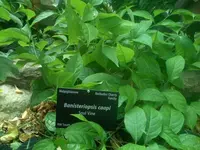
Banisteriopsis caapi is a woody tropical liana known for its long, twisting vines and smooth, brown bark. It produces small, pale flowers and can climb high into tree canopies. Native to the Amazon rainforest, it naturally grows in warm, humid, partially shaded forest edges and secondary growth. In cultivation it is typically grown as an ornamental or ethnobotanical vine where climate allows frost-free conditions. The plant prefers consistently moist, well-drained soil and support to climb. Understanding how to care for ayahuasca starts with providing stable warmth, humidity, and protection from strong, direct sun, which can make it more challenging outside true tropical or subtropical regions.

Care Difficulty
Hard Care

Light Preference
Partial Shade

Water Requirements
Keep Soil Moist

Temperature Preference
Tropical / Frost Sensitive

Hardiness Zone
11–12

Soil Texture
Loamy, Peaty, Organic-rich

Soil pH
Acidic (5.5–6.5), Slightly acidic (6.5–7.0)

Soil Drainage
Moist but well-drained

Fertilization
Light (every 4–6 weeks)
Scan your plant to receive care tips personalized for your specific plant
Available on iOS and Android
Banisteriopsis caapi is a tropical liana that needs bright, gentle light to grow dense foliage and strong vines.
Banisteriopsis caapi prefers consistently moist but not waterlogged soil, similar to a humid forest edge.
This tropical vine requires warm, frost-free conditions to maintain healthy growth and leaf cover.
This tropical vine prefers high, stable humidity to maintain healthy foliage and growth.
This vine performs best in deep, loose, organic-rich soil that drains freely yet holds steady moisture.
This species can be grown in containers if the pot supports its vigorous, climbing habit and extensive root system.
Banisteriopsis caapi responds well to modest, steady nutrition during active growth when grown for ayahuasca indoor care or in containers.
Pruning helps manage the vigorous climbing habit of Banisteriopsis caapi and keeps vines healthy and workable.
Container-grown Banisteriopsis caapi benefits from occasional repotting or transplanting to support its strong root system.
Banisteriopsis caapi is commonly propagated from semi-hardwood cuttings and sometimes from seed for new plants.
Banisteriopsis caapi is a tropical species and is not tolerant of freezing winter conditions.

Plant Health Check
Not sure what's wrong with your plant? Check your plant's health inside the app.
This woody vine is the primary source of beta-carboline alkaloids such as harmine and harmaline, which act as reversible monoamine oxidase A (MAO-A) inhibitors and are pharmacologically central to traditional ayahuasca brews.
It is a climbing liana that can reach the canopy of lowland Amazonian rainforests by twining around tree trunks, relying on host trees for structural support while investing its own energy mainly in stem growth and bark thickening.
Mature stems often develop large, rope-like, and somewhat quadrangular or knotted segments, a growth pattern that makes the vine easy to recognize and is used locally to distinguish it from similar-looking woody climbers.

Molecular phylogenetic studies have shown that this species belongs to the Malpighiaceae family, a group better known for oil-producing flowers that coevolved with specialized oil-collecting bees, meaning this culturally important liana is part of a lineage shaped by a very specific plant–pollinator relationship.
This liana is relatively fast-growing, often adding 1–3 m of vine per year in warm, humid conditions with support. Growth slows sharply in cool temperatures, low light, or when roots are confined in a small container.
Keep your plants happy and healthy with plant identification, disease detection, and easy care guidance.

 POPULAR
Philodendron melanochrysum
Philodendron melanochrysum

Philodendron 'McColley's Finale'
Philodendron 'McColley's Finale'
lesser yam
Dioscorea esculenta

Assai palm
Euterpe oleracea
Chinese Pothos
Pothos chinensis
Giant Leopard Plant
Farfugium japonicum var. giganteum
Goeppertia micans
Goeppertia micans
Split Leaf Climber
Philodendron radiatum