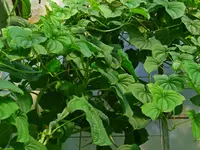
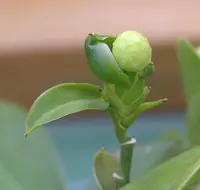
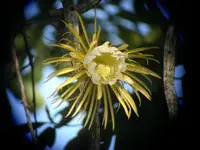
Secure Climbing Support
Install a strong trellis, fence, or wire frame before the vine gets large, then tie young stems loosely with soft garden ties so the heavy flowers and foliage are supported and do not tear in wind.

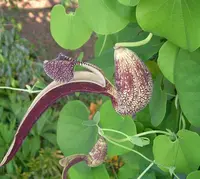
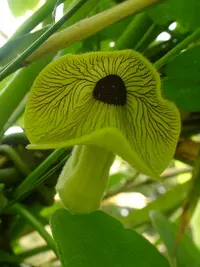
Gaping dutchman's pipe (Aristolochia ringens) is a vigorous, woody climbing vine grown mainly for its unusual, pipe-shaped flowers and lush foliage. It is typically trained on trellises, fences, or arbors where it can form a dense green screen.
The large, contorted blooms are often greenish to purple-brown and attract pollinating insects, while the leaves create a tropical look. In the wild, this species occurs in warm regions of Central and South America, favoring humid, frost-free habitats.
Its fast growth and strong twining habit make it striking but sometimes demanding to manage in small spaces. To care for gaping dutchman's pipe, provide stable warmth, bright light with some protection from harsh sun, and evenly moist, well-drained soil.

Care Difficulty
Moderate Care

Light Preference
Partial Sun

Water Requirements
Regular Water

Temperature Preference
Tropical / Frost Sensitive

Hardiness Zone
10–12

Soil Texture
Loamy, Sandy, Organic-rich

Soil pH
Acidic (5.5–6.5), Slightly acidic (6.5–7.0)

Soil Drainage
Moist but well-drained

Fertilization
Light (every 4–6 weeks)
Scan your plant to receive care tips personalized for your specific plant
Available on iOS and Android
Aristolochia ringens prefers bright, indirect light with some direct sun for strong growth.
This vine prefers consistently moist but not waterlogged soil for stable growth.
This species thrives in warm, frost-free conditions typical of tropical to subtropical climates.
This species prefers moderately humid air but usually adapts to typical home conditions.
This vine performs best in loose, organic-rich, well-draining soil that stays lightly moist.
This species is suitable for container growing when the pot supports its vigorous climbing habit.
This vigorous vine benefits from modest, steady feeding during the warm growing season to support foliage and flowering.
Pruning supports controlled growth, flowering, and vine health in Aristolochia ringens.
This twining vine is often grown in the ground but can adapt to large containers with thoughtful transplanting.
Aristolochia ringens is commonly propagated from seeds and semi-ripe stem cuttings under warm, humid conditions.
This tropical vine is frost-sensitive and needs protection in regions with cold winters.

Plant Health Check
Not sure what's wrong with your plant? Check your plant's health inside the app.
The flowers have a rigid, gaping, hook-shaped tube and inflated base that function as a temporary trap for pollinating flies, which are guided and briefly held by inward-pointing hairs before being released with pollen.
This species uses visual and scent mimicry of decaying organic matter to attract saprophagous flies, an example of deceptive pollination where the insect receives no real food reward.
Native to tropical America, this vigorous climber has been widely cultivated as an ornamental in warm climates, and in some regions it has escaped cultivation and naturalized along fences, thickets, and disturbed sites.

The unusually large and grotesque flower form of this species has led to its use as a teaching example in botany courses to illustrate extreme floral specialization for fly pollination and the evolutionary trade-offs involved in deceptive pollination systems.
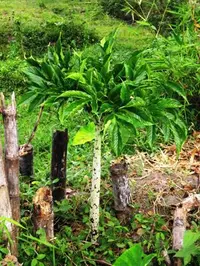
This species is a vigorous twining vine. It climbs by wrapping its flexible stems around nearby supports rather than clinging with roots. Without vertical support, it tends to sprawl horizontally and can tangle surrounding vegetation.
Keep your plants happy and healthy with plant identification, disease detection, and easy care guidance.