


Provide climbing support
Install a sturdy trellis, fence wire, or brush pile before new shoots emerge in spring so vines can attach early and develop strong, well-aerated growth.

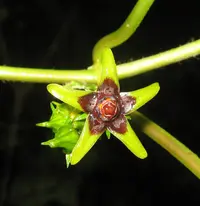
Anglepod, Gonolobus suberosus, is a twining perennial vine in the milkweed family, native to woodlands, thickets, and stream edges in eastern North America. It climbs over nearby vegetation using slender stems and opposite leaves, and produces small, greenish to brownish star-shaped flowers followed by distinctive angled seed pods.
This species favors partial sun, consistent soil moisture, and well-drained, humus-rich ground. It can be moderately challenging to grow in gardens, as it prefers naturalistic conditions and may resent heavy disturbance. Gardeners who learn how to care for Anglepod usually focus on mimicking its woodland edge habitat.

Care Difficulty
Moderate Care

Light Preference
Partial Shade

Water Requirements
Moderate Water

Temperature Preference
Warm Climate

Hardiness Zone
6–9

Soil Texture
Sandy, Loamy, Organic-rich

Soil pH
Acidic (5.5–6.5), Slightly acidic (6.5–7.0)

Soil Drainage
Moist but well-drained

Fertilization
Minimal (feed rarely)
Scan your plant to receive care tips personalized for your specific plant
Available on iOS and Android
This twining native vine prefers bright, indirect light with some direct sun for best flowering.
This vine prefers evenly moist, well-drained soil that never stays soggy for long periods.
This species grows best in warm, temperate conditions without prolonged frost or extreme heat.
This temperate vine manages well in typical outdoor humidity but benefits from moderate moisture in the air.
Gonolobus suberosus prefers loose, moderately fertile soil that drains reliably yet retains some moisture.
This species can be grown in containers if the pot allows for climbing support and stable root conditions.
This native vine generally needs minimal fertilization in garden soil with some organic matter.
Pruning Gonolobus suberosus focuses on tidying the vine and managing its spread rather than strict shaping.
This species is usually grown in the ground, so care focuses on transplanting young vines rather than frequent repotting.
Propagation of Gonolobus suberosus is most reliable from seed under controlled conditions.
This hardy native vine usually needs little special winter care in its normal outdoor range.

Plant Health Check
Not sure what's wrong with your plant? Check your plant's health inside the app.
This species develops thick, corky seed pods with prominent angles, which help protect the developing seeds and give rise to the common name anglepod.
The vines climb using slender, twining stems that weave through and hook around nearby vegetation, allowing the plant to scramble over shrubs and small trees rather than producing strong, woody supports of its own.
This species belongs to Apocynaceae, the dogbane and milkweed family, and like many relatives it produces a white latex sap that discourages many generalist herbivores from feeding on its leaves and stems.

The flowers of this species are adapted for specialized insect pollination, with a complex floral structure that guides visiting insects into contact with the reproductive parts, improving the precision of pollen transfer in its native woodland and thicket habitats.
This species is a twining vine that climbs by wrapping its flexible stems around nearby plants, fences, or other supports. Without something to climb, it sprawls along the ground and can tangle through surrounding vegetation.
Keep your plants happy and healthy with plant identification, disease detection, and easy care guidance.

 POPULAR
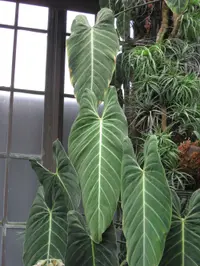
Philodendron melanochrysum
Philodendron melanochrysum
 POPULAR
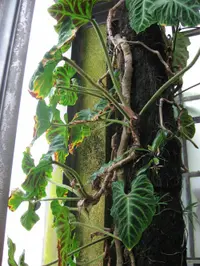
Philodendron verrucosum
Philodendron verrucosum
Split Leaf Climber
Philodendron radiatum

lesser yam
Dioscorea esculenta
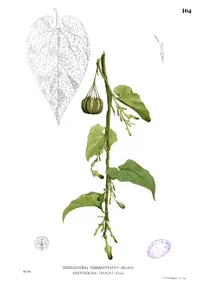
Indian Birthwort
Aristolochia acuminata
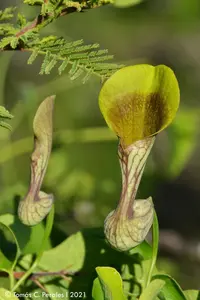
Aristolochia argentina
Aristolochia argentina
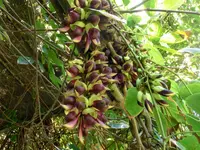
long-fruited mucuna
Mucuna macrocarpa

Philodendron pastazanum
Philodendron pastazanum