Staggered Succession Sowing
Sow small patches every 2–3 weeks from late spring to mid-summer so flowering continues longer and gaps from weather damage or pests are quickly filled.

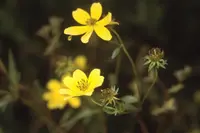
Bearded beggarticks (Bidens aristosa) is an annual wildflower in the aster family, grown mainly for its golden, daisy-like blooms. It typically forms tall, upright clumps with many branching stems and fine, divided leaves, creating a loose, meadow-style look.
This species is native to eastern and central North America, where it often grows in damp fields, roadsides, and along stream banks. It self-seeds readily, so it can spread but is usually easy to manage in gardens.
Bearded beggarticks generally prefers full sun, moist but well-drained soil, and tolerates occasional short dry periods. These traits make it relatively simple to care for bearded beggarticks in naturalistic plantings and pollinator gardens.

Care Difficulty
Easy Care

Light Preference
Full Sun

Water Requirements
Moderate Water

Temperature Preference
Warm Climate

Hardiness Zone
5–9

Soil Texture
Sandy, Loamy, Silty

Soil pH
Acidic (5.5–6.5), Slightly acidic (6.5–7.0)

Soil Drainage
Moist but well-drained

Fertilization
Minimal (feed rarely)
Scan your plant to receive care tips personalized for your specific plant
Available on iOS and Android
This sun-loving North American annual thrives in open, bright sites with long daylight exposure.
This species prefers consistently moist but well-drained soil, especially while establishing.
This warm-season annual grows best in mild to hot conditions typical of many temperate and subtropical regions.
Humidity is not a critical factor for Bidens aristosa, which thrives in typical outdoor air conditions.
Bidens aristosa grows best in moderately fertile, well-drained mineral soil.
This species can be grown in containers if the pot supports its deep, fibrous root system and upright growth.
Bidens aristosa grows well in average soil but responds to modest feeding in gardens or containers.
Pruning Bidens aristosa supports dense growth and consistent flowering.
This species is usually grown as a garden annual, so focus on transplanting rather than repotting.
For Bidens aristosa, seed propagation is the standard and most practical method.
In most climates this plant behaves as a frost-tender annual and needs minimal winter care.

Plant Health Check
Not sure what's wrong with your plant? Check your plant's health inside the app.
This species naturally occurs in moist prairies, floodplains, and ditches in eastern North America and often forms dense stands after seasonal flooding as water recedes.
Its bright yellow flowers bloom late into fall and provide nectar and pollen for many native bees, butterflies, and other insects when few other wildflowers are still in peak bloom.
The barbed, two-toothed achenes attach to animal fur or clothing but can also be moved by water, allowing the plant to spread efficiently in both terrestrial and riparian habitats.

Genetic and morphological studies place this species within a group of North American Bidens that likely diversified alongside the expansion of open, disturbance-prone habitats such as river terraces and early-successional prairies, highlighting its close evolutionary link to dynamic landscapes.
This species self-seeds heavily and can spread quickly in open, disturbed soils. Deadhead spent flowers before seeds form, and thin unwanted seedlings in spring to prevent dense colonies and maintain better species balance in garden beds or meadows.
Keep your plants happy and healthy with plant identification, disease detection, and easy care guidance.