Use host trees
Establish the fungus near compatible host trees such as oaks or other hardwoods, since this mycorrhizal species depends on tree roots for nutrition and will not fruit well in isolated substrate beds.

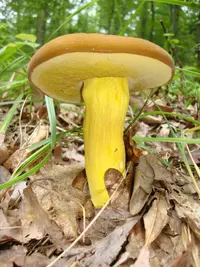
Butter-foot bolete, Boletus auripes, is a mycorrhizal mushroom, not a traditional houseplant. It forms a symbiotic relationship with tree roots, helping trees absorb water and nutrients. The fungus itself lives in the soil and the visible mushroom is its fruiting body.
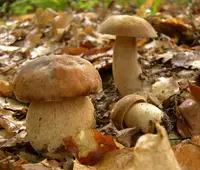
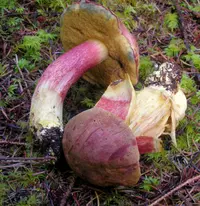
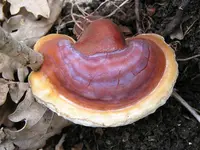
This species typically shows a yellow to golden stem with a smooth brown cap and pores instead of gills. It is naturally found in forests of eastern North America and parts of East Asia, usually near hardwoods.
For those interested in how to care for butter-foot bolete, it is important to understand that it cannot be grown like a potted plant. Successful cultivation depends on compatible host trees, undisturbed soil, and stable woodland-like moisture levels.

Care Difficulty
Hard Care

Light Preference
Partial Shade

Water Requirements
Keep Soil Moist

Temperature Preference
Cool Climate

Hardiness Zone
Unknown

Soil Texture
Loamy, Silty, Organic-rich

Soil pH
Acidic (5.5–6.5)

Soil Drainage
Moist but well-drained

Fertilization
Minimal (feed rarely)
Scan your plant to receive care tips personalized for your specific plant
Available on iOS and Android
This ectomycorrhizal fungus prefers forest conditions with dappled, shifting light.
This woodland species depends on consistently moist, not saturated, soil around its tree partners.
This species fruits best in mild, temperate conditions typical of late spring to early fall forests.
Humidity is not a key factor for Boletus auripes compared with moisture in the surrounding soil and leaf litter.
Boletus auripes depends on suitable forest-like ground rather than conventional potting soil.
This species is not suitable for container growing because it relies on living tree roots in natural ground.
Boletus auripes is a mycorrhizal fungus associated with trees, so direct fertilizing is usually unnecessary and can disturb the soil balance.
Pruning is not applicable to Boletus auripes, since it is a wild mushroom rather than a woody or leafy plant.
This fungus is rarely grown in containers; focus instead on maintaining a stable outdoor habitat for its tree partners.
Propagation of this species in gardens is complex and rarely successful for home growers, since the fungus depends on living tree roots.
Boletus auripes is naturally cold hardy in its range and needs no special winter care once established with its host trees.

Plant Health Check
Not sure what's wrong with your plant? Check your plant's health inside the app.
This species is named for its bright yellow to golden stipe, which often has a smooth, buttery appearance that contrasts with its duller brown cap.
Boletus auripes forms ectomycorrhizal partnerships with hardwood trees, especially oaks and beeches, exchanging mineral nutrients from the soil for sugars produced by the tree through photosynthesis.
This bolete has a disjunct distribution, being reliably recorded in eastern North America and parts of East Asia, which suggests a long evolutionary history linked to similar hardwood forest types on both continents.

Unlike many boletes that show dramatic blue staining when bruised, the flesh and pores of Boletus auripes typically remain unchanged or only faintly discolor, which makes it a useful reference species when comparing similar yellow-stemmed boletes in the field.
This species is considered an edible wild mushroom in many guides, with a mild flavor and firm texture. Accurate identification is critical, as some boletes can cause stomach upset or be confused with toxic lookalikes.
Keep your plants happy and healthy with plant identification, disease detection, and easy care guidance.