Substrate depth control
Keep the organic substrate layer shallow (2–4 cm) over the main soil so the puffballs can form close to the surface and release spores effectively instead of being buried too deep.

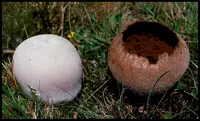
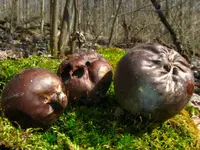
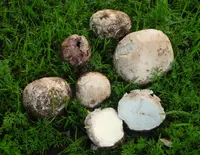
The mosaic puffball, Bovistella utriformis, is a saprobic fungus rather than a leafy plant. It forms rounded, cushion-like fruiting bodies that may crack into irregular patches, giving a mosaic pattern on the surface. As it matures, the interior turns into a mass of spores that are released through openings in the outer skin.
This species occurs in grasslands, open woods, and disturbed soils, often in temperate and semi-arid regions. It typically grows on the ground, sometimes in small groups. For those interested in how to care for mosaic puffball, it is important to know it prefers well-drained soils, moderate moisture, and undisturbed conditions, but it is not commonly maintained as a traditional garden or indoor specimen.

Care Difficulty
Moderate Care

Light Preference
Partial Shade

Water Requirements
Moderate Water

Temperature Preference
Warm Climate

Hardiness Zone
Unknown

Soil Texture
Loamy, Sandy, Organic-rich

Soil pH
Slightly acidic (6.5–7.0)

Soil Drainage
Well-drained

Fertilization
Minimal (feed rarely)
Scan your plant to receive care tips personalized for your specific plant
Available on iOS and Android
This terrestrial fungus prefers open, lightly shaded sites similar to short grassland or disturbed ground.
This ground-dwelling species depends on naturally moist but not waterlogged soil conditions.
This species develops best in mild, temperate conditions typical of late summer to autumn.
Humidity plays little role in the health of this dry-adapted puffball fungus.
This puffball develops best in loose, free-draining, relatively poor soil that mimics open grassland or sandy pasture conditions.
This species is generally unsuitable for long-term container growing and is best observed in natural or semi-natural ground habitats.
Bovistella utriformis is a saprobic fungus that normally gains all needed nutrients from decaying organic matter and does not require added fertilizer in garden or container culture.
Pruning is not a standard practice for Bovistella utriformis, since the visible structure is a short-lived fruiting body rather than a woody or leafy plant.
Transplanting mosaic puffball is rarely necessary or practical, as the main organism lives hidden in soil or organic debris rather than in a typical rootball.
Reproducing Bovistella utriformis for home culture is uncommon and technically challenging, since it relies on spore dispersal and specific soil conditions.
Bovistella utriformis is generally cold hardy in temperate climates and needs no special winter care beyond maintaining its natural habitat.

Plant Health Check
Not sure what's wrong with your plant? Check your plant's health inside the app.
The mature fruit body develops a distinctive cracked outer skin that breaks into irregular, pale polygonal patches, creating the mosaic pattern that gives this puffball its common name.
As it ages, the inside transforms into a large, hollow chamber filled with olive-brown spores, which are released through wide tears in the peridium rather than a single pore, unlike many smaller puffballs.
This species is most often found in open grasslands, lawns, and pastures on well-drained, often calcareous soils, where it fruits on the ground rather than on wood or forest litter.

Large specimens of this puffball can reach sizes comparable to a small football, making them among the more conspicuous grassland gasteroid fungi in regions where they occur.
Young specimens of this species are considered edible by some foragers when the interior flesh is uniformly white and firm. Once the inside turns yellow, olive, or powdery, it should not be eaten.
Keep your plants happy and healthy with plant identification, disease detection, and easy care guidance.