Spore-friendly harvest
Cut mature caps cleanly at the base and leave at least a few older, undamaged specimens in place so their pores can release spores and support future populations when growing Boletus subluridellus.

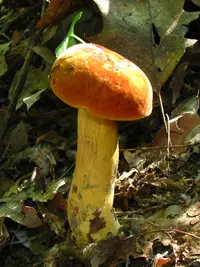
Boletus subluridellus is a fleshy, mycorrhizal mushroom, not a leafy houseplant. It forms a thick, often reddish-brown cap with a yellowish pore surface and stout stem. In nature it grows on the ground in mixed hardwood forests, especially with oaks, in parts of North America. The species relies on close partnership with tree roots, so it is not practical to cultivate indoors or in regular garden beds. For those studying how to care for Boletus subluridellus, it is mainly about preserving suitable woodland habitat with moist, well-drained, undisturbed soil.

Care Difficulty
Moderate Care

Light Preference
Partial Shade

Water Requirements
Moderate Water

Temperature Preference
Cool Climate

Hardiness Zone
Unknown

Soil Texture
Loamy, Silty, Organic-rich

Soil pH
Acidic (5.5–6.5)

Soil Drainage
Moist but well-drained

Fertilization
Minimal (feed rarely)
Scan your plant to receive care tips personalized for your specific plant
Available on iOS and Android
This ectomycorrhizal bolete develops best in dappled forest light rather than direct open-sun exposure.
This woodland fungus depends on stable, moderately moist but never waterlogged soil conditions around its host trees.
This species fruits in temperate climates where soil and air temperatures stay cool to mild for extended periods.
Humidity control is not a meaningful factor for Boletus subluridellus, which forms outdoor mycorrhizal mushrooms tied to natural soil moisture rather than air humidity.
This ectomycorrhizal fungus depends on suitable forest ground conditions rather than conventional potting soil.
This species is not suitable for container growing, as it relies on complex mycorrhizal associations with tree roots in undisturbed soil.
This ectomycorrhizal fungus relies on its tree partners for nutrients, so Boletus subluridellus needs no direct fertilization.
As a wild, mycorrhizal mushroom, Boletus subluridellus is not pruned in the usual horticultural sense.
This species grows in symbiosis with trees in soil, so transplanting focuses on preserving the forest-like setting rather than moving the fungus itself.
Reproducing this bolete is complex, since it depends on a specific ectomycorrhizal relationship with host tree roots and is not treated like a standard garden plant.
Boletus subluridellus is naturally cold hardy as a forest-dwelling fungus and requires no dedicated winter care from gardeners.

Plant Health Check
Not sure what's wrong with your plant? Check your plant's health inside the app.
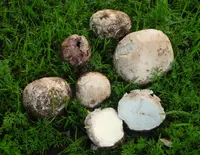
Mature fruiting bodies typically show a red to orange-red pore surface that can age to yellow-olive, a feature that helps distinguish this species from many other red-pored boletes.
When the flesh or pore surface is bruised or cut, it often shows a rapid blue staining reaction due to oxidation of specific pigment compounds, an important diagnostic character for this species.
This ectomycorrhizal fungus forms mutualistic root partnerships primarily with oak species in eastern North America, exchanging mineral nutrients and water for sugars produced by the tree.

This species is considered toxic and has been associated with gastrointestinal upset in humans, so it is not recommended for consumption even though it may resemble some edible red-pored boletes.
This bolete is generally considered inedible or at least not recommended. Identification is difficult, and confusing it with toxic red-pored boletes is easy. For safety, foragers should avoid consumption and focus on observation rather than harvest.
Keep your plants happy and healthy with plant identification, disease detection, and easy care guidance.