Site hygiene
Remove and discard old caps and stem bases promptly after spore release so slugs and fungal gnats are less attracted to the patch and disease pressure stays lower for future fruiting.

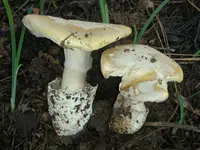
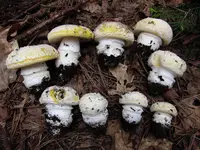
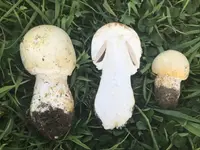
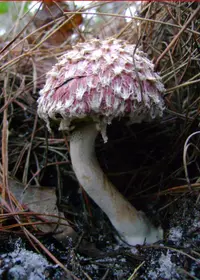
Spring coccora (Amanita vernicoccora) is a mycorrhizal mushroom that forms a symbiotic relationship with tree roots rather than growing as a typical potted plant. It produces pale yellow to cream caps with a smooth surface and a distinct white stem, often emerging in small groups on the forest floor. Native to western North America, it is usually found in oak and mixed conifer woodlands during spring. This fungus is highly specialized, relying on specific tree partners and undisturbed soil, which makes it difficult or impractical to cultivate at home. For this reason, guides on how to care for Spring Coccora focus more on habitat understanding than on active cultivation.

Care Difficulty
Hard Care

Light Preference
Partial Shade

Water Requirements
Keep Soil Moist

Temperature Preference
Cool Climate

Hardiness Zone
Unknown

Soil Texture
Loamy, Silty, Organic-rich

Soil pH
Acidic (5.5–6.5), Slightly acidic (6.5–7.0)

Soil Drainage
Moist but well-drained

Fertilization
Minimal (feed rarely)
Scan your plant to receive care tips personalized for your specific plant
Available on iOS and Android
This fungus relies on dappled woodland light rather than full open sun exposure.
Amanita vernicoccora depends on consistently moist, not saturated, woodland soil.
This woodland species develops best in mild, cool to moderately warm conditions.
Humidity is not a primary cultivation factor for this mycorrhizal fungus and is best managed by overall site moisture rather than air humidity.
This ectomycorrhizal fungus depends on specific host trees and natural forest soil rather than prepared potting mixes.
This species is not realistically suitable for container growing because it relies on complex mycorrhizal relationships with host tree roots.
This native ectomycorrhizal fungus does not require fertilization and usually performs best in unfertilized, natural woodland soils.
Amanita vernicoccora is not pruned, as it is a wild ectomycorrhizal mushroom rather than a conventional garden plant.
Transplanting this ectomycorrhizal fungus is not practical because it depends on a stable symbiosis with the roots of host trees.
Propagation of this species is highly specialized and is not feasible for typical home growers, since it relies on complex mycorrhizal relationships with suitable trees.
This woodland mushroom is adapted to its native climate and does not need targeted winter care in natural or semi-natural settings.

Plant Health Check
Not sure what's wrong with your plant? Check your plant's health inside the app.
This species occurs primarily in California and is strongly associated with native oaks such as Quercus garryana and Quercus kelloggii, forming ectomycorrhizal partnerships with their roots that improve water and nutrient uptake for the trees.
It is one of the earliest amanitas to appear each year in its range, often fruiting from late winter to early spring when soil temperatures are still relatively low, which makes it easier to distinguish from many summer and autumn amanitas.
Mature specimens typically show a yellow to yellow-orange, somewhat varnished-looking cap with white to pale veil remnants, a combination of traits used by field mycologists to separate it from similar toxic yellow amanitas in western North America.

Mycologists consider this species part of a small western North American complex of yellow, oak-associated amanitas, and careful microscopic study of spores and tissues has been important in defining its taxonomic boundaries relative to closely related, sometimes confused species.
This mushroom is considered edible only at a very specific, correctly identified stage, and it closely resembles deadly Amanita species. Due to high misidentification risk, foragers are strongly advised not to consume it at all.
Keep your plants happy and healthy with plant identification, disease detection, and easy care guidance.