Establish deep roots
During the first 2–3 years, apply water slowly but deeply in a wide ring around the young palm to encourage a broad, deep root system that stabilizes this large species against wind as it matures.

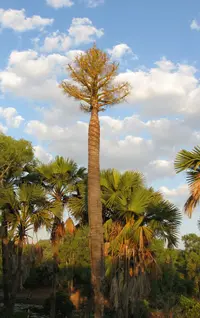
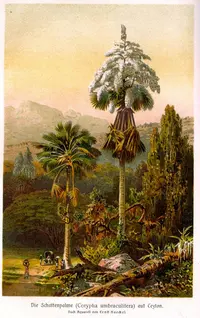
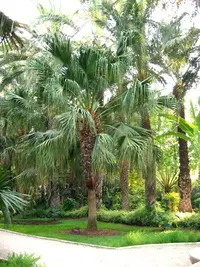
The gebang palm, Corypha utan, is a massive, single-trunk fan palm native to tropical Asia and northern Australia. It typically grows in open lowland forests, coastal areas, and seasonally dry habitats. The plant forms a huge crown of stiff, fan-shaped leaves and develops a very thick trunk, so it is not suited to small gardens or long-term indoor culture. This palm is slow to mature and flowers only once, then dies after setting seeds. Its need for strong sun, warmth, and space makes it challenging for beginners, but understanding how to care for gebang palm helps improve long-term success in suitable climates.

Care Difficulty
Hard Care

Light Preference
Full Sun

Water Requirements
Regular Water

Temperature Preference
Tropical / Frost Sensitive

Hardiness Zone
11–12

Soil Texture
Sandy, Loamy, Organic-rich

Soil pH
Slightly acidic (6.5–7.0), Neutral (7.0)

Soil Drainage
Moist but well-drained

Fertilization
Minimal (feed rarely)
Scan your plant to receive care tips personalized for your specific plant
Available on iOS and Android
This large tropical palm needs intense, consistent sun to build strong trunks and leaves.
This palm prefers steadily moist but not waterlogged soil, especially during active growth.
This species thrives in consistently warm, tropical to subtropical conditions with no frost exposure.
This species tolerates a wide humidity range but benefits from moderately humid air when young.
Corypha utan prefers deep, well-drained mineral soil that still holds some moisture.
This large, eventually massive palm is only suitable for container growing during its juvenile stage.
Corypha utan is a slow-growing palm that benefits from light, steady feeding rather than heavy fertilization.
Corypha utan needs minimal pruning focused on safety, cleanliness, and maintaining a healthy canopy.
This large palm is usually grown in the ground, so transplanting young Corypha utan plants is more common than long-term container repotting.
Corypha utan is propagated almost exclusively from seed, and the process is slow and specialized.
This tropical palm has low frost tolerance and needs thoughtful winter care in climates with cool or cold seasons.

Plant Health Check
Not sure what's wrong with your plant? Check your plant's health inside the app.
Corypha utan is a monocarpic palm, meaning it flowers only once at the end of its life, then the entire plant dies after setting seed.
At maturity, this species produces one of the largest known inflorescences among flowering plants, forming a huge branched flower structure that can bear thousands of small blossoms.
In parts of South and Southeast Asia, its large, tough leaves and strong leaf ribs are traditionally used for thatching, weaving, and making durable everyday items such as mats and baskets.

Historically, the large, fan-shaped leaves of Corypha utan were used in South and Southeast Asia as an early writing material known as palm leaf manuscripts, which preserved religious, legal, and literary texts for centuries in durable, hand-inscribed form.
This species is monocarpic, so it flowers only once at the end of its life cycle, often after several decades. A plant that has not reached full trunk maturity will not produce its massive inflorescence.
Keep your plants happy and healthy with plant identification, disease detection, and easy care guidance.