Sturdy spine support
Install a strong central stake or tomato cage early, as the plant becomes top-heavy with large leaves and fruit, and loosely tie the main stem with soft ties to prevent wind damage and stem splitting.

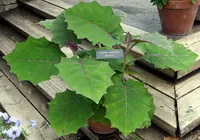
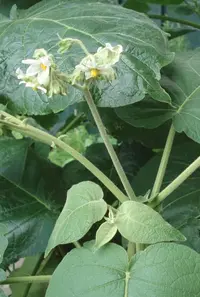
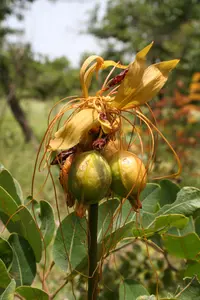
Naranjilla, Solanum quitoense, is a subtropical shrub grown for its striking foliage and tangy, orange, tomato-like fruits. It usually forms a bushy plant with large, soft leaves that may have purple veins and small spines on stems and leaf veins.
In the wild, it comes from the cool, humid highlands of Colombia, Ecuador, and nearby Andean regions. It prefers bright light without harsh midday sun, evenly moist soil, and good drainage.
Its need for consistent warmth, humidity, and protection from strong wind makes it a bit challenging outside suitable climates. For those willing to care for naranjilla, it can be an unusual and rewarding fruiting plant.

Care Difficulty
Hard Care

Light Preference
Partial Sun

Water Requirements
Keep Soil Moist

Temperature Preference
Tropical / Frost Sensitive

Hardiness Zone
10–12

Soil Texture
Loamy, Silty, Organic-rich

Soil pH
Acidic (5.5–6.5)

Soil Drainage
Moist but well-drained

Fertilization
Moderate (every 2–4 weeks)
Scan your plant to receive care tips personalized for your specific plant
Available on iOS and Android
Solanum quitoense needs bright, gentle light to grow large, healthy leaves and fruit.
This species prefers evenly moist soil but reacts poorly to both drought and prolonged saturation.
This plant thrives in warm, frost-free conditions similar to a mild tropical highland climate.
This species benefits from fairly high humidity, especially in warm conditions.
Solanum quitoense prefers moist, well-aerated, organic-rich soil that drains freely but never dries out completely.
This species adapts well to container growing when given enough root space and stable support.
Solanum quitoense is a fast-growing, nutrient-hungry shrub that responds well to consistent but moderate feeding.
Pruning Solanum quitoense helps manage size, improve structure, and maintain healthy, productive growth.
This species grows quickly and often outgrows its container or initial planting spot within a short period.
Solanum quitoense is commonly propagated from both seeds and stem cuttings under warm, bright conditions.
This tropical shrub is highly sensitive to frost and requires active winter management in most temperate climates.

Plant Health Check
Not sure what's wrong with your plant? Check your plant's health inside the app.
Although it develops a woody base, this species is botanically a large, short-lived herb with conspicuous spines on stems, petioles, and even leaf veins, which help protect it from herbivores in its native Andean range.
Young leaves often have a dense covering of fine hairs that give them a velvety texture and can show striking purple coloration, especially on the undersides and along the veins.
The orange fruit has a seedy, green interior pulp with a complex, acidic flavor often compared to a mix of pineapple, passion fruit, and citrus, and is widely used for fresh juices in Colombia and Ecuador when growing naranjilla at scale.

In traditional Andean agroforestry systems, this species is sometimes cultivated under partial shade alongside larger crops such as plantains or timber trees, where it benefits from moderated temperatures while contributing economically important fruit to smallholder farms.
Lack of flowering usually comes from stress: insufficient plant maturity, nutrient imbalance with too much nitrogen, temperature fluctuations, or root restriction. Check fertilization balance, pot size, and protect from chill to support reliable bud and fruit formation.
Keep your plants happy and healthy with plant identification, disease detection, and easy care guidance.