lychee Care (Litchi chinensis)

lychee

About lychee

Lychee, Litchi chinensis, is an evergreen fruit tree in the soapberry family, valued for its sweet, aromatic clusters of red, bumpy-skinned fruit. It typically has a rounded crown with dense, glossy, narrow leaves and can become a medium to large tree in suitable climates.

This species is native to southern China and parts of Southeast Asia, where it grows in warm, humid, frost-free areas. It can be challenging outside subtropical and tropical regions, as it dislikes cold, dry air, and poor drainage.

Lychee prefers bright light, evenly moist but not waterlogged soil, and protection from strong, drying winds. Understanding these needs is key to successful care for lychee.

Main Plant Requirements

Care Difficulty

Hard Care

Light Preference

Full Sun

Water Requirements

Regular Water

Temperature Preference

Tropical / Frost Sensitive

Hardiness Zone

10–11

Soil Texture

Sandy, Loamy, Organic-rich

Soil pH

Strongly acidic (4.5–5.5), Acidic (5.5–6.5)

Soil Drainage

Moist but well-drained

Fertilization

Moderate (every 2–4 weeks)

Get Personalized Care Plan

Scan your plant to receive care tips personalized for your specific plant

Available on iOS and Android

How to Care for the lychee

This subtropical fruit tree needs abundant light for strong growth and flowering.

  • Provide 6–8 hours of direct sun daily, with morning sun preferred and some protection from harsh late afternoon exposure in very hot regions.
  • Young trees benefit from 30–40% filtered shade cloth in their first 1–2 years to reduce leaf scorch, then can transition to full sun as they establish.
  • In cloudy or higher-latitude areas, plant lychee in the brightest, south-facing spot to avoid leggy growth and poor fruiting due to low light.

This species requires consistent moisture but reacts poorly to saturated soil.

  • Irrigate when the top 3–5 cm of soil feels dry, aiming for evenly moist soil that never becomes waterlogged, especially on young or newly planted trees.
  • Use deep, infrequent watering so moisture reaches 20–30 cm deep, then allow the surface to dry slightly; well-drained, loamy soil helps prevent root rot in Litchi chinensis.
  • Reduce frequency in cool or rainy seasons, and watch for yellowing, soft leaves as a sign of overwatering or dry, crisp leaf edges as a sign of underwatering.

This tree performs best in warm, frost-free climates with mild seasonal variation.

  • Ideal growing temperatures are 70–86°F (21–30°C), with stable warmth promoting good shoot and flower development.
  • The tree is sensitive to cold and should be protected if temperatures approach 32°F (0°C); young plants can be damaged even at 34–36°F (1–2°C).
  • Mature trees tolerate short heat spikes up to about 100°F (38°C) if soil moisture is maintained, but prolonged extreme heat can cause leaf scorch and fruit drop, especially with dry winds.

This species prefers consistently humid air for healthy foliage and flowering.

  • Aim for 50–70% humidity; use a hygrometer to confirm levels near the canopy.
  • In dry air, leaf tips may brown, curl, or drop prematurely, signaling humidity stress.
  • Raise humidity with grouped plants, a nearby humidifier, or a pebble tray that keeps the lychee pot above, not sitting in, water.

This tree needs deep, moisture-retentive yet free-draining soil to support strong root development.

  • Use a loamy mix with 40–50% organic matter such as compost plus 20–30% coarse sand and 10–20% perlite for structure and drainage.
  • Maintain slightly acidic soil, ideally pH 5.5–6.5, since alkaline conditions reduce nutrient availability and weaken growth in Litchi chinensis.
  • Ensure water drains within a few minutes after irrigation; standing water signals compaction and needs more coarse sand or perlite mixed in.
  • Avoid heavy clay, salty soils, or mixes dominated by fine peat that stay waterlogged, limit aeration, and promote root diseases.

This species can be grown in containers when kept as a small tree or juvenile specimen.

  • Choose a tall, heavy pot to balance the eventually top-heavy canopy and reduce tipping in wind.
  • Select a container material that matches climate; porous clay suits humid regions, while thick plastic reduces moisture loss in hot, dry sites.
  • Leave a 3–5 cm gap between soil surface and rim to allow thorough watering without overflow and to help flush excess salts.

This subtropical fruit tree benefits from moderate, targeted feeding during active growth.

  • Use a balanced granular or slow-release fertilizer (for example 8-8-8 or 10-10-10) or well-rotted compost around the drip line.
  • Feed outdoor lychee trees every 6–8 weeks in spring and summer, avoiding late-season applications that stimulate tender growth.
  • Apply at half the label rate for young trees; mature trees can take the full recommended dose if soil tests support it.
  • Reduce or stop fertilizing during fall and winter when growth slows, especially in cooler regions or for container plants.

Pruning Litchi chinensis aims to maintain a strong framework and light-filled canopy for healthy flowering and fruiting.

  • Carry out structural pruning in late winter or very early spring before active growth resumes.
  • Remove dead, diseased, crossing, or inward-growing branches first, using clean, sharp bypass pruners or a pruning saw.
  • Shorten excessively long or top-heavy shoots to keep the canopy 3–4 main tiers high and easier to harvest.
  • Thin dense interior growth to improve light penetration and air flow, limiting cuts to smaller branches to reduce stress.

Gardeners usually focus on transplanting this tree outdoors rather than frequent container repotting.

  • Transplant in late spring after frost risk, when soil is warm and roots are actively growing.
  • Look for signs such as roots circling the pot, water running off quickly, or slowed growth in container-grown plants.
  • Move to a container or planting hole only 1–2 sizes larger, keeping the root ball intact and teasing only the outer circling roots.
  • Water thoroughly after planting, provide light shade for 1–2 weeks, and maintain even moisture to limit transplant shock.

Litchi chinensis is most reliably propagated by air layering and grafting, while seed-grown plants are slower and variable.

  • Perform air layering in late spring to early summer on pencil-thick, healthy shoots, using moist sphagnum moss and wrapping with plastic.
  • Allow roots to develop fully inside the moss over several months before cutting and potting the new plant.
  • Sow fresh seeds in warm, well-drained mix at 75–85°F, keeping consistently moist but not waterlogged for best germination.
  • Provide bright, indirect light and high humidity for young plants, avoiding strong sun and drought during establishment.

This subtropical tree is sensitive to freezing temperatures and needs thoughtful winter care in cooler climates.

  • In-ground trees tolerate only brief exposure near 28–30°F; young plants are more vulnerable than established specimens.
  • Apply a 5–10 cm layer of organic mulch around the root zone, keeping it slightly away from the trunk to reduce rot risk.
  • Wrap young trunks and main branches with breathable frost cloth during freezing nights to limit tissue damage.
  • Move container plants indoors or into a bright, frost-free greenhouse, reducing watering while keeping the root ball slightly moist.

Care Tips

Rootzone mulching

Apply a 5–8 cm layer of coarse organic mulch around the dripline, keeping it 5–10 cm away from the trunk, to stabilize soil moisture and temperature and reduce weed competition without risking trunk rot.

Wind and branch support

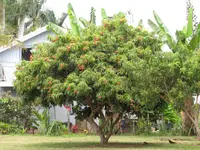
Install sturdy stakes or a simple windbreak for young trees and loosely tie main stems with soft ties so branches do not snap under wind or fruit load as the canopy develops.

Flower and fruit thinning

On heavily blooming trees, remove a portion of flower panicles or small developing fruit by hand so the remaining fruit size and quality improve and the tree is less stressed in the following season.

Controlled canopy shaping

After harvest, selectively shorten long, upright shoots to outward-facing buds to create an open, tiered canopy that allows better light penetration and air movement through the interior of the tree.

Ant and scale management

Regularly check new growth and panicles for scale insects and use ant barriers on the trunk if ants are present, because controlling ants improves biological control of scale and mealybugs when growing lychee.

Common Pests and Diseases

Lychee erinose mite

This pest causes abnormal, felt-like hairy growths and blistered patches (erinea) on the undersides of leaves, which can spread to young shoots and inflorescences. Symptoms include distorted new growth and reduced vigor in severe infestations.

Solution

Prune and destroy heavily deformed leaves and twigs, then spray the remaining foliage thoroughly with a sulfur-based miticide or horticultural oil, repeating according to label directions. Avoid moving infested plant material or tools between trees, and monitor new flushes of growth closely as part of ongoing Litchi chinensis care.

Lychee stink bug

This pest feeds on developing flower clusters and young fruit, causing flower drop, misshapen fruit, and premature fruit fall. These insects also excrete foul-smelling droplets that can attract ants and secondary pests.

Solution

Handpick and remove visible bugs and egg masses, and prune dense inner canopy sections to improve visibility and reduce shelter sites. Use targeted contact sprays such as insecticidal soap or pyrethrin on clusters during bug activity, avoiding open bloom when possible to protect pollinators.

Fruit borer

This pest is caused by moth larvae that bore into young lychee fruit, leaving small entry holes, frass (sawdust-like droppings), and internal decay. Symptoms include premature fruit drop and low-quality remaining fruit.

Solution

Remove and destroy infested or dropped fruit promptly to break the life cycle, and use fine mesh bags over developing fruit clusters to prevent egg-laying. Where needed, apply a biological insecticide containing Bacillus thuringiensis (Bt) to young fruit according to label directions, focusing on early larval stages.

Anthracnose

This disease produces dark, sunken spots on leaves, twigs, flowers, and fruit, often with a yellow halo and irregular margins. Symptoms include dieback of tender shoots, blossom blight, and fruit blemishes, especially in warm, humid weather.

Solution

Prune out infected twigs and remove fallen leaves and fruit to reduce fungal spores, then improve airflow by thinning crowded branches. During wet periods, protect young shoots and flower panicles with a preventive fungicide labeled for anthracnose, and avoid overhead watering that keeps foliage wet for long periods.

Algal leaf spot

This disease forms circular, raised, green to reddish-brown patches on leaves and sometimes twigs, which may coalesce and cause leaf yellowing or early drop. Symptoms include rough, scaly lesions that feel corky or slightly raised to the touch.

Solution

Prune and discard heavily affected leaves and small twigs, and increase light penetration and air movement by thinning dense canopy areas. In humid climates, copper-based fungicides applied to new flushes and during wet seasons can help suppress new infections, combined with avoiding overhead irrigation when possible.

Interesting Facts

Ancient Chinese cultivation

Archaeological and historical records show that lychee has been cultivated in southern China for more than 2,000 years, with detailed descriptions in Han dynasty texts that mention its flavor and difficulty of transport.

Heat-triggered sweetness

The aril, which is the edible white flesh, accumulates sugars best under warm day temperatures and relatively cool, dry winters, which is why consistent subtropical seasonal patterns are important for high-quality fruit.

One-seeded berry fruit

Lychee fruits are botanically classified as one-seeded berries with a leathery, warty pericarp that turns red at maturity, and the seed inside produces toxic compounds, so only the fleshy aril is eaten.

Botan icon

Did you know?

In imperial China, fresh lychees were so prized at court that special fast courier systems were organized to transport fruit from Guangdong and Fujian to the capital before it spoiled, making lychee one of the earliest documented luxury perishable crops in long-distance trade.

FAQs about lychee

Container culture is possible but challenging long term. Use a large, deep pot, excellent drainage, and regular root pruning. Dwarf cultivars adapt better. Expect slower growth and reduced fruiting compared with trees planted in open ground.

Grow Healthy Plants with Botan Care

Keep your plants happy and healthy with plant identification, disease detection, and easy care guidance.

Botan plant care app — identify plants on mobile

Explore More Plants