Select Host Trees
Target recently dead or very weak conifers such as spruce, fir, or hemlock with intact bark, since this fungus colonizes heartwood best in stressed or freshly killed hosts rather than long-rotten logs.

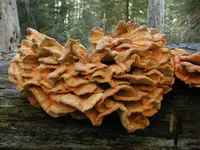
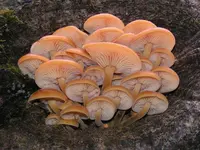
Conifer chicken of the woods, Laetiporus conifericola, is a wood-decay fungus rather than a traditional leafy plant. It forms overlapping, bright orange to yellow shelves on dead or living conifer trunks and stumps. The fruiting bodies are thick, fleshy, and usually appear in large clusters.
This species occurs mainly in western North America, especially in forests dominated by conifers such as Douglas fir and spruce. It plays an important ecological role by decomposing wood.
For those who want to care for Conifer Chicken of the Woods in cultivation, it is generally grown on suitable conifer logs or supplemented sawdust, with stable moisture and indirect light. It is considered moderately challenging for beginners because it requires clean conditions and the right wood substrate.

Care Difficulty
Hard Care

Light Preference
Partial Shade

Water Requirements
Keep Soil Moist

Temperature Preference
Cool Climate

Hardiness Zone
6–9

Soil Texture
Loamy, Organic-rich

Soil pH
Strongly acidic (4.5–5.5), Acidic (5.5–6.5)

Soil Drainage
Moist but well-drained

Fertilization
Minimal (feed rarely)
Scan your plant to receive care tips personalized for your specific plant
Available on iOS and Android
This wood-decay fungus prefers bright forest-edge conditions rather than dense, deep shade.
This fungus depends on host wood moisture rather than direct soil watering, so hydration focuses on site conditions.
This species fruits best in cool to mild outdoor conditions typical of temperate conifer forests.
Humidity plays a minor role for Laetiporus conifericola, which primarily relies on overall substrate moisture and outdoor climate.
This wood-decay fungus does not grow in conventional potting soil but in or on conifer wood with specific structural and moisture conditions.
This species is not naturally suited to decorative container growing and is usually cultivated on logs or stumps rather than in pots.
This wood-decay fungus grows on nutrient-rich conifer wood and normally does not require additional fertilizer.
Laetiporus conifericola does not need true pruning, but fruiting bodies can be managed for safety, tree health assessment, or harvest.
This species naturally colonizes living or dead conifer wood and is not suited to traditional container culture or routine transplanting.
Propagation of Laetiporus conifericola is typically done by spores or plug spawn in specialized cultivation, not by casual home methods.
Established mycelium in intact conifer logs tolerates typical outdoor winter conditions in most temperate climates and needs minimal care.

Plant Health Check
Not sure what's wrong with your plant? Check your plant's health inside the app.
This species is restricted to conifers such as Douglas-fir and other needle-leaved trees, unlike many related chicken of the woods that prefer hardwoods. Its host preference helped mycologists separate it from the similar-looking Laetiporus gilbertsonii and Laetiporus sulphureus.
It causes a brown rot, breaking down cellulose and hemicellulose in conifer wood while leaving modified lignin behind. This process produces dry, cubical cracking in the wood and plays a major role in nutrient cycling in conifer forests of western North America.
This fungus is mainly found in the Pacific Northwest and adjacent regions, particularly along the range of Douglas-fir. Its fruiting bodies often appear in late spring through fall, reflecting the cool, moist climate of coastal and montane conifer forests.

Molecular studies using DNA sequencing led to the formal recognition of this species as distinct from other yellow Laetiporus taxa, highlighting that visually similar chicken of the woods mushrooms on different hosts can represent separate evolutionary lineages.
Young, fresh brackets are commonly eaten after thorough cooking and proper identification, as misidentification or spoiled material can cause illness. Some people experience allergic or digestive reactions, so always sample a small, well-cooked portion first.
Keep your plants happy and healthy with plant identification, disease detection, and easy care guidance.