red floripontio Care (Brugmansia sanguinea)

Also known as: Red Angel's Trumpet, Thorn Apple
red floripontio

About red floripontio

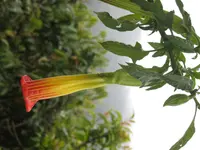
Red floripontio, Brugmansia sanguinea, is a woody shrub or small tree known for its large, pendulous trumpet-shaped flowers in red, orange, or yellow tones. It keeps its foliage year-round in mild climates and often forms a dense, branching canopy.

This species is native to cool, highland regions of the Andes in South America, where it grows in moist, sheltered spots. In gardens it is usually grown as an ornamental feature plant for its striking flowers and strong presence.

Brugmansia sanguinea can be moderately demanding, as it dislikes extreme heat, frost, and prolonged dryness. Gardeners who learn how to care for red floripontio tend to focus on stable moisture, fertile well-drained soil, and bright but not scorching sun.

Main Plant Requirements

Care Difficulty

Moderate Care

Light Preference

Full Sun

Water Requirements

Regular Water

Temperature Preference

Tropical / Frost Sensitive

Hardiness Zone

9–11

Soil Texture

Loamy, Organic-rich

Soil pH

Acidic (5.5–6.5), Slightly acidic (6.5–7.0)

Soil Drainage

Moist but well-drained

Fertilization

Moderate (every 2–4 weeks)

Get Personalized Care Plan

Scan your plant to receive care tips personalized for your specific plant

Available on iOS and Android

How to Care for the red floripontio

This species prefers bright exposure with some protection from intense midday sun, especially in hot climates.

  • Provide 4–6 hours of direct morning sun with light afternoon shade or filtered light, particularly for young plants or in zones with hot summers.
  • Tolerates partial shade (2–4 hours direct sun) but flowering of red floripontio can decrease if light is too low, leading to leggy, weak growth.
  • In very strong sun, especially in late spring and summer, monitor leaves for scorch or bleaching and provide dappled shade during 11 a.m.–3 p.m. if needed.

This plant has high water demand but suffers if soil stays saturated for long periods.

  • Water when the top 3–5 cm of soil feel dry, applying a deep soak so moisture reaches the root zone, then allow excess to drain away fully.
  • In hot, active growth periods, monitor daily for drooping leaves and dry soil; in cool weather or slower growth, extend intervals and check moisture before adding water.
  • Overwatering shows as yellowing leaves and soft stems, while underwatering causes rapid wilting; grow Brugmansia sanguinea in well-draining, rich soil to reduce both risks.

This species prefers mild, frost-free conditions with cool nights and moderate daytime warmth.

  • Aim for 60–75°F (16–24°C) for steady growth and flowering, with slightly cooler nights around 50–55°F (10–13°C) improving bud set in many climates.
  • Protect from frost; foliage and young growth are damaged around 30–32°F (-1–0°C), and the plant may die back to the base if exposed to harder freezes.
  • Tolerates short periods around 80–90°F (27–32°C) if soil moisture is stable, but prolonged heat and hot dry winds can cause leaf scorch and bud drop.

This species prefers moderate humidity and reacts quickly to very dry air.

  • Aim for 50–70% humidity, which matches many sheltered outdoor patios and mild coastal climates.
  • It tolerates brief dips to 30–40%, but extended dry air causes curled leaf edges and pale, drooping foliage in red floripontio.
  • Increase humidity outdoors by grouping containers, using large saucers filled with wet gravel beneath pots, or placing it near but not in irrigation overspray.

This plant performs best in deep, moisture-retentive yet well-drained soil.

  • Use a loamy mix with high organic matter, such as 2 parts peat or coco coir, 1 part compost, and 1 part perlite or coarse sand for structure.
  • Ensure very free drainage so water runs through within seconds; roots decline in heavy clay, compacted ground, or standing water.
  • Aim for slightly acidic to neutral pH around 6.0–7.0, which supports nutrient availability and stable growth in Brugmansia sanguinea.
  • Improve aeration by raising beds, mixing in chunky bark or perlite, and breaking up any dense subsoil before planting.

This species is well suited to container growing when the pot supports its fast, woody growth and heavy canopy.

  • Choose a large, deep container to allow an extensive root system that can support frequent flowering and prevent rapid drying between waterings.
  • Use a heavy, wide-based pot or add bricks at the bottom layer to keep the tall, top-heavy plant stable in wind.
  • Select thicker-walled terracotta or composite pots in hot regions to moderate root temperatures and slow moisture loss on exposed patios.

Brugmansia sanguinea is a heavy feeder that responds well to consistent nutrition during the warm growing season.

  • Use a balanced liquid fertilizer (e.g., 10-10-10 or 20-20-20) diluted to 1/2 strength every 1–2 weeks in spring and summer.
  • Supplement with compost or a slow-release granular fertilizer at the start of the growing season for sustained nutrients when caring for red floripontio.
  • Rinse the soil with plain water once a month to reduce salt buildup from frequent feeding.
  • Reduce feeding sharply in fall and stop during winter dormancy, resuming only when vigorous new growth appears.

Thoughtful pruning keeps Brugmansia sanguinea flowering well and maintains a safe, manageable structure.

  • Carry out main pruning in late winter or very early spring before vigorous growth starts.
  • Remove dead, diseased, crossing, or inward-growing branches first, using clean, sharp bypass pruners or loppers.
  • Shorten overly long shoots to shape the canopy and keep flowering wood at a comfortable viewing height.
  • Avoid cutting all flowering-age wood; retain Y-shaped branches where trumpet flowers are produced.

Container-grown Brugmansia sanguinea benefits from periodic repotting or transplanting to support its fast growth.

  • Check for roots circling the pot, pushing out of drainage holes, or slowed top growth as signs it needs a larger container.
  • Plan repotting or transplanting for early spring, just as new growth starts, typically every 1–2 years for young, vigorous plants.
  • Move up only 1–2 pot sizes, using a free-draining, rich mix; keep the root ball at the same soil level as before.
  • Water thoroughly after moving, shade for several days, and maintain even moisture to limit transplant shock and root stress.

New Brugmansia sanguinea plants are most commonly produced from cuttings rather than seed for reliable traits and faster flowering.

  • Take semi-ripe or softwood stem cuttings in late spring or summer, 10–15 cm long with several nodes.
  • Remove lower leaves, dip the cut end in rooting hormone, and insert into a moist, free-draining medium such as perlite and peat.
  • Provide bright, indirect light, high humidity, and warmth around 70–75°F to encourage rooting.
  • For seed propagation, sow fresh seed in spring on the surface of sterile mix and keep evenly moist and warm until germination.

Winter care is important because Brugmansia sanguinea is sensitive to hard frost and prolonged freezing.

  • In regions below about 25°F, grow in containers or as a die-back shrub rather than an exposed small tree.
  • Before first frost, mulch the root zone 5–10 cm deep with leaves or bark to stabilize soil temperature.
  • Move potted plants indoors to a cool, bright area or an unheated greenhouse, keeping soil just barely moist.
  • In mild climates, light frosts may kill top growth, but plants often reshoot from protected basal stems in spring.

Care Tips

Sturdy structural support

Install a strong stake or small trellis early and secure the main stem with soft ties, adjusting them every 4–6 weeks so the plant can carry the heavy flowers without leaning or snapping in wind.

Nighttime frost protection

When late frosts are possible, move container plants to a sheltered spot or wrap the canopy and pot with frost cloth or an old sheet overnight, removing covers each morning to prevent overheating and mildew.

Targeted pest scouting

Inspect flower buds, the undersides of leaves, and tender shoot tips twice weekly for aphids, spider mites, or whiteflies, and rinse off small infestations with a firm stream of water before considering insecticidal soap.

Root-zone refresh

Every 1–2 years, slip the plant from its pot, trim away 10–20% of the outer, circling roots, and repot at the same depth in fresh mix to maintain vigour and reduce the risk of the plant becoming pot-bound.

Safe handling routine

Because all parts of this plant are poisonous, always wear gloves when pruning or repotting, avoid touching your face, and wash hands, tools, and any exposed surfaces thoroughly after caring for red floripontio.

Common Pests and Diseases

Spider mites

This pest thrives on Brugmansia foliage in warm, dry, sheltered spots and feeds by piercing leaves and sucking sap, leading to stippling and dull, dusty-looking leaves. Symptoms include fine webbing on the undersides of leaves and leaf yellowing or drop during infestations.

Solution

Rinse the plant thoroughly with a strong but controlled stream of water, focusing on leaf undersides, then repeat every few days until populations drop. In red floripontio indoor care, maintain higher humidity, isolate affected plants, and use horticultural oil or insecticidal soap directed to the leaf undersides according to label directions.

Whiteflies

These insects are often found on the tender new growth and leaf undersides, where they suck sap and weaken the plant. Symptoms include clouds of tiny white insects flying up when the plant is disturbed, sticky honeydew, and possible sooty mold on leaves below.

Solution

Remove heavily infested leaves if practical, then use yellow sticky traps to monitor and reduce adult numbers. Treat leaf undersides with insecticidal soap or horticultural oil in the early morning or evening and repeat at 5–7 day intervals until new growth appears clean.

Aphids

These insects cluster on tips, buds, and the backs of young leaves, extracting sap and distorting growth. Symptoms include curled or twisted new leaves, deformed flower buds, and shiny honeydew that can attract ants or lead to sooty mold.

Solution

Prune or pinch off heavily infested shoot tips and rinse remaining foliage with a firm stream of water to dislodge aphids. Follow up with insecticidal soap or neem oil on all soft new growth, repeating weekly as needed and managing nearby ant activity that can protect aphids.

Powdery mildew

This disease appears on Brugmansia in conditions with high humidity but relatively dry leaf surfaces, especially in dense or shaded plantings. Symptoms include white to gray powdery patches on leaves, followed by yellowing and premature leaf drop if severe.

Solution

Improve air circulation around the plant by thinning crowded stems and avoiding overhead watering in the evening. Remove the most affected leaves and apply a sulfur, potassium bicarbonate, or other labeled powdery mildew fungicide, ensuring full coverage of both leaf surfaces.

Tomato spotted wilt virus

This disease is transmitted by thrips and is a known risk on Brugmansia, causing distorted growth and variegated or ring-patterned leaf and flower discoloration. Symptoms include stunted plants, bronzed or mottled foliage, and misshapen flowers that do not develop normally.

Solution

There is no cure, so remove and destroy infected plants to prevent spread to other solanaceous plants such as tomatoes and peppers. Control thrips with sticky traps, regular inspection of new growth, and targeted use of insecticidal soap or spinosad-based products according to label instructions.

Interesting Facts

High Andean origin

This species is native to cool, high-elevation valleys of the northern Andes, where it grows in cloud forests rather than in lowland tropical habitats typical of many other brugmansias.

Cold-tolerant brugmansia

Compared with most relatives, it tolerates significantly lower night temperatures and often continues flowering in cool, misty conditions that would stress other angel’s trumpet species.

Distinctive red tubular flowers

Its pendulous flowers are narrower, more tubular, and typically red to orange-red with yellow or greenish tips, an adaptation associated with bird pollinators rather than the moth pollinators of many white-flowered brugmansias.

Botan icon

Did you know?

Historical records from Andean regions describe this plant as part of traditional ritual and shamanic practices, where its strong tropane alkaloids were used with great caution due to their powerful psychoactive and toxic effects.

FAQs about red floripontio

All parts of this species are highly toxic to people and animals if eaten, due to tropane alkaloids affecting the nervous system. Ingestion can cause serious illness. Keep plants out of reach and avoid using near children’s play areas.

Grow Healthy Plants with Botan Care

Keep your plants happy and healthy with plant identification, disease detection, and easy care guidance.

Botan plant care app — identify plants on mobile

Explore More Plants