

giant puffball Identification (Calvatia gigantea)

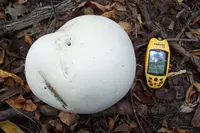
Recognize giant puffball by its single, nearly spherical fruiting body, usually 8 to 20 inches (20 to 50 cm) across, with no visible stem or cap.

The outer surface is smooth and white to off-white, and the interior, when cut, is solid white and uniform, without gills, pores, or internal chambers.

Calvatia gigantea Identification

Is This giant puffball?

Upload a clear photo to check your plant identification with Botan.

Clear images work best. Avoid photos taken too close or too far away

Check the fruiting body’s size, shape, and surface first.

  • A single, nearly spherical ball sits on the ground, often looking stemless or with only a very short base.
  • It is large: commonly 8 to 20 inches (20 to 50 cm) across, sometimes bigger than a soccer ball.
  • The outer surface is smooth to finely velvety, plain white to off-white, without scales, warts, or obvious segmented pattern.
  • No cap, gills, pores, or true stalk are visible anywhere on the outside.

A clean, round outline and very large size are the quickest useful clues.

Calvatia gigantea shows clear visual shifts as the fruiting body expands and ages.

  • Young plant: Early growth appears as a firm, smooth, white ball emerging at ground level, with no visible stem, cap, gills, or surface cracking.
  • Mature plant: At maturity, the round to slightly flattened body enlarges to 8-20 inches (20-50 cm) across, staying white outside while remaining evenly solid inside.
  • Fruiting stage: As spores develop, the outer surface turns duller, then yellowish to brown, and the interior changes from dense white flesh to olive-brown, powdery spore mass.

In late summer to fall, Calvatia gigantea appears as large, round white fruiting bodies sitting directly on the ground, often in lawns, meadows, or open woods. As the season advances, the smooth white surface turns duller yellowish or brown, and older puffballs may split or open to release olive-brown spores. This shift from solid white to browning is a useful field clue.

A few white puffballs can be mistaken for giant puffball.

pestle puffball(Handkea excipuliformis)

Similar when young because it is pale and round. It usually develops a distinct sterile base, giving a pestle or club shape, rather than a smooth ball.

skull-shaped puffball(Calvatia craniiformis)

Also large, white to buff, and ball-like. It is usually more pear- or skull-shaped, and the outer surface often becomes cracked or slightly sculptured instead of staying evenly smooth.

earthballs(Scleroderma species)

Young earthballs can look like small white puffballs. They are usually much smaller, with a thicker, tougher skin, and the inside turns dark purple-black early instead of remaining solid white.

Calvatia gigantea is native across temperate parts of Europe and North America. It is most often found in open habitats rather than deep forest, especially meadows, pastures, grassy fields, lawns, and woodland edges. That setting is useful for identification because very large white puffballs appearing on the ground in open grassland are more consistent with Calvatia gigantea than with many woodland mushrooms. Finding it in clusters or singly in disturbed grassy places can help narrow the ID.

  • Serious misidentification risk: Calvatia gigantea is a mushroom, so wrong identification can cause poisoning in humans and pets through ingestion. The main safety concern is confusing it with immature Amanita mushrooms, called button stages, which can be deadly toxic.
  • Key visible check: A true giant puffball is solid white inside with no developing cap, gills, or stem. If a cut specimen shows any mushroom-shaped structures, do not treat it as Calvatia gigantea.

Confirm the Species with Botan

Upload a photo to compare key details and get help identifying or confirming what you found.

FAQ

The best check is the interior. When cut open, it should be solid, pure white, and uniform with no cap, gills, stem, or developing mushroom shape. That is central to giant puffball identification.

More Plant Identification Guides

Identify the Plant and Get Its Profile

Upload a photo with Botan to identify it, then review species details, care information, and common problems.

Botan app identifying a plant from a photo
20 Funny Plant Names That Make You Laugh

8 min read · 16 Oct 2026

20 Funny Plant Names That Make You Laugh

Some plants carry names that sound like jokes. This guide explains the origins of 20 funny plant names. You will also see which of these plants you can grow at home.

Plant Recommendations
20 Funny Plant Names That Make You Laugh
Top 15 Fast-Growing Trees For Your Garden

13 min read · 28 Jul 2026

Top 15 Fast-Growing Trees For Your Garden

Learn which of the 15 fastest-growing trees will suit your area. We’ll share detailed information on each: growth rate, mature spread, key tree demands, and main vulnerabilities. Read on and make the best choice possible.

Plant Recommendations
Top 15 Fast-Growing Trees For Your Garden
Can Plants Grow With Artificial Light?

6 min read · 15 Sept 2026

Can Plants Grow With Artificial Light?

Plants can grow under artificial light when the setup provides a suitable spectrum, enough intensity, and sufficient daily exposure. This guide explains how artificial lighting compares with sunlight, which options work indoors, and how to match a setup to houseplants.

Plant Care
Can Plants Grow With Artificial Light?