




Wild Plum Identification (Harpephyllum caffrum)

Recognize Wild Plum by its pinnate leaves with opposite, narrow leaflets and a single terminal leaflet, usually hanging in clusters at branch ends.

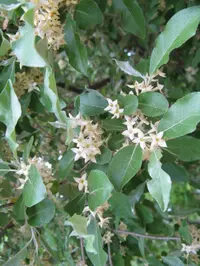
It is a medium to large evergreen tree with a stout, often low-branching trunk and dense rounded crown. Small greenish flowers are borne on branched sprays.

Harpephyllum caffrum Identification

Is This Wild Plum?

Not sure about your plant ID? Upload a photo and check it with Botan.

Clear images work best. Avoid photos taken too close or too far away

Harpephyllum caffrum is easiest to spot by its leaf structure, crown shape, and plum-like fruit.

  • Leaves are alternate and pinnate, with about 4-8 pairs of leaflets plus one terminal leaflet.
  • Leaflets are narrow, glossy, and smooth-edged, often slightly curved, usually 2-6 inches (5-15 cm) long.
  • The tree forms a dense, rounded crown and can grow as a broad evergreen tree.
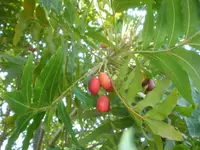
  • Fruits hang in clusters and look like small oval plums, turning red when ripe.

Check both the odd-pinnate leaves and clustered red fruit together for a stronger visual match.

Harpephyllum caffrum shows clear visual shifts from sapling form to flowering and fruiting adults.

  • Young plant: Young plants are upright and narrow, with a slim single stem and relatively large pinnate leaves that often hang near the top.
  • Mature plant: Mature plants develop a broad, dense crown and thicker trunk, becoming a rounded evergreen tree about 20-50 feet (6-15 m) tall.
  • Flowering stage: Flowering branches carry many small pale flowers in clustered sprays, adding a fine, airy look that is absent on nonflowering plants.
  • Fruiting stage: Fruiting plants show dangling clusters of fleshy, plum-like drupes that turn red and stand out strongly against the dark foliage.

Harpephyllum caffrum often shows a brief flush of coppery to reddish new leaves, a useful clue when fresh growth appears. Flower clusters become visible in spring, followed by hanging fruits that ripen from green to red later in the year. In fruit, the tree is especially easy to recognize from a distance.

A few southern African trees can be mistaken for Harpephyllum caffrum at a glance.

mango(Mangifera indica)

Both are evergreen trees with long, leathery leaves clustered near branch tips. Mango usually has simple leaves, not compound leaves with distinct leaflets. Its fruits are much larger and fleshy, unlike the smaller plum-like fruits of Wild Plum.

forest false currant(Allophylus natalensis)

This can cause confusion when young because both have glossy, evergreen foliage and red fruits. Allophylus natalensis has trifoliate leaves, meaning three leaflets per leaf, while Harpephyllum caffrum has many more leaflets along one leaf stalk.

Harpephyllum caffrum is native to southeastern Africa, especially eastern South Africa, with range extending into southern Mozambique and Zimbabwe. In the wild it is most often associated with coastal and riverine forest, forest margins, and moist woodland. That setting can help narrow identification. A candidate tree found naturally in humid lowland forest, near streams, or along the subtropical coast is more consistent with Harpephyllum caffrum than one from dry inland scrub or open grassland.

Confirm the Species with Botan

Upload a photo to compare key details and help identify the plant or confirm the name before you label it.

FAQ

The clearest clue is its compound leaf: several glossy, leathery leaflets arranged along one central stalk, usually with a larger terminal leaflet. In Harpephyllum caffrum identification, this separates it from many simple-leaved evergreen trees.

More Plant Identification Guides

Identify First. Learn What Comes Next.

Use a photo to identify the plant, then see species-specific care information, safety notes, and common problems.

Botan app identifying a plant from a photo
How to Winterize Your Garden in 6 Steps

5 min read · 28 Sept 2026

How to Winterize Your Garden in 6 Steps

Learn how to prepare your garden for winter with a practical six-step checklist covering cleanup, tender plant care, watering, mulching, winter protection, and winterizing equipment and containers.

Plant Care
How to Winterize Your Garden in 6 Steps
12 Most Wanted Rare Houseplants to Grow at Home

6 min read · 21 Sept 2026

12 Most Wanted Rare Houseplants to Grow at Home

Rare houseplants can turn an ordinary corner in your apartment into a living botanical collection. This guide covers 12 most admired picks, what makes them special, and how to grow them successfully at home.

Plant Recommendations
12 Most Wanted Rare Houseplants to Grow at Home
Best Bedroom Plants – Top 10 to Grow in Your Space

8 min read · 8 Jul 2026

Best Bedroom Plants – Top 10 to Grow in Your Space

Discover the top 10 houseplants that are suitable for growing in your bedroom. Compare their light and water needs, pet safety, and benefits. Find out where best to place greenery in your relaxation space and what species to avoid.

Plant Recommendations
Best Bedroom Plants – Top 10 to Grow in Your Space