
Good King Henry Identification (Blitum bonus-henricus)

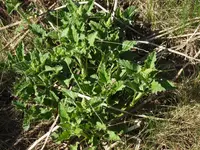
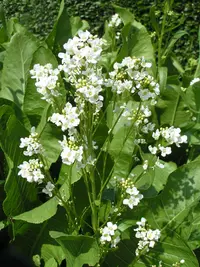
Recognize Good King Henry by its basal clump of broad, triangular to arrow-shaped leaves on long stalks and its upright, unbranched to lightly branched stems.

The flowers form narrow, green, spike-like clusters at stem tips and upper leaf joints, usually on plants about 1 to 2 feet (30 to 60 cm) tall.

Blitum bonus-henricus Identification

Check Your Plant ID

Check your plant ID by uploading a clear photo to Botan.

Clear images work best. Avoid photos taken too close or too far away

Use these quick visual checks to assess Blitum bonus-henricus.

  • Forms an upright, clump-forming herb, usually about 1-2 feet (30-60 cm) tall.
  • Leaves are alternate, simple, and broadly triangular to arrow-shaped, often 2-6 inches (5-15 cm) long.
  • Leaf edges are mostly entire to slightly wavy, not deeply divided or toothed.
  • Basal leaves sit on longer stalks, while upper leaves become smaller and hug the stem more closely.
  • Flowers appear as small, green, petal-less clusters packed into narrow, upright spikes at the stem tips.

Check the leaf shape and the tight green flower spikes together for the clearest match.

Good King Henry shows clear visual shifts from basal leaves to dense flowering spikes.

  • Juvenile plant: Early growth appears as a low basal rosette. Leaves are softer, broader, and more triangular to arrow-shaped, with long stalks and no obvious flowering stem.
  • Mature plant: Before blooming, the plant forms a clump of larger basal leaves and sends up stout, upright stems, often reaching 1-2 feet (30-60 cm).
  • Flowering stage: Upper stems become narrower-leaved and more branched. Small green flower clusters pack into dense, spike-like panicles above the broader lower leaves.
  • Fruiting stage: After flowering, the same spike-like clusters turn seed-bearing and less distinctly floral, while the plant keeps its upright, leafy framework rather than forming showy fruits.

In spring, Good King Henry sends up fresh triangular to arrow-shaped basal leaves, creating a low leafy clump. By late spring to early summer, upright flower spikes rise above the leaves and become the clearest seasonal clue. After seed set, the plant gradually dies back, leaving little or no top growth through winter.

A few spinach relatives can be mistaken for Good King Henry.

lamb's quarters(Chenopodium album)

Both have mealy, triangular leaves. Lamb's quarters is usually taller and more branched, often 1-4 feet (30-120 cm), with thinner leaves and dense green flower clusters along many stems; Blitum bonus-henricus stays in a tighter basal clump with thicker leaves.

garden orache(Atriplex hortensis)

It also has arrow- to triangular leaves and green flower spikes. Garden orache grows as an upright annual, commonly 3-6 feet (0.9-1.8 m), with a single main stem; Good King Henry is shorter and forms a perennial clump from the base.

Blitum bonus-henricus is native to much of Europe and western Asia. It is typically found in mountain meadows, grassy slopes, roadsides, and disturbed ground, often near old settlements or livestock areas. That setting helps with identification because it is more often encountered in cool-temperate uplands and open, nitrogen-rich sites than in woodland or wetland habitats. Habitat alone is not enough to confirm it, but it can narrow the search.

Confirm It from a Photo

Use Botan to identify or verify the plant from an image, helping you avoid mix-ups before labeling, planting, or sharing it.

FAQ

This plant forms a clump of upright leafy stems with goosefoot-shaped, medium to dark green leaves and dense green flower spikes. Mature plants often reach about 1 to 2 feet tall (30 to 60 cm).

More Plant Identification Guides

Identify It. Learn More About It.

Use Botan to identify a plant from a photo, then get species-specific plant details, care information, and common problems.

Botan app identifying a plant from a photo
12 Best Plants That Repel Spiders For Your Home and Garden

8 min read · 24 Jul 2026

12 Best Plants That Repel Spiders For Your Home and Garden

Spiders constantly appear in places you don't want them. A few common plants can help repel them using scent alone. Here are 12 options suitable for both indoors and outdoors, plus care tips for each.

Plant Recommendations
12 Best Plants That Repel Spiders For Your Home and Garden
Best Time to Mow Lawn – A Complete Guide

5 min read · 10 Aug 2026

Best Time to Mow Lawn – A Complete Guide

Explore when to mow your lawn for its health and a pleasant green color. Find out the best time for this task during the summer heat, and follow practical tips for correctly cutting the grass, and learn common mistakes to avoid.

Plant Care
Best Time to Mow Lawn – A Complete Guide
Frozen vs Fresh Vegetable Nutrients: Which Option Is Healthier?

6 min read · 8 Sept 2026

Frozen vs Fresh Vegetable Nutrients: Which Option Is Healthier?

Frozen and fresh vegetables are nutritionally comparable: frozen produce often retains vitamins just as well as fresh and may sometimes contain more. Here’s how blanching and storage affect nutrients—and when to choose each.

Plant Recommendations
Frozen vs Fresh Vegetable Nutrients: Which Option Is Healthier?