Sage of the diviners Identification (Salvia divinorum)

Recognize Salvia divinorum by its large opposite leaves, usually oval to lance-shaped, with softly toothed edges and a pointed tip. The stems are square and thick, and the plant grows as a lanky, branching subshrub rather than a single woody trunk.

Leaves commonly reach about 4 to 8 inches (10 to 20 cm) long.

Salvia divinorum Identification

Check Your Plant ID

Upload a clear photo to check your plant identification with Botan.

Clear images work best. Avoid photos taken too close or too far away

Check Salvia divinorum for a soft, leafy habit with opposite leaves and square stems.

  • Leaves are broad, oval to slightly heart-shaped, with pointed tips and shallowly toothed edges.
  • Leaf pairs sit directly across from each other on the stem, a common mint-family pattern.
  • Leaves are often 4-8 inches (10-20 cm) long, noticeably large for a sage.
  • Stems are green, hollow-looking, and distinctly four-angled rather than round.
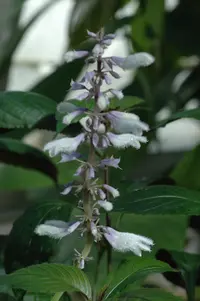
  • Flowers, when present, are white and hooded, held in spaced whorls on upright spikes.

Large opposite leaves and square green stems are the quickest field marks.

Salvia divinorum shows useful visual differences between young vegetative growth and flowering stems.

  • Young plant: Vegetative plants form soft, square stems with opposite, broad ovate leaves. Internodes are fairly open, giving a lanky, upright outline rather than a dense bush.
  • Mature plant: Older plants become taller and more branched, often reaching 3-5 feet (0.9-1.5 m). Lower stems look thicker and may bend or root where nodes touch soil.
  • Flowering stage: Flowering shoots turn more vertical and carry a terminal spike. Small white flowers sit in spaced whorls, and the leafy look shifts to a narrower, tiered outline.

Flowering is the main seasonal clue in Salvia divinorum. In fall, and sometimes into early winter in mild conditions, tall flowering stems rise above the leafy growth, with spaced whorls of white flowers enclosed by purple-tinged calyces, the small cup-like parts behind each flower. Outside the flowering period, the plant is identified more by its broad green leaves and square stems than by strong seasonal color change or showy fruit.

Salvia divinorum is native to the Sierra Mazateca of Oaxaca, Mexico. It is associated with humid montane cloud forest and shaded streamside or ravine habitats, often at mid elevations. That narrow range is useful for identification context because true wild plants are tied to a very specific, moist forest setting rather than open scrub, desert, or dry grassland. Habitat alone will not confirm the species, but it helps rule out many other salvias.

  • Ingestion risk: Leaves contain salvinorin A, a potent psychoactive compound. In humans, swallowing or chewing leaves can cause intense changes in perception and judgment.
  • Pet concern: If a pet eats the leaves, harmful nervous system effects are possible because the active compounds are in the foliage. This is an ingestion concern, not a skin-contact issue.

Confirm It from a Photo

Upload a clear image to Botan to identify the plant or verify your current ID before you label it or look up details.

FAQ

A key Salvia divinorum identification point is its unusually large, bright green leaves with a puckered surface and winged square stems. Common garden sages are usually grayer, hairier, more aromatic, and have smaller leaves.

More Plant Identification Guides

Find Out What Plant It Is

Use Botan to identify it from a photo, then view plant details, care information, and common problems for that species.

Botan app identifying a plant from a photo
How to Tell if a Plant Is Dead

6 min read · 19 Aug 2026

How to Tell if a Plant Is Dead

A plant can lose its leaves, stop growing, or collapse and still remain alive. A closer look at the stems, roots, bulbs, and tubers can show whether the plant still has a chance to recover.

Beginner Guides
How to Tell if a Plant Is Dead
Best Fertilizer for Vegetable Gardens – What to Use for Each Plant

11 min read · 20 Jul 2026

Best Fertilizer for Vegetable Gardens – What to Use for Each Plant

Here, you’ll find the right fertilizer formula for vegetables in your garden. Learn how to adjust feeding correctly throughout the growing cycle, spot nutrient deficiencies by their symptoms, and keep your plants healthy and prolific.

Plant Recommendations
Best Fertilizer for Vegetable Gardens – What to Use for Each Plant
Best Fertilizer for Grass in Summer: How to Choose the Right One

6 min read · 18 Aug 2026

Best Fertilizer for Grass in Summer: How to Choose the Right One

The right fertilizer in summer can make a lawn thrive. The wrong one can damage it. Here, you’ll learn the best NPK ratios by grass type, when and how to apply your formula, and how to recognize the signs of over- or under-fertilizing.

Plant Care
Best Fertilizer for Grass in Summer: How to Choose the Right One