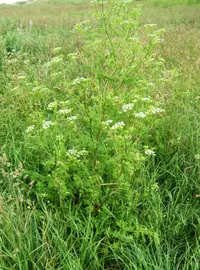

poison hemlock Identification (Conium maculatum)

To recognize poison hemlock, look first for smooth, hollow stems marked with distinct purple blotches, plus large, finely divided fernlike leaves arranged alternately along the stem.

Mature plants are tall, often 3 to 8 feet (0.9 to 2.4 m), and carry many small white flowers in broad, umbrella-shaped clusters.

Conium maculatum Identification

Is This poison hemlock?

Upload a clear image to check whether your plant ID is correct.

Clear images work best. Avoid photos taken too close or too far away

Check the stem, leaves, and flower clusters of poison hemlock.

  • Upright plant, often 3-8 feet (0.9-2.4 m) tall, with smooth, hollow, ridged stems.
  • Stems usually show irregular purple blotches or streaks, especially on the lower parts.
  • Leaves are large, triangular in outline, finely divided 3-4 times, and fern-like overall.
  • Small white flowers form many umbrella-shaped clusters; each flower has 5 petals.
  • Seedheads split into paired, small, ribbed fruits that are broadly oval.

Avoid handling if the stem and foliage match these features.

Poison hemlock shows distinct visual shifts from early rosette growth to seed-bearing stems.

  • Juvenile plant: Forms a low basal rosette with finely divided, triangular leaves on long stalks; there is no tall central stem, unlike later stages.
  • Young plant: A hollow, upright stem appears and elongates quickly; leaves become larger and more fernlike, alternating along the stem instead of staying basal.
  • Flowering stage: Mature plants branch strongly above and often stand 3-8 feet (0.9-2.4 m) tall, carrying many small white flowers in broad, umbrella-like clusters.
  • Fruiting stage: After flowering, the white clusters tighten into green, ridged paired fruits that later dry brown, while stems and leaves begin to look less fresh.

In spring, poison hemlock shows fresh, finely divided parsley-like leaves in a low basal rosette. By late spring to early summer, tall smooth stems with distinctive purple blotches become obvious, followed by broad clusters of small white flowers. After flowering in summer, the plant carries small ribbed seeds in drying umbels. By late summer or fall, plants usually turn brown and dry, leaving hollow, blotched stems standing for a time.

Several carrot-family plants are mistaken for poison hemlock.

wild carrot(Daucus carota)

Both have finely divided leaves and white flower clusters. Wild carrot is usually shorter, often under 4 feet (1.2 m), with hairy stems; Conium maculatum has smooth stems with purple blotches.

cow parsnip(Heracleum maximum)

Both make large white umbels. Cow parsnip has much larger, broad, lobed leaves, not fernlike leaves, and thick green stems without purple spotting.

sweet cicely(Osmorhiza claytonii)

Its divided leaves and white umbels can confuse beginners. Sweet cicely stays lower and has green, unspotted stems; the leaflets are broader and less finely cut.

Conium maculatum is native to Europe, western Asia, and North Africa. It is most often found in lowland disturbed places such as streambanks, ditch edges, roadsides, field margins, waste ground, and moist open woodland edges. That setting is useful for identification because this species commonly turns up in nutrient-rich, damp ground near human activity rather than in dry uplands, deep forest, or true wetlands. Habitat alone is not enough, but it helps narrow the possibilities.

  • Poisonous plant: All parts of Conium maculatum are highly toxic to humans and pets if ingested, including leaves, stems, roots, seeds, and sap.
  • Misidentification risk: It is sometimes mistaken for edible carrot-family plants such as wild carrot or parsley. A key warning sign is the smooth stem with irregular purple blotches; edible look-alikes do not show that pattern.

Scan. Check. Confirm.

Use Botan to identify or confirm a plant from a photo when you need a quick second opinion before labeling it.

FAQ

The clearest field mark is a smooth, hollow green stem marked with irregular purple blotches or streaks. The finely divided, fern-like leaves and flat-topped clusters of small white flowers support poison hemlock identification.

More Plant Identification Guides

Scan Your Plant. Get the Details.

Identify a plant from a photo with Botan, then review its profile, care information, and safety notes in one place.

Botan app identifying a plant from a photo
Best Time to Water Grass in Summer – Lawn Watering Tips

5 min read · 21 Jul 2026

Best Time to Water Grass in Summer – Lawn Watering Tips

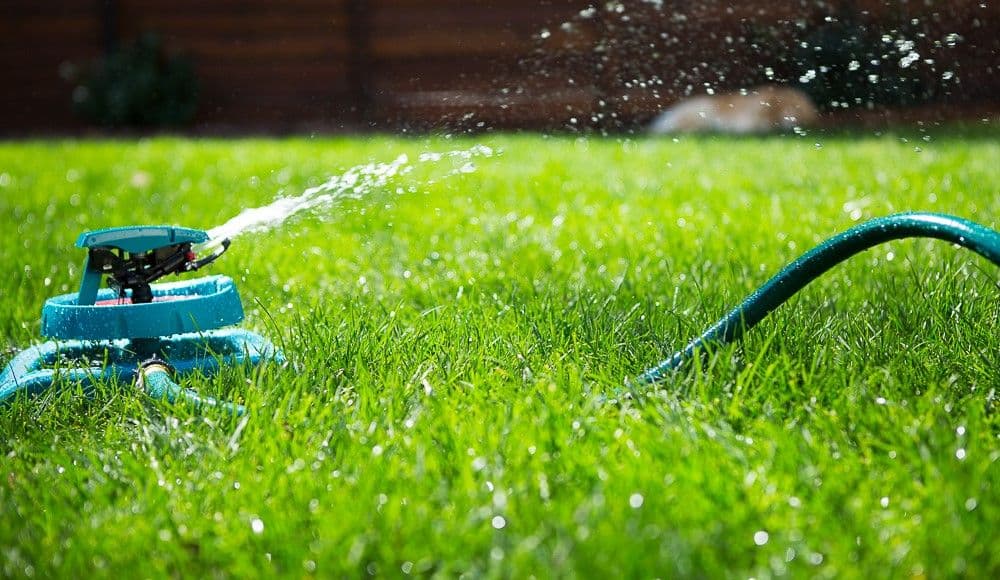
Summer watering is easy to get wrong. This guide explains when to turn on your sprinkler, how much liquid your grass needs each week, and how to tell if you're overwatering or underwatering.

Plant Care

Best Time to Water Grass in Summer – Lawn Watering Tips
How to Increase Humidity for Plants – 8 Simple Ways That Work

8 min read · 14 Aug 2026

How to Increase Humidity for Plants – 8 Simple Ways That Work

Dry indoor air stresses a lot of houseplants. You usually notice it first in the browning leaf tips. This guide describes 8 simple ways to raise the moisture around your plants, from humidifiers to pebble trays.

Plant Care
How to Increase Humidity for Plants – 8 Simple Ways That Work
Plant Pot Sizes: How to Choose the Right Plant Container

7 min read · 20 Aug 2026

Plant Pot Sizes: How to Choose the Right Plant Container

Plant pot sizes can be confusing because the number on the label only tells you part of the required information. A container may look spacious but actually be too shallow. So, how to choose pot size for plant species?

Beginner Guides
Plant Pot Sizes: How to Choose the Right Plant Container