
evening primrose Identification (Oenothera biennis)

Recognize evening primrose by its tall, single upright stem, alternate lance-shaped leaves that narrow toward the tip, and a dense terminal flower spike.

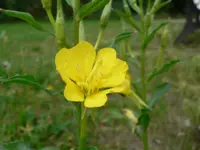
Each flower has four yellow petals and sits above a long narrow floral tube, a strong visual cue for Oenothera biennis.

Oenothera biennis Identification

Identify Your Plant with Botan

Upload a clear photo to check your plant identification with Botan.

Clear images work best. Avoid photos taken too close or too far away

Use these quick checks to assess Oenothera biennis by eye.

  • An upright, usually unbranched stem gives the plant a tall, narrow outline.
  • Leaves are alternate, simple, and lance-shaped, often 4 to 8 inches (10 to 20 cm) long.
  • Leaf edges are slightly toothed or wavy, with a strong pale midrib running down the center.
  • Flowers are yellow with 4 broad petals, about 1 to 2 inches (2.5 to 5 cm) across.
  • Seed capsules are long, narrow, and four-angled, held close along the upper stem.

The combination of yellow 4-petaled flowers and slender angled capsules is especially useful.

Oenothera biennis shows clear stage-to-stage changes that are useful for field identification.

  • Seedling: Seedlings show a small basal rosette with soft, oval to lance-shaped leaves and no upright stem, unlike later stages that elongate quickly.
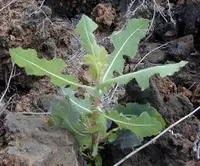
  • Young plant: The first-year plant remains a ground-level rosette, often 4-10 inches (10-25 cm) across, with longer leaves, pale midribs, and wavy or shallowly toothed edges.
  • Flowering stage: In the second year, a tall, usually unbranched stem rises from the rosette, carrying alternate stem leaves and large yellow four-petaled flowers along the upper spike.
  • Fruiting stage: After flowering, the upper stem becomes lined with narrow, upright seed capsules, while petals drop and the plant looks more rigid and columnar.

In the first year, Oenothera biennis is usually a low basal rosette with elongated leaves close to the ground. By the second summer, a tall upright stem appears, making the plant much easier to spot. Flowering is most visible in summer, when large yellow four-petaled flowers open along the upper stem. After bloom, narrow capsules remain on the stem into fall, creating a distinctly seeded look.

A few yellow-flowered biennials are regularly mistaken for evening primrose.

common mullein(Verbascum thapsus)

Both make first-year rosettes and tall second-year spikes. Mullein has thick, gray, very fuzzy leaves and flowers packed into a dense terminal spike. Oenothera biennis has greener, less woolly leaves and larger 4-petaled flowers spaced along the stem.

yellow salsify(Tragopogon dubius)

It can resemble the basal rosette and yellow bloom color. Yellow salsify has narrow, grasslike leaves and a single dandelion-like flower head on a leafless stalk. Oenothera biennis has broader leaves and several cup-shaped flowers along leafy stems.

Oenothera biennis is native to much of eastern and central North America and is widely recorded across the United States and southern Canada. Native range is useful here because it is a common wild species rather than a localized ornamental. It typically appears in open, disturbed places such as roadsides, fields, prairies, old pastures, rail corridors, and waste ground. Finding it in sunny, weedy habitat helps narrow identification better than woodland or wetland settings.

Confirm It from a Photo

Use Botan to identify or confirm the plant from a photo, helping avoid mix-ups before you label, buy, or remove it.

FAQ

First-year plants form a basal rosette, a ground-level circle of leaves. In the second year, stem leaves are alternate, not opposite, and become smaller upward. This pattern helps with evening primrose identification.

More Plant Identification Guides

Identify It. Learn More About It.

Identify a plant from a photo with Botan, then get plant details, care information, and common problems for that species.

Botan app identifying a plant from a photo
Best Water for Plants – How to Choose the Right Type

7 min read · 13 Aug 2026

Best Water for Plants – How to Choose the Right Type

Rainwater, filtered, distilled, and tap water affect plants differently. Learn which types support healthy growth and which cause slow damage. Match each to your plants and discover how to easily improve tap water quality.

Plant Care
Best Water for Plants – How to Choose the Right Type
15 Best Scary Halloween Plants and Fungi for a Spooky Garden

8 min read · 9 Oct 2026

15 Best Scary Halloween Plants and Fungi for a Spooky Garden

Want a garden that looks eerie in October? Here are 15 Halloween plants and fungi, from carnivorous traps to bleeding mushrooms. For each species, we cover its appearance, care requirements, and potential uses in your landscape.

Plant Recommendations
15 Best Scary Halloween Plants and Fungi for a Spooky Garden
Planting Grass Seed in Summer – What Works and What Fails

7 min read · 6 Aug 2026

Planting Grass Seed in Summer – What Works and What Fails

Summer seeding succeeds when the grass type suits the season, and the soil stays moist. Find out how to prepare the seedbed and choose a safe window for planting.

Plant Care
Planting Grass Seed in Summer – What Works and What Fails