
giant ragweed Identification (Ambrosia trifida)

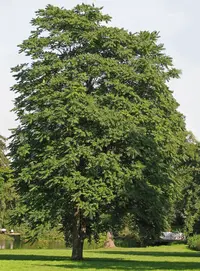
To recognize giant ragweed, look for a tall, upright annual with opposite leaves that are usually 3-lobed and often as wide as they are long. The stems are thick and rough, and plants commonly reach 6 to 15 feet (1.8 to 4.6 m).

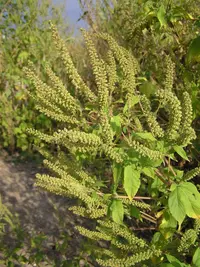
At the top, slender green flower spikes rise above the leaves.

Ambrosia trifida Identification

Is This giant ragweed?

Upload a plant photo and check the identification in seconds.

Clear images work best. Avoid photos taken too close or too far away

Check the leaf shape, stem, and flower placement first on Ambrosia trifida.

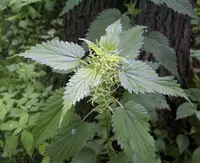
  • Leaves are opposite on the stem and usually have 3 deep lobes, sometimes 5; each leaf can reach about 12 inches (30 cm) long.
  • Stems are thick, upright, and rough-hairy, often branching in the upper part of the plant.
  • Male flower heads form narrow, spike-like clusters at stem tips.
  • Female flower heads sit lower down in the leaf axils, tucked close to the stem.

Large, lobed opposite leaves with tip spikes and hidden lower flowers are strong visual clues.

Ambrosia trifida shows clear visual shifts from seedling leaves to tall, flowering stems.

  • Seedling: Seedlings show a pair of broad cotyledons, then opposite true leaves that are simple at first, unlike the larger lobed leaves later.
  • Young plant: Young plants develop rough, sturdy stems and opposite leaves that become distinctly 3-lobed, with blades often 4-8 inches (10-20 cm) long.
  • Mature plant: Mature plants stand upright with thick, coarse stems, widely spaced branches, and a strong vertical form; upper leaves may be smaller and less deeply lobed.
  • Flowering stage: Flowering stems carry narrow green male flower spikes at branch tips, while small female heads sit lower in leaf axils, creating a two-level flower arrangement.

In spring, giant ragweed emerges with large opposite leaves that quickly become the plant’s most obvious feature. By summer, the upper stems carry narrow green flower spikes, while small female flower clusters sit lower in the leaf axils. In fall, the foliage yellows and dries. The plant then shows rough, branching stems and mature burr-like fruits that remain visible as the leaves wither.

A few tall weeds are often mistaken for giant ragweed.

sunflower(Helianthus annuus)

Both can grow tall with rough leaves. Sunflower leaves are usually unlobed, heart-shaped, and often alternate higher on the stem. Giant ragweed typically has opposite leaves with 3 deep lobes.

Jerusalem artichoke(Helianthus tuberosus)

This species also forms tall stands with coarse foliage. Its leaves are mostly unlobed, sharply toothed, and become alternate up the stem. Giant ragweed keeps broader 3-lobed leaves on long stalks.

Ambrosia trifida is native to much of North America, especially the central and eastern United States and southern Canada. It is most often found in disturbed, nutrient-rich places such as riverbanks, floodplains, ditches, field edges, roadsides, and vacant lots. That setting helps with identification because this species commonly appears in open, recently disturbed ground rather than intact woodland or dry upland prairie. Finding a very large ragweed in moist bottomlands or along streams can strongly narrow the ID.

  • Pollen allergy: The flowers release highly allergenic pollen. In humans, inhalation can trigger hay fever and asthma symptoms during bloom.
  • Skin contact: Leaves and stems can cause contact dermatitis in some people, especially after repeated handling. This is a skin-contact concern, not an ingestion hazard.

Confirm the Species with Botan

Upload a photo to compare key details and help confirm whether the plant matches your identification.

FAQ

The most reliable trait is the leaf shape. This species usually has opposite leaves with 3 deep lobes, sometimes 5, on long stalks. That pattern is central to giant ragweed identification.

More Plant Identification Guides

Identify the Plant and Get Its Profile

Use Botan to identify a plant from a photo, then review species details, care information, and common problems.

Botan app identifying a plant from a photo
15 Best Scary Halloween Plants and Fungi for a Spooky Garden

8 min read · 9 Oct 2026

15 Best Scary Halloween Plants and Fungi for a Spooky Garden

Want a garden that looks eerie in October? Here are 15 Halloween plants and fungi, from carnivorous traps to bleeding mushrooms. For each species, we cover its appearance, care requirements, and potential uses in your landscape.

Plant Recommendations
15 Best Scary Halloween Plants and Fungi for a Spooky Garden
20 Most Popular Fruits Around the World

7 min read · 22 Jul 2026

20 Most Popular Fruits Around the World

Curious which fruits the world actually eats the most? Here's the top-20 by production volume, an overview of what people choose in each region, and a few figures that defy common assumptions.

Plant Recommendations
20 Most Popular Fruits Around the World
Banana Peel Water for Plants: 5 Things to Know Before Trying It

5 min read · 9 Jul 2026

Banana Peel Water for Plants: 5 Things to Know Before Trying It

Banana water can provide potassium and some nutrients that may support plant growth, but it is not a universal fix. Use it carefully and only when the plant actually shows signs of nutrient deficiency rather than as a routine treatment.

Plant Care
Banana Peel Water for Plants: 5 Things to Know Before Trying It