

multiflora rose Identification (Rosa multiflora)

Recognize Rosa multiflora by its long, arching canes, compound leaves with 5 to 11 small leaflets, and clusters of many small five-petaled flowers. The stems usually carry curved prickles, and a fringed stipule at the base of each leaf is a key check.

This combination is distinctive at first glance.

Rosa multiflora Identification

Confirm What Plant You Have

Upload a clear image to check whether your plant ID is correct.

Clear images work best. Avoid photos taken too close or too far away

Check Rosa multiflora for a thorny, arching shrub form with clustered small flowers.

  • Long, fountain-like canes arch and scramble, often forming dense thickets.
  • Leaves are alternate and pinnate, usually with 7-9 small leaflets on each leaf.
  • At the base of each leaf stalk, the fringed stipules look lacy and are easy to spot.
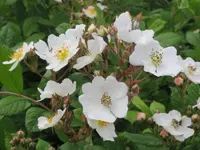
  • Flowers are white to pale pink, about 1 inch (2.5 cm) across, with 5 petals in large branched clusters.
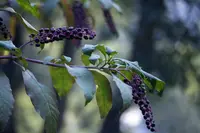
  • Small round hips follow, turning red and staying in tight clusters.

Use the fringed stipules and many-flowered clusters together for the quickest visual check.

Rosa multiflora shows clear visual changes from cane growth to flowers and hips.

  • Young plant: Young plants form arching green canes with widely spaced leaves and fewer side branches, giving a loose outline before the dense thicket habit develops.
  • Mature plant: Mature plants become broad, fountain-shaped shrubs, often 6-15 feet (1.8-4.6 m) tall, with many long, thorned canes and layered branching from the base.
  • Flowering stage: At flowering, branch tips carry large, many-branched clusters of small white roses, shifting attention from the canes to a finely textured, lace-like canopy.
  • Fruiting stage: After bloom, the same branched clusters hold many small red hips, making the shrub look dotted and beaded rather than airy and flower-covered.

In late spring to early summer, Rosa multiflora becomes easier to spot when many small white flowers cover the arching stems in broad clusters. The blooming display is one of the clearest seasonal clues. By late summer into fall, those clusters turn into many small red hips that often persist after leaf drop. In winter, the bare, thorny, arching canes and dense branching stand out more clearly.

A few thorny arching roses can be mistaken for multiflora rose.

dog rose(Rosa canina)

Both are scrambling shrubs with clusters of pale flowers and red hips. Dog rose usually has solitary or small flower clusters, while Rosa multiflora bears many-flowered clusters. Its leaf stalks also lack the fringed stipules, leaf-base appendages, that are a quick clue on multiflora rose.

Macartney rose(Rosa bracteata)

This rose also forms dense, thorny thickets. It differs by having larger single white flowers, often about 2-3 inches (5-8 cm) wide, and mostly evergreen leaves with fewer, broader leaflets rather than the many small leaflets typical of multiflora rose.

Rosa multiflora is native to eastern Asia, including China, Korea, and Japan. In its native range, it occurs in thickets, forest edges, open woodlands, streambanks, and disturbed ground rather than deep shade or very dry sites. That setting helps with identification because this rose often turns up scrambling over shrubs and along sunny margins, hedgerows, and roadsides. Finding it in edge habitats or dense brush can help narrow it from roses more typical of drier uplands or formal plantings.

Rosa multiflora has a practical handling risk rather than a poisoning risk.

  • Sharp prickles: The stems carry curved prickles that can puncture or scratch skin on contact in humans and pets. This is the main safety concern when handling or moving through dense growth.

Scan. Check. Confirm.

Use Botan to identify or verify the plant from a photo, helping avoid mix-ups before buying, removing, or sharing it.

FAQ

The quickest field mark is the fringed stipule at the base of each leaf stalk. In multiflora rose identification, this comb-like, feathery edge is more distinctive than flower color alone.

More Plant Identification Guides

Scan Your Plant. Get the Details.

Identify a plant from a photo with Botan, then review its profile, care information, and common problems.

Botan app identifying a plant from a photo
Best Time to Mow Lawn – A Complete Guide

5 min read · 10 Aug 2026

Best Time to Mow Lawn – A Complete Guide

Explore when to mow your lawn for its health and a pleasant green color. Find out the best time for this task during the summer heat, and follow practical tips for correctly cutting the grass, and learn common mistakes to avoid.

Plant Care
Best Time to Mow Lawn – A Complete Guide
How to Clean Plant Leaves: A Simple Care Guide

6 min read · 4 Aug 2026

How to Clean Plant Leaves: A Simple Care Guide

Dusty leaves look dull and don't absorb light well. Below, you'll find simple ways to clean them, which tools are truly effective, how often you should do it, and what causes damage.

Beginner Guides
How to Clean Plant Leaves: A Simple Care Guide
Plants That Repel Mosquitoes – 10 Effective Choices

8 min read · 6 Jul 2026

Plants That Repel Mosquitoes – 10 Effective Choices

Plants that repel mosquitoes can help mask human scent naturally and make outdoor spaces more comfortable. Explore the most effective options, their benefits and drawbacks, and choose the right plant for your space.

Plant Recommendations
Plants That Repel Mosquitoes – 10 Effective Choices