

Black Currant Identification (Ribes nigrum)

Recognize Black Currant by its palmately lobed leaves, usually with 3 to 5 broad lobes, borne alternately on many upright woody stems that rise from the base.

It typically forms a multi-stem shrub about 3 to 5 feet (0.9 to 1.5 m) tall, with small greenish flowers hanging in short drooping clusters.

Ribes nigrum Identification

Identify Your Plant with Botan

Not sure about your plant ID? Upload a photo and check it with Botan.

Clear images work best. Avoid photos taken too close or too far away

Check the shrub’s leaves, flowers, and berries for Black Currant.

  • Leaves are alternate, simple, and palmately lobed, usually with 3 to 5 broad lobes.
  • Leaf blades are about 2 to 4 inches (5 to 10 cm) wide, with a rounded outline and a heart-shaped base.
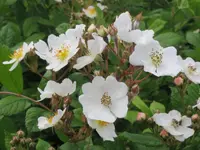
  • Flowers hang in short drooping clusters; each small flower is bell-shaped and greenish to reddish.
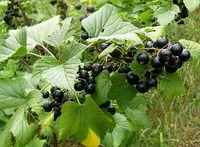
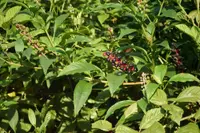
  • Berries hang in strings and mature as round, glossy black fruits about 3/8 inch (1 cm) wide.

Crushed leaves often help confirm the ID by their strong currant scent.

Ribes nigrum shows useful visual differences as shoots, flowers, and berries develop.

  • Young plant: Young plants form a compact, low framework of upright green shoots, with relatively small palmately lobed leaves and sparse side branching compared with older bushes.
  • Mature plant: Mature plants become a many-stemmed shrub about 3-6 feet (0.9-1.8 m) tall, with arching older canes and broader leaves carried along well-branched stems.
  • Flowering stage: Flowers hang in short drooping clusters from the leaf axils; each flower is small, greenish to purplish, and less showy than the foliage.
  • Fruiting stage: The fruiting stage is distinctive because the same hanging clusters carry round black berries, replacing flowers and making branch tips appear heavier and more pendant.

In spring, Black Currant leafs out early with soft, bright green leaves. Drooping flower clusters become visible in mid to late spring, followed by clusters of glossy black berries in early to mid summer. By fall, leaves turn yellow and drop. Through winter, the shrub is bare, so the branching pattern and plump buds are easier to see.

A few other currants and gooseberries are regularly mistaken for Black Currant.

redcurrant(Ribes rubrum)

Often confused because both are deciduous shrubs with 3- to 5-lobed leaves and hanging berry clusters. Redcurrant usually carries translucent red berries, not black, and its flower and fruit clusters are typically longer and more pendulous.

gooseberry(Ribes uva-crispa)

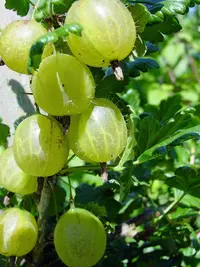
Confusion happens when plants are not fruiting, since both have lobed currant-like leaves on compact shrubs. Gooseberry stems usually have sharp spines at the nodes, while Ribes nigrum is spineless; gooseberry fruits are also borne singly or in small groups, not long strings.

Ribes nigrum is native across much of northern and central Europe and temperate northern Asia. In the wild it is associated with cool regions rather than Mediterranean climates, which helps separate it from some other garden currants and gooseberries. Typical habitats include damp woodland margins, scrub, hedgerows, riverbanks, and other moist, fertile lowland sites. Finding a wild currant in shaded or partly open, moisture-retentive places within that Eurasian range supports identification of this species.

Does Your Plant Match?

Upload a photo to Botan for a quick ID check or confirmation, helping avoid mix-ups with similar plants.

FAQ

Leaves are palmately lobed, usually with 3 to 5 rounded lobes and a heart-shaped base. Margins are toothed. For Black Currant identification, the broad, maple-like outline is useful, though much smaller and softer.

More Plant Identification Guides

Identify the Plant and Get Its Profile

Snap a photo with Botan to identify it, then see plant details, care information, and common problems.

Botan app identifying a plant from a photo
How to Group Plants in Landscaping: A Practical Layout Guide

8 min read · 31 Aug 2026

How to Group Plants in Landscaping: A Practical Layout Guide

Good plant grouping can mean the difference between a well-planned garden and one that looks sloppy. This guide explores layers, spacing, cluster shapes, and the plants that thrive when you group them.

Plant Care
How to Group Plants in Landscaping: A Practical Layout Guide
When to Harvest Carrots: Timing, Signs, and How to Pick Them

6 min read · 23 Oct 2026

When to Harvest Carrots: Timing, Signs, and How to Pick Them

Carrots are usually ready 60-80 days after sowing them in the soil, depending on the variety. Learn how to recognize maturity signs, choose the right harvest season, pull carrots without damaging them, and store roots after picking.

Plant Care
When to Harvest Carrots: Timing, Signs, and How to Pick Them
Banana Peel Water for Plants: 5 Things to Know Before Trying It

5 min read · 9 Jul 2026

Banana Peel Water for Plants: 5 Things to Know Before Trying It

Banana water can provide potassium and some nutrients that may support plant growth, but it is not a universal fix. Use it carefully and only when the plant actually shows signs of nutrient deficiency rather than as a routine treatment.

Plant Care
Banana Peel Water for Plants: 5 Things to Know Before Trying It