Early Vine Training
Install sturdy trellis wires or mesh before the first main shoots appear, then gently spiral new stems around the support weekly to create a dense, controllable screen instead of a tangled mass.

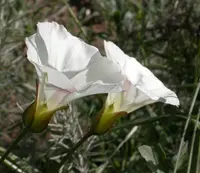
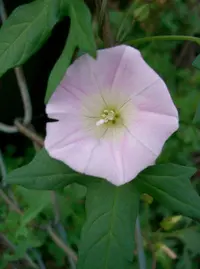
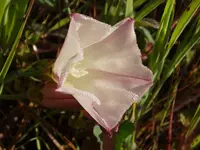
Island false bindweed (Calystegia macrostegia) is a perennial vine native to coastal areas and islands of California and Baja California. It often grows on dry slopes, cliffs, and scrub habitats. The plant climbs or sprawls, forming twining stems with grey‑green, arrow‑shaped leaves and attractive white to pale pink funnel‑shaped flowers. It can cover fences, rocks, or low shrubs when given support. This species is drought tolerant once established and prefers well‑drained soil in sunny, open positions. It can spread quickly in suitable conditions, so gardeners should care for island false bindweed with some attention to space and containment.

Care Difficulty
Easy Care

Light Preference
Full Sun

Water Requirements
Low Water

Temperature Preference
Warm Climate

Hardiness Zone
8–10

Soil Texture
Sandy, Loamy, Rocky

Soil pH
Slightly acidic (6.5–7.0), Neutral (7.0)

Soil Drainage
Well-drained

Fertilization
Minimal (feed rarely)
Scan your plant to receive care tips personalized for your specific plant
Available on iOS and Android
This coastal vine thrives with strong sun but tolerates some shade in hotter inland sites.
This drought-tolerant vine prefers deep, infrequent watering once established.
This species is adapted to mild, Mediterranean-type climates with cool, wet winters and warm, dry summers.
This coastal vine handles low humidity well and rarely needs special moisture control indoors or outdoors.
Calystegia macrostegia prefers lean, fast-draining soils that mimic coastal or chaparral conditions.
This species can be grown in containers if the pot and support are chosen to manage its vigorous, twining growth.
This coastal native vine usually needs minimal feeding, especially in the ground with decent soil.
Thoughtful pruning keeps Calystegia macrostegia vigorous, flowering well, and within bounds.
This vigorous native vine is more often transplanted in the landscape than kept long term in containers.
New plants are commonly produced by division, root pieces, or stem cuttings rather than seed.
In mild-winter climates this vine is generally hardy and needs little special winter attention.

Plant Health Check
Not sure what's wrong with your plant? Check your plant's health inside the app.
Island false bindweed is naturally concentrated on the Channel Islands and a few coastal areas of southern California, where it has evolved as a local coastal scrub and chaparral vine rather than a widespread weedy bindweed.
Its gray-green, softly hairy leaves reduce water loss and reflect intense sunlight, an adaptation that helps the plant survive long, dry Mediterranean-climate summers with minimal rainfall.
The large, pale funnel-shaped flowers typically open during the day and close at night or in poor light, a pattern that helps protect pollen and reproductive structures from moisture and nocturnal herbivores.

Some Channel Islands populations of this species show distinct local forms in leaf size, hairiness, and flower traits, and botanists have described several subspecies to reflect this fine-scale evolutionary divergence across short ocean distances.
This species can spread quickly through twining stems and underground rhizomes, especially in mild climates. In gardens, root barriers, regular edge cutting, and selective thinning help keep it within bounds without removing its habitat value.
Keep your plants happy and healthy with plant identification, disease detection, and easy care guidance.