Rotate For Symmetry
Turn the pot 90° every 2–3 weeks so stems thicken evenly and the plant does not lean or etiolated growth develop toward a single light source.

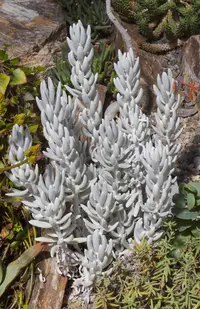
Woolly senecio, Caputia tomentosa, is a small succulent shrub valued for its dense, velvety foliage. The thick, silver‑gray leaves store water, giving the plant a fuzzy, felted appearance.
It typically grows as a low, branching plant that stays compact in pots, making it suitable for bright windowsills and small indoor spaces. In its native habitat in South Africa, it experiences strong light, sharp drainage, and dry periods.
These adaptations make it relatively easy to grow for those who provide bright light, minimal overwatering, and gritty, fast‑draining soil. Understanding these origins helps owners care for woolly senecio with fewer problems.

Care Difficulty
Easy Care

Light Preference
Full Sun

Water Requirements
Low Water

Temperature Preference
Tropical / Frost Sensitive

Hardiness Zone
10–11

Soil Texture
Sandy, Loamy, Rocky

Soil pH
Slightly acidic (6.5–7.0), Neutral (7.0)

Soil Drainage
Well-drained

Fertilization
Minimal (feed rarely)
Scan your plant to receive care tips personalized for your specific plant
Available on iOS and Android
Caputia tomentosa needs bright, mostly indirect light to keep compact, silvery foliage.
This succulent stores water in its leaves, so watering must be infrequent and well controlled.
This species prefers warm, dry conditions similar to a mild, frost-free desert climate.
This succulent prefers quite dry air and rarely suffers from low household humidity.
Caputia tomentosa needs very fast-draining, mineral-rich soil to prevent root rot.
This species is well suited to container growing when drainage and stability are managed carefully.
Caputia tomentosa is a light feeder, so use modest fertilization during active growth only.
Pruning Caputia tomentosa is mainly for shaping and removing weak growth rather than heavy cutting.
Caputia tomentosa suits container culture and needs only infrequent repotting due to its slow growth.
Caputia tomentosa is commonly propagated from stem or leaf cuttings in warm, bright conditions.
Caputia tomentosa is frost sensitive and benefits from careful winter management in most climates.

Plant Health Check
Not sure what's wrong with your plant? Check your plant's health inside the app.
The leaves are densely covered with tiny, felted hairs called trichomes, which give a woolly texture and help reduce water loss and leaf temperature in strong sun.
This species produces small, yellow, daisy-like flower heads on tall stalks that often open in the evening or at night, a trait that may help attract crepuscular or nocturnal pollinators.
Caputia tomentosa is naturally restricted to arid regions of Namaqualand in South Africa, where it grows among rocky outcrops in very low-rainfall environments.

In its native range, Caputia tomentosa can form small, cushion-like mounds that trap leaf litter and fine soil particles around its base, subtly improving local moisture and nutrient availability for itself and nearby plants over time.
Brown leaves usually result from underwatering, intense direct sun scorch, or past overwatering that damaged roots. Check the root system, adjust watering, remove dead tissue, and improve air circulation to prevent fungal issues on damaged foliage.
Keep your plants happy and healthy with plant identification, disease detection, and easy care guidance.