Hardy plumbago Care (Ceratostigma plumbaginoides)

Also known as: hardy plumbago
Hardy plumbago

About Hardy plumbago

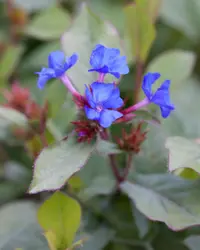
Hardy plumbago, Ceratostigma plumbaginoides, is a low, spreading perennial often used as a groundcover in temperate gardens. It forms dense mats of green foliage that turn red in fall, with bright blue flowers late in the season.

This species is native to rocky slopes and open woodland areas in China, which explains its preference for well-drained soil and moderate moisture. It adapts well to sun or light shade and is generally easy to grow if the soil does not stay waterlogged.

Gardeners looking to care for Hardy plumbago usually find it low maintenance once established and tolerant of typical urban conditions, including some drought and light foot traffic.

Main Plant Requirements

Care Difficulty

Easy Care

Light Preference

Full Sun

Water Requirements

Moderate Water

Temperature Preference

Cold Hardy

Hardiness Zone

5–9

Soil Texture

Sandy, Loamy, Clay

Soil pH

Acidic (5.5–6.5), Slightly acidic (6.5–7.0)

Soil Drainage

Well-drained

Fertilization

Minimal (feed rarely)

Get Personalized Care Plan

Scan your plant to receive care tips personalized for your specific plant

Available on iOS and Android

How to Care for the Hardy plumbago

Ceratostigma plumbaginoides flowers and colors best with plenty of direct sun but accepts some shade.

  • Provide 6–8 hours of direct sun daily; morning sun with light afternoon shade suits most gardens, especially in hotter regions.
  • Plant in a spot with at least 3–4 hours of direct light; in deeper shade, Hardy plumbago becomes leggy and flowering is reduced.
  • In hot summers, protect from intense late afternoon sun to limit leaf scorch, especially in dry soils; in cooler climates, full sun is usually safe.

Ceratostigma plumbaginoides prefers evenly moist but not saturated soil, especially during active growth.

  • Water when the top 3–5 cm of soil feels dry; in average conditions this may mean every few days in summer and far less often in cool, wet weather.
  • Use well-drained soil; pooling water or a sour smell in the root zone signals overwatering and risks root rot.
  • Watch foliage for cues: drooping, crisp leaves and dry soil indicate underwatering, while yellowing leaves with soft stems point to excess moisture.

This perennial tolerates a wide temperature range but grows best in moderate warmth.

  • Active growth and flowering are strongest around 65–80°F (18–27°C), with steady soil moisture and full to partial sun.
  • Dormant crowns usually survive winter down to about -10°F to -15°F (-23°C to -26°C) under mulch in the ground, depending on snow cover and drainage.
  • Heat tolerance is good up to about 90–95°F (32–35°C) if soil does not dry out completely; foliage may scorch in extreme heat combined with strong sun and drought.

This species is tolerant of a wide humidity range and usually does not need special humidity management outdoors.

This plant prefers free-draining, moderately fertile soil to support dense growth and reliable flowering.

  • Use a loamy or sandy-loam soil with plenty of coarse particles so water moves through within a few minutes after watering.
  • Aim for slightly acidic to neutral pH, roughly 6.0–7.0, which supports nutrient availability without causing micronutrient lockout.
  • In heavy ground, improve aeration and drainage by working in 30–40% coarse sand or fine gravel plus well-rotted compost.
  • Avoid compacted clay, spots where water stands after rain, or thick peat mixes that stay wet and exclude oxygen from the roots.

This species suits container growing when the pot supports its spreading, rhizomatous habit.

  • Choose a wide, low container so surface rhizomes can spread while the plant remains stable and less prone to tipping in wind.
  • Use a heavier material such as ceramic or thick-walled terracotta outdoors to reduce overheating and moisture swings in summer.
  • Fill the pot with a sharply draining mix, such as 50% loam-based compost and 50% grit or coarse sand, to prevent rhizome rot in wet weather.

Ceratostigma plumbaginoides benefits from modest feeding in active growth but does not need heavy fertilization.

  • Apply a balanced slow-release fertilizer (e.g., 10-10-10) in early spring as new growth starts for Hardy plumbago.
  • Supplement with a light topdressing of compost once in spring to improve soil structure and nutrient availability.
  • During the growing season, use a half-strength balanced liquid feed only if growth appears weak or soil is poor.
  • Avoid fertilizing in late fall and winter when the plant is dormant to prevent soft, frost-prone growth.

Pruning Ceratostigma plumbaginoides is mainly about tidying growth and maintaining a compact, flowering groundcover.

  • Cut back dead, damaged, or weak stems in late winter or very early spring before new shoots emerge.
  • Shear or trim lightly after flowering flushes to encourage denser growth and more branching.
  • Remove crowded or crossing stems at the base to improve air movement and reduce disease risk.
  • Use clean, sharp hand pruners or shears, disinfecting blades when moving between plants.

This species is most often used as a groundcover, so care focuses on transplanting clumps rather than frequent repotting.

  • Transplant in early spring or early fall when temperatures are mild and soil is workable.
  • Lift and move sections when growth becomes congested or when flowering declines in the center of the patch.
  • If grown in containers, shift to a slightly larger pot when roots circle the sides or growth slows noticeably.
  • Reduce root stress by watering well before and after moving, keeping soil evenly moist until new growth resumes.

Ceratostigma plumbaginoides is commonly propagated by division and softwood cuttings taken in the growing season.

  • Divide established clumps in early spring or early fall, replanting sections at the same depth in moist, well-drained soil.
  • Take 7–10 cm softwood cuttings in late spring or early summer, removing lower leaves and dipping bases in rooting hormone.
  • Insert cuttings into a light, free-draining mix, keep at 65–75°F, and maintain high humidity until roots form.
  • Sow fresh seed in trays with a gritty seed mix, keeping slightly moist and providing bright, indirect light.

This hardy perennial usually needs minimal winter care in most temperate climates.

  • The top growth dies back with frost, but the root system is generally hardy in the ground through typical winters.
  • Apply a 5–7 cm layer of mulch over the root zone in late fall to buffer freeze–thaw cycles and conserve moisture.
  • Container-grown plants benefit from moving to a sheltered, unheated but frost-free spot or heavy wrapping of the pot.

Care Tips

Control underground spread

Install a shallow root barrier or sink bottomless pots 15–20 cm into the soil around beds if you want to limit this plant’s spreading habit, especially near delicate perennials or lawn edges.

Use as living mulch

Plant it around the base of shrubs or open-structured perennials to form a dense groundcover that suppresses weeds while still allowing woody plants above to access light and air.

Encourage better fall color

Avoid high-nitrogen feeding after midsummer and keep the plant in a consistently bright spot so foliage transitions more reliably to strong red tones in fall.

Plan for seasonal dieback

Mark the planting area with unobtrusive labels or stones so you do not accidentally dig up dormant crowns in late fall or early spring when the top growth has completely disappeared.

Divide for rejuvenation

Every 3–4 years, lift and divide overcrowded clumps in early spring, replanting only the youngest, firmest sections to maintain dense growth and improve flowering when growing Hardy plumbago.

Common Pests and Diseases

Powdery mildew

This disease causes white, powdery patches on upper leaf surfaces, often appearing in late summer, especially in dense or shaded plantings.

Solution

Improve air circulation by thinning crowded stems and avoid overhead watering, especially in the evening. Remove and discard heavily infected leaves and, if needed, apply a labeled sulfur or potassium bicarbonate fungicide early in the infection period, following all product directions.

Rust

This disease produces small orange to brown pustules on the undersides of leaves, sometimes leading to yellowing and early leaf drop.

Solution

Remove and dispose of affected leaves to reduce spore levels and avoid wetting foliage when watering. In beds with repeated issues, increase spacing for better airflow and consider using a labeled ornamental rust fungicide at the first sign of symptoms.

Aphids

These insects cluster on young shoots and the undersides of leaves, sucking sap and sometimes causing curling foliage and sticky honeydew on the plant.

Solution

Spray stems and leaves with a firm stream of water to dislodge colonies, repeating as needed. For persistent infestations, use insecticidal soap or a light horticultural oil, ensuring thorough coverage of leaf undersides and new growth while treating in cooler parts of the day.

Spider mites

This pest thrives in hot, dry conditions, causing fine stippling on leaves, dull foliage color, and sometimes delicate webbing between stems and leaves.

Solution

Increase humidity around low-growing clumps with regular, gentle hosing and wash both sides of leaves to knock mites off. For ongoing problems, apply insecticidal soap or a miticide labeled for ornamental plants, repeating according to label intervals until new growth appears clean.

Crown and stem canker

This disease causes localized sunken, dark lesions at the base of stems or in the crown area, which can lead to dieback of affected shoots, especially in poorly drained or damaged sites.

Solution

Cut out and discard affected stems back to healthy tissue, sterilizing pruning tools between cuts with alcohol or a 10% bleach solution. Improve drainage, avoid injuring the crown during maintenance, and do not allow mulch to sit directly against stems to reduce future infection risk while supporting overall Ceratostigma plumbaginoides care.

Interesting Facts

Late-season blue blooms

This species flowers from late summer into fall, providing intense cobalt-blue flowers at a time when many perennials are fading, and the flowers often overlap with the onset of its red-bronze autumn foliage.

Color-shifting autumn foliage

Its small green leaves turn vivid red to burgundy in fall, a color change triggered by cooler temperatures and shorter days as the plant accumulates protective pigments called anthocyanins.

Dense, spreading root system

It spreads by slender rhizomes just below the soil surface, gradually forming low, dense groundcover mats that help stabilize soil on slopes and in rock gardens when kept within boundaries.

Botan icon

Did you know?

Ceratostigma plumbaginoides is native to rocky, open habitats in China, where its natural tolerance of poor, well-drained soils and temperature fluctuations has contributed to its reputation as a resilient ornamental groundcover in temperate gardens.

FAQs about Hardy plumbago

This species spreads slowly by short underground rhizomes, forming a low mat over several seasons. It is usually not aggressive in typical garden beds but can gradually fill open spaces if soil is loose and competition is low.

Grow Healthy Plants with Botan Care

Keep your plants happy and healthy with plant identification, disease detection, and easy care guidance.

Botan plant care app — identify plants on mobile

Explore More Plants