Rotate for symmetry
Turn the pot 90° every 2–3 weeks so new fronds receive even light, which keeps the plant upright instead of leaning toward the window.

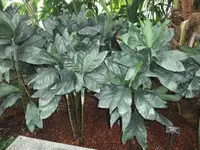
Chamaedorea metallica is a compact understory palm valued for its unusual metallic blue-green foliage. It naturally grows in the shaded rainforests of southern Mexico. Leaves are thick, often paddle-shaped, and usually held on a single stem, giving the plant a tidy, architectural form suitable for small indoor spaces. Growth is slow to moderate and the plant stays relatively low, which makes it manageable in homes and offices. This palm prefers bright, indirect light, modest but regular moisture, and a freely draining potting mix. These traits make it one of the simpler palms for beginners who want to learn how to care for Chamaedorea metallica.

Care Difficulty
Moderate Care

Light Preference
Bright Indirect Light

Water Requirements
Moderate Water

Temperature Preference
Tropical / Frost Sensitive

Hardiness Zone
10–11

Soil Texture
Loamy, Peaty, Organic-rich

Soil pH
Acidic (5.5–6.5), Slightly acidic (6.5–7.0)

Soil Drainage
Moist but well-drained

Fertilization
Light (every 4–6 weeks)
Scan your plant to receive care tips personalized for your specific plant
Available on iOS and Android
This shade-tolerant palm prefers soft, indirect light that mimics an understory forest habitat.
Watering should keep the root zone lightly moist but never saturated for long periods.
Stable, mild temperatures support steady growth and reduce stress for this small palm.
This small palm prefers moderately humid air but usually tolerates typical indoor conditions.
This species needs a loose, airy potting medium that drains freely yet retains some moisture.
This palm is well suited to container growing for long-term indoor display.
This palm responds to moderate feeding but does not require heavy fertilization for healthy growth.
Pruning is minimal and focuses mainly on hygiene and maintaining a neat appearance for this small palm.
This compact palm prefers slightly snug pots and benefits from careful, infrequent repotting.
Propagation of this species is possible but slow, so it is not the primary method for expanding a collection.
This tropical palm is not frost hardy and needs indoor or sheltered conditions in winter in most climates.

Plant Health Check
Not sure what's wrong with your plant? Check your plant's health inside the app.
This species is native to dense rainforests of southeastern Mexico, where it grows as an understory palm in very low, filtered light, which explains its unusual tolerance of dim indoor conditions compared with many other palms.
The leaves have a natural bluish to steely sheen caused by the way the cuticle and surface cells scatter and reflect light, giving a metallic appearance that is especially noticeable under indirect or artificial lighting.
Unlike many feather-leaved Chamaedorea palms, this species produces simple, entire leaves that are often paddle-shaped and slightly asymmetrical, a trait that makes it easy to distinguish from related species at a glance.

In its native habitat, this palm typically grows on limestone-derived soils, showing a natural tolerance for relatively high calcium levels that can stress many other tropical houseplants, which is useful to understand for Chamaedorea metallica indoor care in hard-water regions.
Brown tips usually result from low humidity, underwatering, or excess fertilizer salts. Fluoride or chlorine in tap water can also scorch margins. Use filtered water, moderate fertilizer, and increase humidity with a pebble tray or room humidifier.
Keep your plants happy and healthy with plant identification, disease detection, and easy care guidance.