African teak Care (Milicia excelsa)

Also known as: Iroko, Mvule
African teak

About African teak

African teak, Milicia excelsa, is a large deciduous tree valued mainly for its very durable timber. It has a broad, rounded crown and thick trunk, and in nature can form part of moist lowland and riverine forests in tropical Africa.

The species prefers warm conditions, moderate moisture, and deep, well-drained soil. It grows slowly to moderately in cultivation and needs space and time to develop a strong framework.

For growers, the main considerations in how to care for African teak are providing consistent warmth, avoiding waterlogged roots, and allowing full light as the tree matures.

Main Plant Requirements

Care Difficulty

Moderate Care

Light Preference

Full Sun

Water Requirements

Moderate Water

Temperature Preference

Tropical / Frost Sensitive

Hardiness Zone

11–12

Soil Texture

Loamy, Sandy, Organic-rich

Soil pH

Acidic (5.5–6.5), Slightly acidic (6.5–7.0)

Soil Drainage

Moist but well-drained

Fertilization

Minimal (feed rarely)

Get Personalized Care Plan

Scan your plant to receive care tips personalized for your specific plant

Available on iOS and Android

How to Care for the African teak

This large tropical tree needs strong outdoor light to build dense, straight growth.

  • Provide 6–8 hours of direct sun daily, ideally strong morning and midday sun; young African teak seedlings benefit from light afternoon shade to limit leaf scorch.
  • Tolerates partial shade (around 3–4 hours of direct sun) but growth slows and trunks may become more slender or leaning toward the light.
  • Avoid deep shade, which causes sparse foliage and weak stems, and reduce exposure to reflected heat from walls or pavement in very hot, dry seasons.

This species prefers consistently moist, deep soil but suffers if roots stay saturated for long periods.

  • In the ground, water when the top 5–8 cm of soil feels dry, giving a long soak so moisture reaches 30–40 cm depth, especially during the first 2–3 years.
  • Use well-drained loam or sandy loam; poor drainage, standing water, or foul smell near roots suggests overwatering and increases risk of root rot.
  • During hot, dry seasons, watch Milicia excelsa for dull, drooping leaves as a sign to water; in cooler or rainy periods, extend intervals and rely more on natural rainfall.

This tropical hardwood tree needs warm, frost-free conditions for reliable growth and long-term survival.

  • Optimal growth occurs around 77–90°F (25–32°C); active shoot extension and leaf production decline noticeably below this range.
  • Trees are very sensitive to cold and should not be exposed below about 50°F (10°C); brief drops toward 45°F (7°C) can cause leaf yellowing and stress.
  • Frost is usually lethal, and heat above 100°F (38°C) can scorch leaves unless soil moisture is stable and roots are insulated with mulch during hot, dry periods.

This species tolerates a fairly wide humidity range but grows best with moderately moist air.

  • Aim for 40–60% humidity for African teak, similar to most temperate indoor environments.
  • Leaves may show brown tips, edge crisping, or slowed growth if air stays very dry for extended periods.
  • Increase humidity locally by grouping plants, placing the container on a pebble tray with water below the pot base, or using a small humidifier nearby.

Milicia excelsa prefers deep, fertile, well-structured soil that drains freely yet holds some moisture.

  • Use a loamy mix with both mineral and organic parts, such as 50% garden loam, 30% compost, and 20% coarse sand or fine gravel.
  • Ensure rapid drainage while retaining moisture by adding coarse sand or grit rather than fine, compacting sand.
  • Target a slightly acidic to neutral pH around 6.0–7.0, avoiding strongly acidic or saline substrates that restrict root development.
  • Prevent waterlogging by avoiding heavy, unamended clay and breaking up compacted layers so roots can penetrate and access oxygen.

This tree is generally unsuitable for long-term container growing, but short-term container culture of young plants is possible.

  • Choose a deep, heavy container to counteract top-heaviness and reduce the risk of the pot tipping in wind.
  • Use a free-draining mix and raise the container slightly on feet or bricks so drainage holes never sit in pooled water.
  • Position the container where roots are shaded from intense sun to limit overheating and excessive moisture loss through the pot walls.

Milicia excelsa grows well in reasonably fertile soil but benefits from light, targeted feeding in cultivation.

  • Use a balanced slow-release fertilizer (around 10-10-10) or well-rotted compost at the start of the warm growing season.
  • Feed young or container-grown trees every 8–10 weeks during active growth, avoiding heavy applications.
  • Apply fertilizers at 1/2 strength for container plants to limit salt buildup and root burn.
  • Stop feeding in late fall and avoid fertilization during the cool dormant period to prevent weak, tender growth.

Pruning Milicia excelsa focuses on structural training and removal of weak wood rather than frequent shaping.

  • Carry out main pruning in late dry season or late winter, before vigorous new growth starts.
  • Remove dead, damaged, crossing, or inward-growing branches to improve airflow and light penetration.
  • Use clean, sharp bypass pruners or a pruning saw, making smooth cuts just outside the branch collar.
  • Limit heavy crown reduction; instead, guide young trees by selecting a single strong leader and well-spaced scaffold branches.

This species is usually field-grown, so management centers on transplanting young Milicia excelsa trees from nursery bags or pots to the ground.

  • Transplant when roots just fill the container, with some circling visible but not tightly pot-bound.
  • Aim to plant out during the warm rainy season for reliable soil moisture and faster root establishment.
  • Transplant every 1–2 years while young, shifting to progressively larger containers or a final ground position.
  • Minimize stress by watering well before and after planting, handling the root ball gently, and shading the tree for 1–2 weeks if sun is intense.

Milicia excelsa is typically propagated by seed, with vegetative methods used mainly in specialized setups.

  • Collect ripe seeds, clean the pulp, and sow in late spring to early summer in a free-draining, sterile mix.
  • Provide warmth around 75–85°F, consistent moisture, and bright shade for even germination.
  • Use semi-hardwood cuttings only under controlled conditions: high humidity, bottom heat, and rooting hormone.
  • Thin seedlings gradually and transplant once they are sturdy, avoiding disturbance of the main taproot.

African teak is a tropical tree that has low tolerance to frost and needs protection in climates with cold winters.

  • In marginal climates, grow in large containers so plants can be moved indoors or to a heated greenhouse before temperatures drop below 40°F.
  • Indoors, place in bright light and keep temperatures above 60°F with moderate, even moisture.
  • In frost-free areas, a light organic mulch around the root zone can moderate soil temperature and conserve moisture.

Care Tips

Root space planning

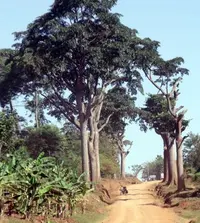
Site young trees where they have 10–15 m of clear radial space from buildings, pipes, and hardscape, as African teak develops a powerful root system that can lift structures over time.

Early leader training

During the first 3–5 years, select and maintain one strong central leader by removing or shortening competing uprights in late dry season to build a straight, storm-resistant trunk.

Wind-firm staking

In exposed sites, use 2–3 low, flexible stakes set outside the root ball and tied with soft, adjustable ties so the trunk can move slightly and develop strong taper without rubbing damage.

Mulch for buttress flare

Apply a 5–8 cm ring of coarse organic mulch, keeping it 10–15 cm away from the trunk, to maintain soil moisture and encourage healthy buttress root development without trapping moisture against the bark.

Harvest-friendly spacing

When planning a small woodlot, space trees 6–8 m apart in rows to allow light penetration, trunk access, and safe felling or pruning operations as you are growing African teak for timber or shade.

Common Pests and Diseases

Gonatocerus psyllid

This pest is a sap‑sucking insect that attacks young shoots and leaves, causing curling, distortion, and reduced growth. Symptoms include sticky honeydew and sooty mold on foliage and stems.

Solution

Prune and destroy heavily infested shoot tips, then monitor new growth closely. For remaining colonies, use a targeted systemic insecticide labeled for psyllids or apply repeated sprays of insecticidal soap or neem oil to young foliage, ensuring thorough coverage of leaf undersides.

Gall-forming aphids

These insects induce galls on leaves and young stems, which deform tissue and can slow growth when populations are high. This pest also produces honeydew that encourages sooty mold development.

Solution

Remove and dispose of heavily galled leaves and shoots to lower the population. Where needed, encourage natural predators such as lady beetles, or use insecticidal soap or horticultural oil on flushing foliage before gall formation is advanced.

Leaf spot

This disease causes brown to dark purplish spots on leaves, sometimes with yellow halos and premature leaf drop. Symptoms include scattered lesions that may merge, giving foliage a scorched, patchy appearance.

Solution

Collect and destroy fallen leaves, thin nearby vegetation to improve airflow, and avoid overhead watering that keeps leaves wet. In high-value trees or plantations, a copper-based fungicide or other labeled foliar fungicide can be applied at the start of the rainy period to protect new foliage.

Powdery mildew

This disease produces a white to gray powdery coating on young leaves, shoots, and sometimes inflorescences, leading to leaf curling and reduced vigor. Symptoms include a dusty film that rubs off easily on fingers.

Solution

Enhance light penetration and air movement around the canopy by pruning crossing or crowded branches. In persistent cases, use a sulfur-based or potassium bicarbonate fungicide labeled for powdery mildew, applying during dry weather and coating both leaf surfaces.

Heartwood borers

These insects bore into the trunk and large branches, creating galleries that weaken the wood and reduce timber quality. Symptoms include frass (wood dust) at bark cracks and dieback in affected limbs.

Solution

Promptly remove and destroy heavily infested or dead branches to disrupt the borer life cycle, and keep trees vigorous through proper watering and balanced nutrition. In plantation or high-value settings, monitor for fresh frass and consider trunk or injection treatments registered for wood-boring beetles as part of integrated Milicia excelsa care instructions.

Interesting Facts

Keystone forest species

This large deciduous tree dominates parts of West and Central African lowland forests and creates extensive, dense crowns that strongly influence local light conditions and understorey plant communities.

Dioecious flowering habit

Individual trees are either male or female, so pollen and seed production occur on separate plants, with wind-dispersed pollen and small, fig-like syncarpous fruits that develop only on female trees.

Threat from overexploitation

Its highly valued, durable timber known as African teak has led to heavy logging pressure, and in several range countries wild populations are now considered threatened by habitat loss and unsustainable harvest.

Botan icon

Did you know?

Milicia excelsa can reach more than 45 m in height with massive buttressed trunks, and in its native range it often serves as a traditional village meeting or ceremonial tree because of its size, shade, and longevity.

FAQs about African teak

This species is considered fast-growing for a hardwood tree, often adding 1–2 m in height per year under warm, moist, fertile conditions. Growth slows in poor soil, dry sites, or where temperatures drop significantly.

Grow Healthy Plants with Botan Care

Keep your plants happy and healthy with plant identification, disease detection, and easy care guidance.

Botan plant care app — identify plants on mobile

Explore More Plants