Leave Dormant Foliage
Allow the foliage to yellow and wither naturally after flowering, then mark the clump locations with discreet labels or stones so the tiny dormant tubers are not disturbed by later digging or planting.

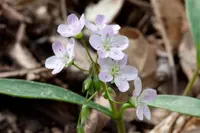
Virginia springbeauty, Claytonia virginica, is a small, early-blooming woodland wildflower native to eastern North America. It grows from tuber-like roots and forms loose clumps of narrow leaves.
In spring it produces delicate white to pale pink flowers with fine pink veins, often carpeting forest floors before trees fully leaf out. The plant goes dormant soon after flowering, disappearing underground for the rest of the year.
It is generally easy to care for Virginia springbeauty when planted in lightly shaded spots with moist, well-drained, humus-rich soil. Its natural adaptation to deciduous woodlands makes it well suited to low-maintenance, naturalized garden areas.

Care Difficulty
Easy Care

Light Preference
Partial Shade

Water Requirements
Regular Water

Temperature Preference
Cold Hardy

Hardiness Zone
3–8

Soil Texture
Loamy, Silty, Organic-rich

Soil pH
Acidic (5.5–6.5), Slightly acidic (6.5–7.0)

Soil Drainage
Moist but well-drained

Fertilization
Minimal (feed rarely)
Scan your plant to receive care tips personalized for your specific plant
Available on iOS and Android
This spring ephemeral prefers soft woodland light that mimics its native habitat.
This species prefers consistently moist, well-drained soil during its short active season.
This woodland perennial is naturally adapted to cool spring conditions and a dormant summer period.
Claytonia virginica handles a wide humidity range and usually does not need special adjustment outdoors.
Claytonia virginica prefers loose, moist woodland-type soil with consistent drainage.
This species can be grown in containers if the pot mimics a shallow, cool woodland soil profile.
This woodland spring ephemeral needs minimal feeding when grown in suitable soil.
Pruning Claytonia virginica is usually limited to cleanup rather than shaping.
Claytonia virginica is more often transplanted in garden beds than repotted in containers.
This species is commonly propagated by seed and by dividing corms.
Claytonia virginica is cold hardy in much of its range and needs little specific winter care.

Plant Health Check
Not sure what's wrong with your plant? Check your plant's health inside the app.
This species is a classic spring ephemeral, completing most of its growth, flowering, and energy storage before the forest canopy leafs out and then going dormant for the rest of the year.
Its seeds bear a fatty appendage called an elaiosome, which attracts ants that carry the seeds back to their nests, eat the elaiosomes, and leave the seeds to germinate, a process known as myrmecochory.
The pale pink to white petals often show distinct darker pink veins that act as nectar guides, helping early-season pollinators like bees accurately locate the nectar and pollen.

Genetic studies have revealed complex variation and hybridization within the Claytonia virginica complex, contributing to considerable diversity in flower color, leaf shape, and chromosome numbers across its eastern North American range.
This species spreads slowly by seed and small underground tubers, forming loose patches rather than dense mats. It is not considered aggressive and usually coexists well with other woodland plants in gardens and naturalized areas.
Keep your plants happy and healthy with plant identification, disease detection, and easy care guidance.