Encourage Pendant Growth
Position the pot on a shelf or in a hanging basket so stems can trail freely, then gently redirect new shoots downward as they elongate to create an even, cascading form and reduce stem breakage at the rim of the pot.

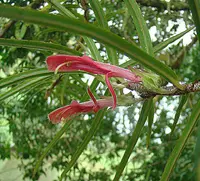
Columnea linearis is an epiphytic trailing plant from humid forests of Central and South America, belonging to the African violet family (Gesneriaceae). It naturally grows on tree branches, forming long, slender stems that can hang gracefully from baskets or mounted displays. Narrow leaves and tubular flowers give it a fine, delicate look, but the plant is more resilient than it appears. It prefers bright, filtered light, evenly moist but not soggy conditions, and a loose, airy potting mix. Understanding how to care for Columnea linearis starts with recreating its native, sheltered forest environment indoors.

Care Difficulty
Moderate Care

Light Preference
Bright Indirect Light

Water Requirements
Moderate Water

Temperature Preference
Tropical / Frost Sensitive

Hardiness Zone
11–12

Soil Texture
Loamy, Peaty, Organic-rich

Soil pH
Acidic (5.5–6.5), Slightly acidic (6.5–7.0)

Soil Drainage
Moist but well-drained

Fertilization
Light (every 4–6 weeks)
Scan your plant to receive care tips personalized for your specific plant
Available on iOS and Android
This trailing epiphyte thrives in bright, indirect light that mimics dappled forest conditions.
Watering should keep the root zone lightly moist but never saturated for extended periods.
This species prefers consistently warm, stable temperatures with no exposure to frost.
This species prefers moderately humid air and reacts quickly to very dry conditions.
Columnea linearis prefers a loose, airy, organically rich mix that drains very quickly.
This trailing species is well suited to container culture, especially hanging baskets and elevated pots.
Light, consistent feeding supports foliage and flowering without overwhelming the fine roots of Columnea linearis.
Thoughtful pruning keeps Columnea linearis compact, encourages branching, and supports better flowering.
Repotting helps maintain root health and growth in container-grown Columnea linearis.
Stem cuttings are the most practical method for Columnea linearis propagation in home conditions.
Cool-season care for Columnea linearis focuses on avoiding frost damage and maintaining stable indoor conditions.

Plant Health Check
Not sure what's wrong with your plant? Check your plant's health inside the app.
In its native Central American range, this species often grows as an epiphyte on mossy tree trunks and occasionally on shaded limestone cliffs, anchoring its roots into crevices rather than typical soil.
The bright red flowers are long and narrow, adapted to restrict access mainly to long-billed pollinators and to protect nectar from rain and small nectar thieves that cannot reach the tube base.
Field observations indicate that the species is primarily pollinated by hummingbirds, whose hovering flight and bill length match the pendant, tubular flowers and support effective pollen transfer.

This species shows a marked sensitivity of its flower production to small changes in day length and light intensity, so in cultivation even slight seasonal shifts in light exposure can noticeably change how many blooms it produces from year to year.
Poor flowering often comes from insufficient light intensity, temperature swings, or lack of rest after blooming. Avoid heavy pruning right before the flowering season, and keep feeding moderate so the plant does not focus only on foliage.
Keep your plants happy and healthy with plant identification, disease detection, and easy care guidance.