Antrophyum boryanum Care

Antrophyum boryanum

About Antrophyum boryanum

Antrophyum boryanum is a small epiphytic fern that often grows on tree trunks or rocks in humid tropical forests. It forms narrow, strap-like fronds that create a simple, elegant look.

This species is native to parts of Asia and the Pacific, where it thrives in shaded, moist habitats with good air movement. Its delicate roots and thin fronds make it sensitive to drying out and sudden environmental changes, so it is moderately challenging for beginners.

Those looking to learn how to care for Antrophyum boryanum should provide stable humidity, gentle filtered light, and a moisture-retentive but airy substrate similar to an epiphyte mix.

Main Plant Requirements

Care Difficulty

Hard Care

Light Preference

Shade

Water Requirements

Keep Soil Moist

Temperature Preference

Tropical / Frost Sensitive

Hardiness Zone

11–12

Soil Texture

Loamy, Peaty, Organic-rich

Soil pH

Acidic (5.5–6.5)

Soil Drainage

Moist but well-drained

Fertilization

Minimal (feed rarely)

Get Personalized Care Plan

Scan your plant to receive care tips personalized for your specific plant

Available on iOS and Android

How to Care for the Antrophyum boryanum

This epiphytic fern prefers soft, filtered light that mimics shaded forest canopies.

  • Provide bright, filtered light with 1–3 hours of gentle morning sun and full shade by afternoon to protect fronds from scorch.
  • Grow Antrophyum boryanum under 50–70% shade cloth outdoors or behind a sheer curtain, avoiding direct midday sun that causes bleaching and crisping.
  • In winter, move it slightly closer to light sources or use dappled supplemental light to compensate for shorter days while still avoiding harsh direct rays.

This fern prefers consistently moist conditions without becoming waterlogged.

  • Water when the top 1–2 cm of the substrate feels just barely starting to dry, aiming to keep the root zone evenly damp at all times.
  • Use a loose, well-draining mix over bark or rock so water runs through within seconds, preventing stagnant moisture that leads to root or rhizome rot.
  • Reduce frequency slightly in cooler months, watching for limp, curling fronds from underwatering or blackened, mushy roots as a sign of excess moisture in Antrophyum boryanum.

This tropical fern grows best in stable, warm conditions without temperature extremes.

  • Aim for 65–80°F (18–27°C) for active growth, keeping day and night swings moderate to avoid stress to the fronds and rhizomes.
  • Protect it from cold; growth slows below 60°F (16°C) and tissue damage can occur near 45°F (7°C), with frost likely to kill exposed foliage.
  • In hotter periods up to about 85–90°F (29–32°C), increase shade and humidity and ensure strong air movement to prevent heat stress and leaf scorch.

This fern prefers consistently humid air to keep fronds healthy and hydrated.

  • Aim for 60–80% humidity, as Antrophyum boryanum is adapted to moist, sheltered forest habitats.
  • It tolerates brief dips to 40–50%, but prolonged dry air leads to crisping tips and rolled frond edges.
  • Increase humidity with a nearby cool-mist humidifier, grouped plants, or a pebble tray placed directly beneath the container.

This species requires a loose, organic, and constantly moist but well-drained substrate.

  • Use a mix of fine bark, peat or coco coir, and perlite in roughly equal parts to mimic humus-rich forest floor.
  • Aim for slightly acidic to neutral pH, around 5.5–7.0, which supports nutrient availability and healthy root function.
  • Keep texture airy, avoiding compaction by including coarse components that create small air pockets around the roots.
  • Avoid heavy garden soil or pure peat that stays waterlogged, as this promotes root rot and suffocation.

This fern grows well in containers when moisture and stability are managed carefully.

  • Choose a wide, shallow pot to accommodate its spreading rhizomes and keep the root zone evenly moist without deep, soggy pockets.
  • Opt for plastic or glazed ceramic if higher moisture retention is needed, but ensure the mix stays airy to prevent stagnation.
  • Set the container in a stable position where the relatively light, spreading fronds will not tip the pot when fully grown.

This fern grows on low-nutrient substrates and needs only light fertilization in cultivation.

  • Use a balanced, dilute liquid fertilizer (around 1/4 strength, such as 10-10-10) for Antrophyum boryanum during active growth.
  • Feed every 4–6 weeks in spring–summer if fronds look pale or growth slows.
  • Skip or reduce feeding in fall–winter when growth is minimal.
  • Avoid heavy compost or slow-release granules that can burn fine roots; flush the substrate occasionally with plain water.

Pruning needs are minimal and focus on hygiene rather than shaping.

  • In late winter or early spring, remove dead, yellowing, or diseased fronds at the base with clean, sharp scissors.
  • Trim only damaged frond tips, not the central midrib, to maintain photosynthesis and overall vigor.
  • Thin crowded or overlapping fronds lightly to improve air circulation and reduce fungal problems.
  • Disinfect tools before and after use with alcohol or a bleach solution to prevent disease spread.

This species dislikes frequent disturbance, so repot or transplant only when clearly necessary.

  • Repot when roots circle the pot, water drains very quickly, or growth declines despite correct care.
  • Plan repotting for early spring, just before new fronds emerge, to support faster recovery.
  • Move up only 1 pot size, using a loose, airy, humus-rich mix; keep rhizomes at the same depth.
  • Water thoroughly after repotting, then keep humidity high, light gentle, and soil just moist to limit root stress.

Propagation of this fern is usually done from spores and requires controlled conditions.

  • Collect mature, brown spores from the underside of fronds and sow them on sterile, finely moistened peat or sphagnum.
  • Carry out spore sowing in spring–summer under bright, indirect light and stable warmth around 70–77°F.
  • Cover the container to maintain very high humidity and avoid air movement over the surface.
  • Keep the medium consistently moist, then separate and pot on young plants once small fronds and roots develop.

This fern is frost sensitive and needs protection in regions with cold winters.

  • For containers, move plants indoors before temperatures drop below 50°F, placing them in bright, indirect light.
  • Maintain indoor temperatures around 60–75°F and keep humidity high using trays or a humidifier.
  • Reduce watering slightly in winter, keeping the substrate barely moist, never soggy or bone dry.
  • In mild climates, grow in a sheltered, frost-free, shaded spot with leaf litter to buffer temperature swings.

Care Tips

Epiphytic mounting

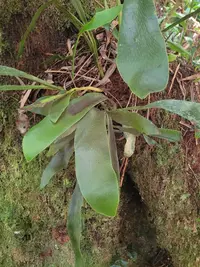
Mount the plant on cork bark or tree fern fiber with a thin layer of long-fiber sphagnum around the roots to mimic its natural epiphytic habit and keep the rhizome aerated.

Thin, not divide

If the clump becomes crowded, remove only the oldest, declining fronds at the base instead of cutting the rhizome, which is easily damaged and slow to re-establish after division.

Gentle water quality

Use rainwater, distilled, or low-mineral filtered water if tap water is hard, as mineral buildup along the long, strap-like fronds can cause spotting and yellowing over time.

Subtle airflow management

Provide very gentle, indirect air movement from a fan set on low and not aimed directly at the fronds to discourage fungal issues without drying the thin leaves.

Microclimate underbench

In greenhouse or cabinet setups, position the plant on a lower shelf or underbench area where light is filtered and humidity is more stable, which closely suits the niche conditions for growing Antrophyum boryanum.

Common Pests and Diseases

Scale insects

This pest attaches to fronds and midribs, sucking sap and causing yellowing, spotting, and general decline of the thin strap-like leaves.

Solution

Remove heavily infested frond sections and gently scrape or wipe remaining scales with a cotton pad dipped in 70% isopropyl alcohol, then rinse the plant with lukewarm water; in persistent cases, use a light horticultural oil spray, ensuring good airflow and avoiding use during high heat or strong sun.

Fern aphids

These insects cluster on young frond bases and undersides, causing distortion, pale growth, and sticky honeydew that can support sooty mold.

Solution

Shower the plant thoroughly with lukewarm water to dislodge aphids, then apply insecticidal soap to both upper and lower frond surfaces, repeating weekly until populations drop while also reducing excess nitrogen fertilization that favors soft, aphid-prone growth.

Rhizoctonia blight

This disease attacks the rhizome and frond bases in very wet, warm conditions, leading to brown, sunken lesions, frond collapse, and dieback from the base.

Solution

Remove and discard affected fronds and rhizome sections, then improve drainage, reduce watering frequency, and increase air movement around the mounting or substrate; in valuable collections, a labeled systemic fungicide for ferns may be used according to instructions while monitoring for new symptoms as part of Antrophyum boryanum care.

Bacterial leaf spot

This disease produces small, water-soaked translucent spots on the narrow fronds that may enlarge, turn dark, and coalesce along the veins.

Solution

Cut off and discard spotted frond sections using sterile tools, avoid overhead misting that leaves foliage wet for long periods, increase airflow, and keep the plant on the drier side of its moisture range while the outbreak is present; copper-based bactericides labeled for ferns can be used cautiously if cultural corrections are not sufficient.

Interesting Facts

Ribbon-like fronds

This fern produces narrow, strap-shaped fronds with a smooth, almost leathery surface and no obvious leaf divisions, a growth form that is characteristic of only a small group within the vittarioid ferns.

Spore lines under surface

Instead of round or clustered sori, this species bears its sporangia in long, continuous lines following the frond veins on the underside, which helps with efficient spore release in humid forest air.

Rock and tree specialist

In its native range, this fern often grows directly on rocks or tree trunks in shaded tropical forests, relying on constant ambient humidity and surface moisture rather than deep soil.

FAQs about Antrophyum boryanum

This species usually performs better in shaded, humid outdoor or greenhouse conditions that resemble a tropical forest understory. Indoors it can be grown in terrariums or high-humidity plant cabinets with stable warmth and gentle, filtered airflow.

Grow Healthy Plants with Botan Care

Keep your plants happy and healthy with plant identification, disease detection, and easy care guidance.

Botan plant care app — identify plants on mobile

Explore More Plants